Alabama Supreme Court Backs State in Mobile Towing Forfeiture Case, but Justices Question Bond Law’s Fairness
The Alabama Supreme Court reversed a Mobile County judge's order that had lowered a bond requirement for a family-owned towing company to reclaim seized trucks, even as several justices raised concerns about how the state's civil forfeiture bond law can threaten small businesses.
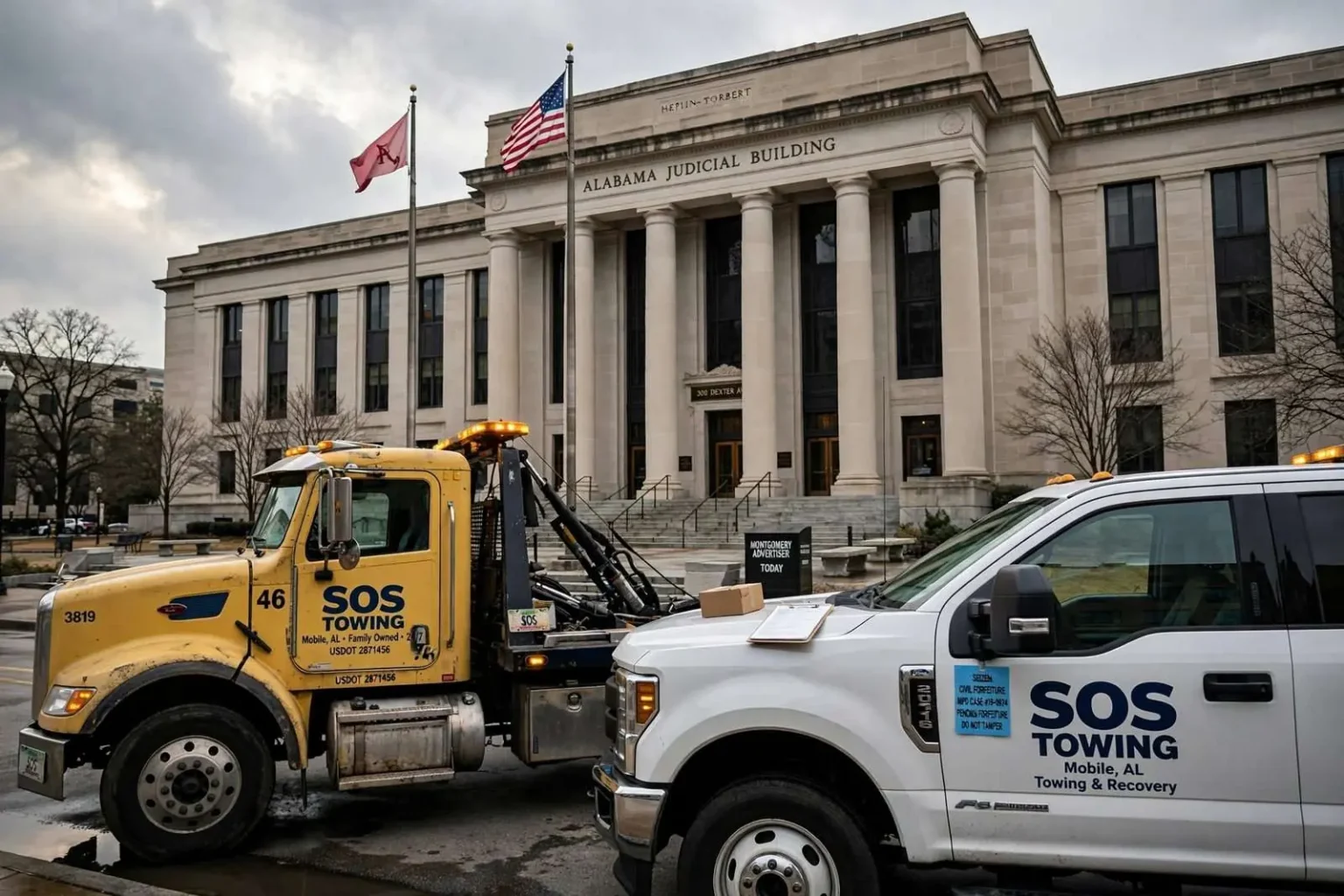
The Alabama Supreme Court has sided with prosecutors in a closely watched civil forfeiture dispute involving a Mobile County towing company, reversing a lower court’s attempt to lower the bond required for a family-owned business to reclaim seized tow trucks — even as several justices expressed unease with how the state’s forfeiture law can affect small businesses. The case stems from a September 2019 investigation by the Mobile Police Department into towing companies accused of charging fees above what is allowed under a city ordinance. Gary Smith Sr. and his son, Gary Smith Jr., who own SOS Towing, were arrested on insurance fraud charges as part of that investigation. Prosecutors subsequently moved to seize four of the company’s tow trucks under Alabama’s “fruits of crime” forfeiture statute, which allows law enforcement to take property believed to be connected to criminal activity.
Under state law, a person facing forfeiture can regain possession of seized property while the case is pending by posting a bond worth twice its value. The Smiths argued they had tried and failed to secure that bond — reported at roughly $192,000 — because they could not use the trucks themselves, which remained in the state’s possession, as collateral, and because the seizure had cut off the income the trucks would normally generate. Mobile County Circuit Judge Wesley Pipes agreed the seizure had put SOS Towing’s viability at risk and set a lower bond of $5,000, allowing the company to get its trucks back while the forfeiture case proceeded. The state appealed, and the Alabama Supreme Court reversed that decision Friday, ruling that the double-value bond set out in state law is “the exclusive means” for a business or individual to recover seized property during a pending forfeiture case, and that a judge does not have the authority to substitute a lower bond or an injunction instead.
The statutory framework
Alabama’s civil forfeiture law, codified at Section 20-2-93 of the Code of Alabama, authorizes the seizure of property “used or intended for use” in connection with drug offenses and certain other crimes. The “fruits of crime” provision extends to property derived from or realized through criminal activity. The double-value bond requirement appears in subsection (c), which states that a claimant may obtain release of seized property “upon the execution of a bond… in an amount equal to twice the value of the property.” The statute does not explicitly grant courts discretion to reduce the bond, nor does it provide for a hardship exception. The Supreme Court’s majority, in an opinion authored by Justice Sarah Hicks Stewart, read the language as mandatory: “The legislature has prescribed the exclusive means for recovery of seized property pending forfeiture proceedings. This Court cannot rewrite the statute to add exceptions the legislature did not include.”
Judge Pipes’ reasoning and the Supreme Court’s reversal
Circuit Judge Wesley Pipes, a former Mobile County district attorney appointed to the bench in 2011, found that the $192,000 bond — twice the appraised value of the four tow trucks — would effectively end SOS Towing’s business. The trucks, a 2016 Ford F-550, a 2017 Freightliner M2, a 2018 Kenworth T370, and a 2019 Peterbilt 389, represented the company’s entire operational fleet. Without them, the Smiths could not generate revenue to pay the bond premium, which a surety company quoted at 10 percent ($19,200) with full collateralization. The trucks themselves, held by the state, could not serve as collateral. The Smiths’ real property, a modest home in Semmes and a commercial lot on Old Shell Road, carried existing liens that left insufficient equity.
Judge Pipes invoked the Alabama Constitution’s guarantee that “all persons shall, before conviction, be bailable by sufficient sureties” and the due process clause, arguing that a bond requirement that is practically impossible to meet amounts to a denial of the statutory right to reclaim property. He set the bond at $5,000 — roughly the value of the oldest truck — and ordered the trucks returned pending the forfeiture trial. The state appealed immediately, arguing that the circuit court had exceeded its authority by substituting its own bond calculation for the legislature’s formula.
The Supreme Court’s majority agreed with the state. Justice Stewart’s opinion emphasized that the forfeiture statute is a civil proceeding, not a criminal one, and that the constitutional bail provisions do not apply. The double-value bond, the Court held, is a condition precedent to the release of property, not a bail determination. The legislature’s choice of a fixed formula reflects a policy judgment that the state’s interest in preserving the forfeitable asset outweighs the claimant’s interest in continued use. The Court acknowledged the harsh result — “the bond amount may, in practical terms, preclude recovery for claimants of modest means” — but concluded that any remedy lies with the legislature.
The concurring opinions: unease on the bench
Justice Tommy Bryan wrote separately to express “deep concern” with the practical operation of the forfeiture law. While concurring in the judgment, Bryan noted that the statute creates a dynamic in which the seizure itself destroys the claimant’s ability to meet the bond condition, a result that “bears an uncomfortable resemblance to the very abuse the Excessive Fines Clause was designed to prevent.” He cited the Timbs decision and urged the legislature to consider amendments allowing courts to consider a claimant’s financial circumstances and the proportionality of the seizure to the alleged offense.
Justice Greg Shaw joined Bryan’s concurrence and added his own, emphasizing that civil forfeiture in Alabama does not require a criminal conviction — only a preponderance of evidence that the property is connected to criminal activity. This standard, combined with the double-value bond, means that a business can lose its operating assets based on allegations that never result in a conviction. Shaw noted that the Smiths’ criminal cases were still pending, and that an acquittal would not automatically return the trucks; a separate forfeiture trial would proceed on the lower civil standard. “The law permits the state to take a man’s livelihood before it proves he broke it,” Shaw wrote. “That is a power that demands careful legislative calibration.”
Chief Justice Tom Parker, in a brief concurrence, declined to join the Bryan-Shaw critique, writing only that “the statute says what it says” and that “policy arguments belong in the State House, not this Court.” The division on the Court — a unanimous judgment with three justices signaling discomfort — reflects a broader national conversation about civil forfeiture reform that has produced legislative changes in more than thirty states since 2014.
Impact on Mobile’s towing industry
The SOS Towing case sent ripples through Mobile County’s towing sector, which operates under a fragmented regulatory patchwork. The City of Mobile’s ordinance applies within city limits; unincorporated Mobile County relies on the Alabama Public Service Commission’s wrecker certification program, which sets maximum rates for non-consensual tows but lacks the credit card and receipt requirements. The Mobile County Commission, responding to constituent complaints about predatory towing at apartment complexes in Tillman’s Corner and Theodore, adopted its own fee schedule in 2020, but enforcement falls to the sheriff’s office, which prioritizes violent crime.
SOS Towing, unable to post the $192,000 bond, lost its trucks for the duration of the forfeiture proceedings. The company continued operating with rented equipment at reduced capacity, but the loss of the Peterbilt and Kenworth — the heavy-duty units that handled commercial accounts — meant losing the contracts that paid the overhead. By the time the Supreme Court decision was issued, the Smiths had laid off their three employees and were personally driving the remaining light-duty wrecker. The criminal insurance fraud charges were eventually resolved in a plea agreement: Gary Smith Sr. pleaded guilty to a reduced misdemeanor count, received a suspended sentence and probation, and agreed to restitution. The forfeiture case proceeded separately; the state ultimately prevailed on two of the four trucks, which were sold at auction.
The reform debate in Montgomery
The case became a reference point in the 2022 legislative session, when Senator Chris Elliott (R-Daphne) and Representative Chip Brown (R-Hollinger’s Island) co-sponsored the Alabama Forfeiture Reform Act. The bill would have required a criminal conviction before property could be forfeited in most cases, replaced the double-value bond with a judicial determination of reasonable security, and directed forfeiture proceeds to the state General Fund rather than law enforcement budgets. The bill passed the Senate Judiciary Committee but stalled on the floor after the Alabama Sheriffs Association, the Alabama Association of Chiefs of Police, and the Attorney General’s office lobbied against it, arguing that civil forfeiture is an essential tool against drug trafficking and organized crime.
A narrower reform, allowing judges to reduce the bond upon a showing of financial hardship and no flight risk, passed as an amendment to an omnibus criminal justice bill in 2023. The amendment, sponsored by Senator Vivian Figures (D-Mobile), applies only to claimants whose gross annual income is below 200 percent of the federal poverty guideline and who own no other property sufficient to secure the bond. It did not apply retroactively to the Smiths’ case. Legal observers note that the hardship exception, while a step toward proportionality, preserves the structural dynamic that the Bryan-Shaw concurrences identified: the seizure precedes the hearing, the bond is calculated on the state’s valuation, and the claimant bears the burden of proving inability to pay.
The broader context
Alabama’s civil forfeiture revenue, tracked by the Institute for Justice, averaged $2.3 million annually from 2015 to 2020, distributed among hundreds of law enforcement agencies. Mobile County’s share, typically $150,000 to $300,000 per year, funds equipment, training, and overtime that municipal budgets cannot cover. The SOS Towing case, while involving a relatively small seizure, illustrated the mechanism by which forfeiture can affect legitimate businesses caught in regulatory crossfire. The towing ordinance violation — a misdemeanor punishable by a $500 fine — triggered a forfeiture action that threatened a family’s livelihood and their employees’ jobs. The Supreme Court’s ruling, legally sound on the statutory text, left the policy question unresolved: whether a regulatory violation justifies a civil seizure that destroys the regulated entity before guilt is proven.
For the Smiths, the legal battle ended with a misdemeanor conviction, the loss of half their fleet, and a business that survives at a fraction of its former scale. For the Mobile Police Department, the investigation validated the towing ordinance and demonstrated that fee violations can carry consequences beyond municipal court. For the Alabama Supreme Court, the case produced a unanimous statutory interpretation accompanied by a rare public airing of judicial discomfort with the law’s consequences. And for the legislature, the case joined the growing file of forfeiture controversies that reform advocates cite when they argue that the tool has outgrown its purpose.