Mobile Man Pleads Not Guilty in Officer Tuder Killing as Handcuffs Draw Objection
Marco Perez pleaded not guilty to capital murder in the shooting death of Mobile Police Officer Sean Tuder, and his defense objected after Perez was brought into court wearing handcuffs engraved with the slain officer's name.
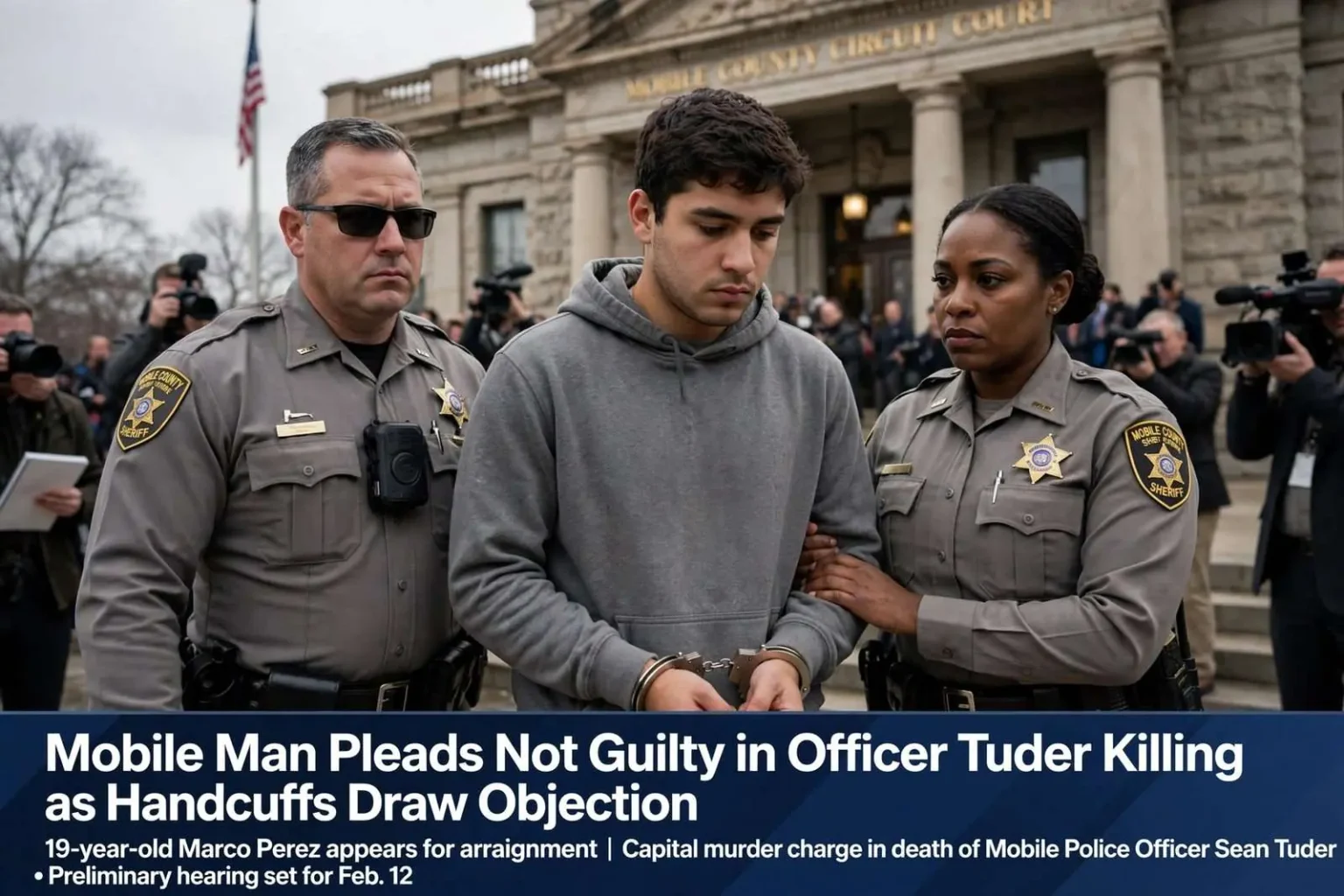
The man accused of killing Mobile Police Officer Sean Tuder pleaded not guilty Monday to capital murder during an arraignment that took an unusual turn when his defense attorney raised concerns about the restraints used to bring him into the courtroom. The plea sets the formal start of what will almost certainly be one of the most closely watched criminal cases in Mobile County, following the death of an officer whose killing stunned the department and the neighborhoods he patrolled.
Marco Perez, 19, appeared before Circuit Judge Ben Brooks with court-appointed attorneys Dennis Knizley and Jason Darley to enter his plea in the Jan. 20 shooting death of Tuder, who was shot while investigating a tip on Perez’s whereabouts at the Peach Place Inn apartment complex. Officers had been searching for Perez in connection with multiple outstanding warrants, and the tip sent responding officers to the apartment complex in the Toulminville area of the city, where the confrontation took place in the afternoon.
Perez had been the subject of multiple outstanding warrants at the time of the confrontation. He has not yet been arraigned on several lesser charges stemming from the case or on an unrelated federal gun charge. That means additional court appearances will follow even as the capital murder case moves through the Circuit Court docket, and decisions about the order of the proceedings remain ahead of the court.
A preliminary hearing has been set for Tuesday, Feb. 12, at 3:30 p.m. In Alabama’s system, the preliminary hearing gives a district court judge the task of deciding whether the prosecution’s evidence is sufficient to send the case to a grand jury, which decides whether to return an indictment. The hearing is not a trial: the standard is probable cause, not guilt, and defendants rarely testify. Still, it gives the defense its first structured look at the state’s evidence and often foreshadows the legal battles to come.
Capital murder charges in Alabama carry the possibility of the death penalty or life imprisonment without parole upon conviction, which is why these cases are prosecuted with additional procedural protections. The pace of a capital case is typically slower than other felonies, with extensive motion practice over evidence, media coverage, and trial logistics.
The handcuff dispute
What might otherwise have been a routine procedural hearing drew added attention after Knizley told the court he wanted the record to reflect that Perez had been placed in handcuffs bearing Tuder’s last name during the proceeding. The detail, reported by a local television station, quickly became the subject of wide discussion in Mobile’s legal community, in part because of what it suggested about the intersection of commemoration and courtroom procedure.
Knizley, who has practiced as a defense attorney in Mobile for decades, said he had never encountered anything comparable in a case he handled. “It’s quite unusual, and it’s not necessary,” Knizley told reporters following the hearing. “Let’s just treat everyone like you would anyone else accused of an offense.” His point, he said, was not about the gravity of the charges but about the presumption of innocence and the appearance of a proceeding conducted with pre-judgment of the defendant.
Knizley said a local television station had reported on the plan to have Perez wear the handcuffs before the arraignment even took place. He said the episode could become relevant if the defense later seeks a change of venue, arguing that the volume of local media coverage surrounding Tuder’s death and the prosecution could make it difficult to seat an impartial jury. Change-of-venue motions in Alabama are governed by statute and are rarely granted, but judges are required to consider extensive media coverage when defendants request a move, and high-profile cases often involve the surveying of potential jurors to gauge exposure to news reports.
The defense intends to file a motion asking that the handcuffs not be used again going forward. Whatever the court decides, the issue illustrates a recurring tension in cases involving fallen officers: the department’s desire to honor its own, the community’s grief, and the defendant’s constitutional right to a proceeding that looks the same as any other, no matter the charges.
Mobile County District Attorney Ashley Rich, who is prosecuting the case alongside Assistant District Attorney Jennifer Wright, said her office played no role in arranging the handcuffs, drawing a line between the sheriff’s custodial operation of the courtroom and the prosecution of the case. The office said its focus remains on presenting the evidence to the court through the ordinary channels of the criminal justice system.
Rich’s office has been at the center of several of the region’s most prominent prosecutions in recent years, and the district attorney has repeatedly emphasized the office’s support for law enforcement officers killed in the line of duty while also defending the integrity of the process. Balancing those commitments publicly is one of the reasons prosecutors in officer-death cases tend to say little on the record outside the courtroom, letting filings and hearings carry the case forward.
The case and the investigation
The shooting occurred Jan. 20 at the Peach Place Inn complex, an area of apartment buildings that Mobile police had been called to repeatedly over the years as part of focused enforcement efforts. According to officers’ accounts after the killing, the department had received information about Perez’s location, and Tuder was among the officers who responded. The circumstances — an officer following up on a tip about a wanted man — have been cited by city officials as an example of the unpredictable dangers of routine police work.
Tuder’s death prompted an outpouring across Mobile: officers from departments across Mobile County and the Gulf Coast lined processional routes, city leaders held memorials, and residents left flowers and notes at police facilities in the days that followed. The Mobile Police Department, one of the largest municipal forces in Alabama, has historically emphasized community policing and neighbor-level relationships in its patrol divisions, and officers described Tuder as a colleague known for his work in the neighborhoods he served.
The investigation into the killing was handled with the urgency that follows any officer death, with detectives working to reconstruct the events at the complex, collect physical evidence, and identify witnesses. Multiple agencies assisted in the days after the shooting, a common arrangement in south Alabama where departments routinely back each other up on major incidents. The evidence assembled in that initial period forms the backbone of the state’s case as it moves toward the preliminary hearing and grand jury review.
Perez’s arrest followed the shooting after a search by area law enforcement, and he has remained in custody since. The additional charges that have not yet been through arraignment, along with the federal gun case, mean that the totals of his legal exposure are still being tallied even as the capital case proceeds. Defense attorneys in such multi-track situations typically coordinate appearances so that statements made in one case do not complicate another.
What comes next in the process
The Feb. 12 preliminary hearing will be the first test of the evidence in open court. Prosecutors are expected to call officers and investigators to outline what happened at the apartment complex; the defense may cross-examine but usually reserves its arguments for later stages. If the district judge finds probable cause, the case goes to a Mobile County grand jury, which has traditionally met in secret to consider indictments. A capital murder indictment then sends the case to Circuit Court for arraignment on the indictment and, eventually, trial.
Along the way, the parties will fight through a familiar list of pretrial issues. In capital cases those motions often address venue, the composition of jury panels, the admissibility of statements and physical evidence, discovery of lab results and forensic testing, and the qualifications of defense mitigation specialists who build the case against a death sentence. Each motion takes time, and the court’s docket — one of the busiest in Alabama — shapes the pace as much as the lawyers do.
The defense team brings considerable experience to the task. Knizley has spent decades in Mobile courtrooms handling serious felony defense, including capital litigation, and Darley has built a practice around criminal defense work in the region. Court-appointed capital defense requires specialized training and certification under Alabama’s rules, and defendants facing the death penalty are entitled to a defense team prepared to handle both the guilt phase and the sentencing phase of trial.
For the Mobile Police Department, the case runs parallel to its own grieving and its own review. Officer-involved fatalities lead departments to examine their callout practices, the information officers receive before responding, and the support systems available to surviving family members and to officers who worked alongside the fallen. The department has continued its enforcement focus in the neighborhoods around the apartment complex, where residents have both welcomed the attention to chronic problems and worried about the disruptions that follow major police activity.
Community leaders in the Toulminville area and across Mobile have used the case to discuss the broader pressures on the city’s young people, the role of the courts, and the relationship between officers and residents. Those conversations rarely map neatly onto the courtroom calendar, but they shape the atmosphere in which the trial will eventually be held — an atmosphere the venue question, and motions like the one over the handcuffs, are designed to test.
The arraignment itself was brief by design: the reading of the charge, the entry of the plea, and the setting of next steps. But the hearing signaled the themes both sides may carry for months. For the prosecution, the work is to present the events of Jan. 20 methodically and completely. For the defense, the early emphasis on fairness and process — the handcuffs, the media coverage, the jury pool — sketches the arguments they will make when they ask a judge or jury to see the case through the lens of the defendant’s rights.
Between now and trial, expect a rhythm of hearings, filings and rulings that will unfold over many months. The preliminary hearing in February is the next scheduled step, and it will offer the public its first detailed account of the state’s evidence. What it will not resolve is the larger tension that surfaced Monday: how a community honors a fallen officer while guaranteeing the person accused of his killing a proceeding that is, in form and in fact, like any other.