Marco Perez Seeks Self-Defense Immunity in Fatal Shooting of Mobile Officer Sean Tuder
Attorneys for Marco Perez argued in a Mobile County pretrial hearing that he should be immune from prosecution in the 2019 killing of Officer Sean Tuder, saying Perez never realized he was confronting a police officer.
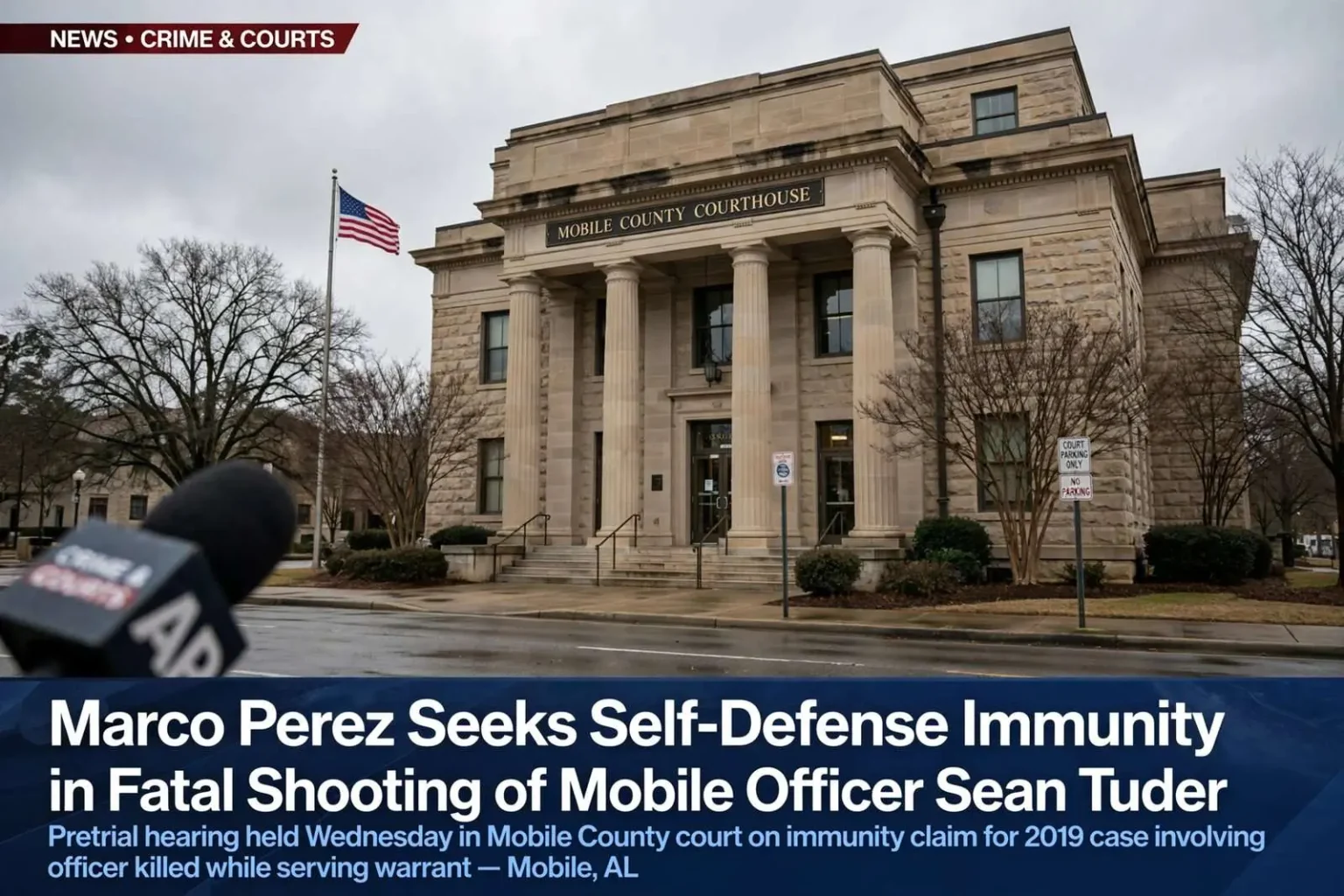
Attorneys for the man charged with capital murder in the 2019 death of Mobile Police Officer Sean Tuder argued in a Mobile County courtroom this week that their client should be shielded from prosecution entirely, telling a judge the shooting was an act of self-defense against a man he did not know was a police officer.
The pretrial evidentiary hearing, held Wednesday, centered on a defense motion seeking immunity for 21-year-old Marco Perez under Alabama’s self-defense statute.
Perez is charged in the Jan. 20, 2019, shooting death of Tuder, 30, a Mobile police officer who was killed while attempting to serve an arrest warrant near an apartment complex on Leroy Stevens Road.
The defense’s account
According to court filings, defense attorneys argued Perez had no way of knowing the man approaching him was a police officer, because Tuder was off duty, out of uniform and driving an unmarked vehicle at the time.
The motion states Tuder had arranged with a confidential informant to pose as a relative offering Perez a ride, a plan investigators say was meant to help Tuder get close enough to serve the outstanding warrant without a confrontation.
“Perez was unaware the CI had contacted a police officer and that Tuder was an officer posing as a relative of the CI to give Perez a ride,” the defense motion states. “Perez was expecting the private vehicle to be his ride. When Perez saw the non-police private vehicle, he approached the vehicle on the passenger side to get in his expected ride.”
Defense attorneys say that as Perez neared the car, Tuder got out and drew his firearm, prompting Perez to back away and raise his hands. A struggle then broke out between the two men, according to the motion, before shots were fired.
Portions of the encounter were captured on nearby surveillance video, but investigators have said the shooting itself happened just out of the camera’s frame, leaving the exact sequence of the final moments in dispute.
Defense attorneys also pointed to testimony from the hearing as they laid out the basis for the immunity request, arguing that the recorded portions of the encounter support their client’s account of how the confrontation began.
Alabama’s self-defense immunity process
Alabama law allows a defendant to claim immunity from prosecution before trial if a judge finds the use of force was justified under the state’s self-defense statute. The hearing is not a trial; it is an evidentiary proceeding in which the defense must show that a reasonable person in the defendant’s position would have believed deadly force was necessary to prevent death or serious injury.
Immunity hearings of this kind are rare and consequential. If the judge grants the motion, the prosecution ends and the charges are dismissed outright — not merely reduced. If the judge denies it, the case proceeds to trial, and the same self-defense arguments can be made again to a jury as an affirmative defense.
Judges weigh these motions on the pretrial record, which can include surveillance footage, witness statements, investigator testimony and the physical evidence. The disputed moments just outside the camera’s frame are likely to be central: the defense’s theory hinges on what Perez knew and saw as Tuder approached, and the prosecution’s case hinges on the officer’s authority and the events that triggered the gunfire.
The warrant operation
The operation that brought Tuder to the Leroy Stevens Road apartment complex was built around a confidential informant, a common tool in warrant service when officers believe a direct approach could be dangerous. By arranging for the informant to set up a ride, investigators hoped Tuder could get close enough to take Perez into custody before any chase or confrontation developed.
Undercover warrant operations walk a narrow line. Officers are trained to identify themselves before making an arrest, but the timing of that identification — and what a suspect perceives in the seconds before it happens — becomes the crux of cases like this one. The defense’s motion argues that identification never reached Perez in a way he could understand before the encounter turned physical.
The prosecution’s view, as reflected in the capital murder charge, is that Tuder was lawfully performing his duties when he was killed. Alabama law treats the killing of a police officer engaged in the performance of official duties with special severity, and the capital classification exposes a defendant to the state’s harshest penalties upon conviction.
Those two framings — an officer lawfully serving a warrant versus a man who never knew an officer was approaching — are the poles around which the immunity fight, and any eventual trial, will turn.
Officer Sean Tuder
Tuder, 30, was a Mobile police officer whose death in January 2019 sent a shock through the department and the city. Officers killed in the line of duty are mourned publicly across the Gulf Coast, and Tuder’s death was no exception, drawing an outpouring of support from law enforcement agencies across the region.
The circumstances of his death — working a warrant, off duty, in plain clothes, relying on an informant’s arrangement — were among the most difficult details for the department and the community to absorb, and they have shaped every stage of the case since.
For the Mobile Police Department, the case has also raised questions about how warrant operations are planned and supervised, and how much risk officers take on when they approach suspects through intermediaries rather than marked units. Those questions do not determine Perez’s guilt or innocence, but they hang over the litigation as it moves forward.
What the surveillance shows — and doesn’t
The surveillance video is the single most important piece of evidence in the dispute, and both sides read it differently. The portions captured on camera show the approach of the vehicle and the moments around the initial contact, while the shooting itself fell outside the frame, leaving a gap that testimony must fill.
That gap is where the immunity hearing will be won or lost. The defense argues that what the video does show — Perez approaching the passenger side of an ordinary private car, backing away, raising his hands — is consistent with a man who did not know he was confronting a police officer. Prosecutors argue that the video, combined with the physical evidence and the testimony of investigators, establishes that Tuder was engaged in official duties and was killed because of it.
Alabama courts have made clear that immunity questions are resolved by the judge, not the jury, when the motion is made before trial. The standard does not require the defense to prove its case beyond a reasonable doubt at this stage, but it does require more than argument — the judge must find the use of force was justified on the evidence presented.
If the judge finds the evidence insufficient to grant immunity, the ruling is not the end of the defense. Self-defense is an affirmative defense at trial, where the jury hears the same evidence under a different standard, and capital murder cases in Alabama routinely present exactly this kind of contested account of a confrontation.
The stakes of a capital case
A capital murder charge places Perez’s case among the most serious matters on the Mobile County docket. Capital cases move differently from ordinary felony prosecutions: they require qualified defense counsel, they generate extensive pretrial litigation, and upon conviction they carry sentences that include life without the possibility of parole or, in some cases, the death penalty.
The immunity motion is one of the few mechanisms that can end a capital case before trial, which is why the defense has invested so heavily in the hearing and why the prosecution has responded in kind. Everything the judge heard this week — the motion’s account of the ride arrangement, the testimony about the struggle, the video — will shape whether the case ever reaches a jury.
What happens next
The judge will rule on the immunity motion after the hearing record is complete, a decision that can take weeks or months in a case of this magnitude. Either outcome is almost certain to be tested further: a grant of immunity would end the prosecution unless the state sought appellate review, and a denial would move the case toward trial while the defense preserved the issue for appeal.
If the case proceeds, the trial will revisit the same ground — the informant’s role, the unmarked vehicle, the moments outside the camera’s view — before a jury that will be asked to decide between the defense’s account of a mistaken, terrified young man and the state’s account of an officer killed while lawfully doing his job.
For the Tuder family, the hearing reopens the loss they have carried since January 2019, and the litigation’s slow pace is a familiar burden in capital cases, where pretrial proceedings routinely stretch across years. For Perez, the hearing represents the single best chance to avoid the trial that could determine the rest of his life.
The Mobile County court system has handled a steady stream of major criminal cases from the 2019 era of the docket, and this one — a killed officer, a contested self-defense claim, and a capital charge — stands among the most consequential. Whatever the judge decides, the ruling will be the pivotal moment in a case that has been four years in the making.
Until then, the account in the defense motion — a ride that was not a ride, an officer out of uniform, a struggle outside the camera’s frame — stands as the defense’s answer to the state’s capital charge, awaiting the ruling that will decide whether it ends the case or frames its trial.