Brass Knuckles Used in Vigor High School Fight; Two Students Arrested
Prichard police arrested two students after a brass-knuckles fight at Vigor High School; a third student was taken to a hospital, MCPSS says.
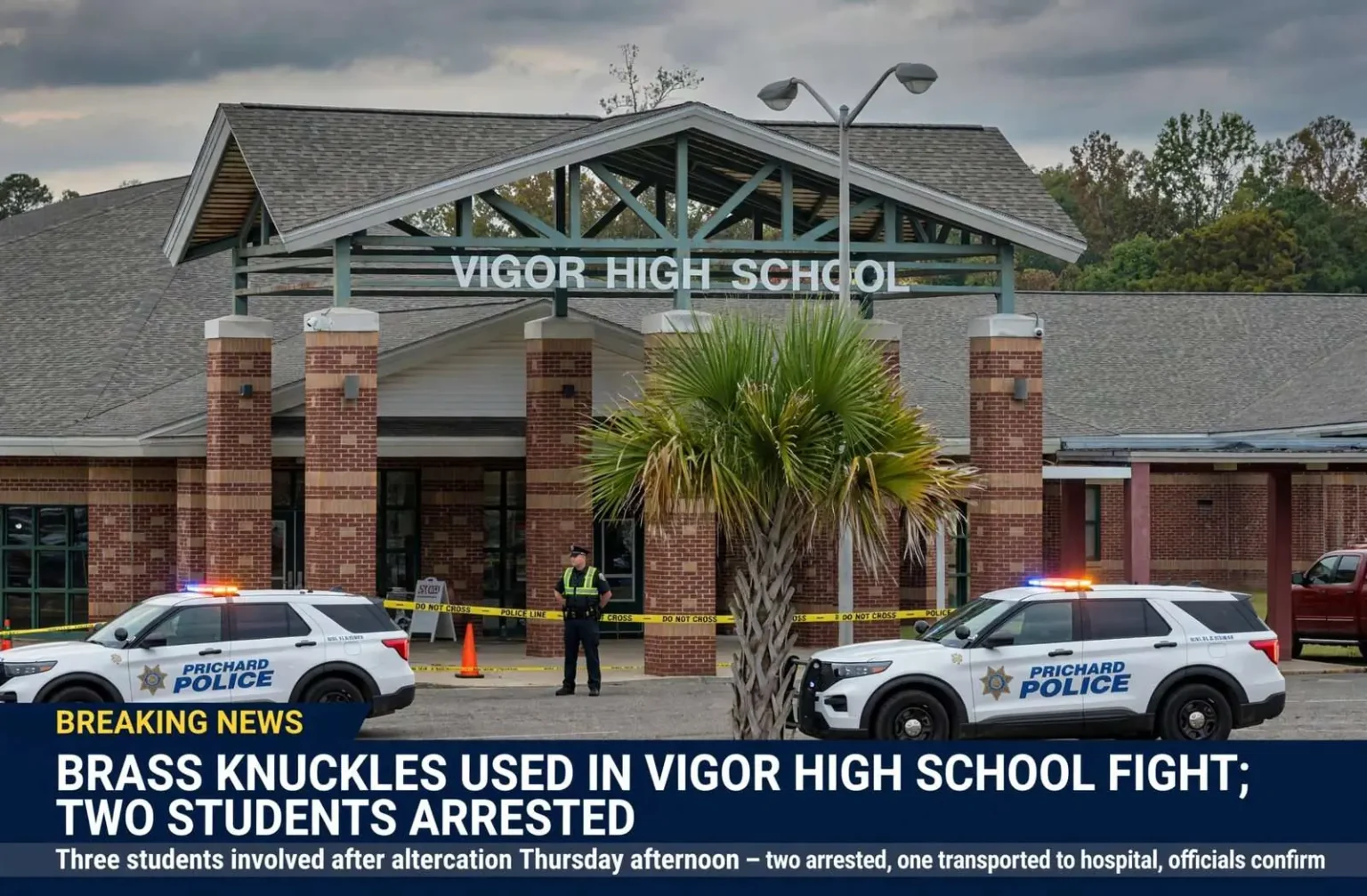
Two students were arrested after a fight involving brass knuckles broke out at Vigor High School in Prichard on a Thursday afternoon, according to Mobile County school officials — an incident that turned an ordinary dismissal-time argument into a police matter and a reminder of how quickly campus altercations can escalate.
The Mobile County Public School System said three female students were involved in the altercation. Rena Phillips, a spokesperson for the district, confirmed that Prichard police took two of the girls into custody, while the third was transported to a hospital. The extent of any injuries was not detailed.
Brass knuckles were reportedly used during the fight, per the district — a detail that separates the incident from the routine shoving matches that school administrators handle internally, and the reason police officers stationed at the school became involved.
What happened at Vigor
The fight broke out Thursday afternoon at the school, and the involvement of a weapon — even one as compact as brass knuckles — converted a disciplinary matter into a criminal one. School resource officers and Prichard police responded, and the decision to arrest two of the three students reflected both the severity of the altercation and the presence of the weapon.
The third student’s transport to a hospital underscored the potential consequences when a weapon enters a school fight. District officials did not release details about her condition or the nature of her injuries, and school systems typically withhold medical specifics involving minors. What the district did confirm was the sequence: three students involved, a weapon used, two arrests by Prichard police, and one hospital transport.
For the students and families at Vigor, the incident interrupted the routine of a Thursday with lockdowns or restricted movement that many schools implement while police clear a scene, followed by the questions that inevitably follow — who was involved, whether anyone else would face discipline, and what the school would do next.
Mobile County school officials have generally handled such incidents with a combination of disciplinary consequences under the student code of conduct and coordination with local police, whose involvement is standard whenever weapons appear on campus. The district’s communication about the incident was deliberately limited, confined to the basic facts and the confirmation of the arrests, consistent with its practices in cases involving minors.
Vigor and the Prichard community
Vigor High School serves the city of Prichard, a community just north of Mobile that has faced decades of economic strain since the decline of its industrial base. The school is one of the anchors of the northern Mobile County communities it serves, and its students come from neighborhoods where the challenges facing urban school systems — poverty, mobility, and the social pressures that follow — are part of daily life.
Prichard, once a thriving industrial city, has worked for years to stabilize its neighborhoods and rebuild its commercial base, and its police department, smaller than Mobile’s, handles the public safety needs of a city of roughly 20,000 residents. School-based incidents like Thursday’s fight draw on that department’s resources and underscore the working relationship between the city and the school system.
The Mobile County Public School System, the largest school district in Alabama, serves tens of thousands of students across the county, from suburban schools in west Mobile to the urban campuses of Prichard and the city’s downtown districts. Vigor, with its long athletic history and its place at the center of the Prichard community, is among the system’s most recognizable campuses.
The afternoon timing of the fight added another layer to the response. Incidents late in the school day coincide with dismissal preparations, bus loading, and the movement of students across campus, which is why administrators treat afternoon altercations differently from morning ones — the crowd that gathers is larger, the students are in transit between classes or waiting for rides, and the job of separating the incident from everyone else takes longer. Districts train their staff for exactly this window, and the presence of officers on campus Thursday afternoon meant the response could begin before the situation drew in more students.
Brass knuckles and Alabama law
Brass knuckles — metal bands worn over the fingers that multiply the force of a punch — occupy a specific place in Alabama’s weapons law. They are classified among the state’s prohibited weapons, and carrying them concealed is a crime under Alabama statute, alongside items like switchblades and knuckle-duster weapons in that category.
Bringing a weapon onto school property raises the stakes further. Alabama law criminalizes the possession of deadly weapons on school grounds, and school systems across the state have adopted zero-tolerance-style provisions in their student codes of conduct for weapons of any kind. A student found with brass knuckles on campus faces disciplinary consequences that can include long-term suspension or expulsion, independent of any criminal charges police pursue.
The choice of weapon in this case reflects a pattern that school safety officials have noted for years: students seeking an edge in a confrontation increasingly carry concealable impact weapons rather than firearms. Brass knuckles are inexpensive, small enough to fit in a pocket or backpack, and often unknown to adults until they are used — a combination that makes them difficult to detect with the screening measures schools typically employ.
Handheld metal detectors, clear backpack policies, and random checks are the standard responses school systems use, and Mobile County schools have employed various screening measures across its campuses. But no screening regime catches everything, and the discovery of a weapon in use — as on Thursday — remains the moment when the system’s limits become visible.
School safety across the Gulf Coast
The incident remains part of an ongoing concern for school systems across the Gulf Coast, where administrators continue to grapple with weapons making their way onto campuses and with how quickly campus altercations can turn dangerous. The region’s districts — Mobile County, Baldwin County, and the systems across the state line in Mississippi and Florida — confront the same underlying dynamics: conflicts that begin off campus and follow students into school, social media disputes that escalate in person, and the presence of weapons that convert what was once a fistfight into a criminal matter.
Administrators describe a landscape that has changed over the past generation. Fights that once ended with suspensions now carry criminal exposure, because the weapons students bring — brass knuckles, knives, and occasionally firearms — change both the physics and the law of an altercation. Police officers stationed on campuses, standard in large districts like Mobile County’s, exist in part for that reason: an officer on site can intervene in seconds, make arrests, and begin the legal record that the courts require.
The presence of school resource officers at Vigor and other Mobile County campuses is itself the product of that evolution. The officers handle everything from trespassers to the fights that break out among students, and their dual role — law enforcement and mentoring — has become a fixture of how large Southern districts manage campus safety.
What happens to the students involved
The two students taken into custody by Prichard police face parallel tracks: the juvenile justice process that follows an arrest, and the school system’s disciplinary process under its code of conduct. Juvenile proceedings in Alabama are closed to the public and handled in Mobile County’s juvenile court, with outcomes that range from diversion programs to formal adjudication depending on the severity of the offense and the student’s history.
The school side moves faster. Suspensions in weapons cases are typically imposed quickly, with longer disciplinary action following a due process hearing, and the district’s policies treat weapons on campus as among the most serious code violations. The student who was hospitalized faces a different timeline — her role in the fight, her injuries, and the circumstances of the altercation will determine whether she is treated primarily as a victim, a participant, or both.
District officials did not say whether additional students might face consequences, and the investigation by Prichard police may develop further details about how the fight began and how the weapon came to be on campus. In incidents like this, the full account usually emerges in pieces: the initial confirmation, the arrests, and then the slower accumulation of facts through the juvenile and disciplinary processes.
The larger conversation
For parents in Prichard and across Mobile County, incidents like Thursday’s fight raise the questions that school safety debates always turn on — whether campus security measures are adequate, how conflicts among students are detected before they escalate, and what role families, churches, and community organizations play in keeping disputes from reaching the schoolhouse door.
School districts across the Gulf Coast have invested in those layers: more counselors and intervention staff, partnerships with community organizations, programs that teach conflict resolution, and the screening measures aimed at keeping weapons out of buildings. The effectiveness of those investments is measured in incidents like this one — and in the fights that never happen because an argument was defused before it reached a hallway.
What the district confirmed Thursday was limited to facts: a fight, brass knuckles, three students, two arrests, one hospital transport. But the incident’s echo will last longer than the afternoon it occupied, in the disciplinary records, the juvenile court docket, and the ongoing work of a school community that now has one more reminder of how quickly an ordinary day can change.
Vigor High School, like campuses across the region, will continue the balancing act that defines modern school administration — maintaining the normal rhythm of classes and activities while managing the security posture that incidents like this one require.