Clarke Preparatory School Cancels Classes for the Week Amid Widespread Illness
Clarke Preparatory School canceled classes for the rest of the week because of widespread illness and a high number of absences, school officials said.
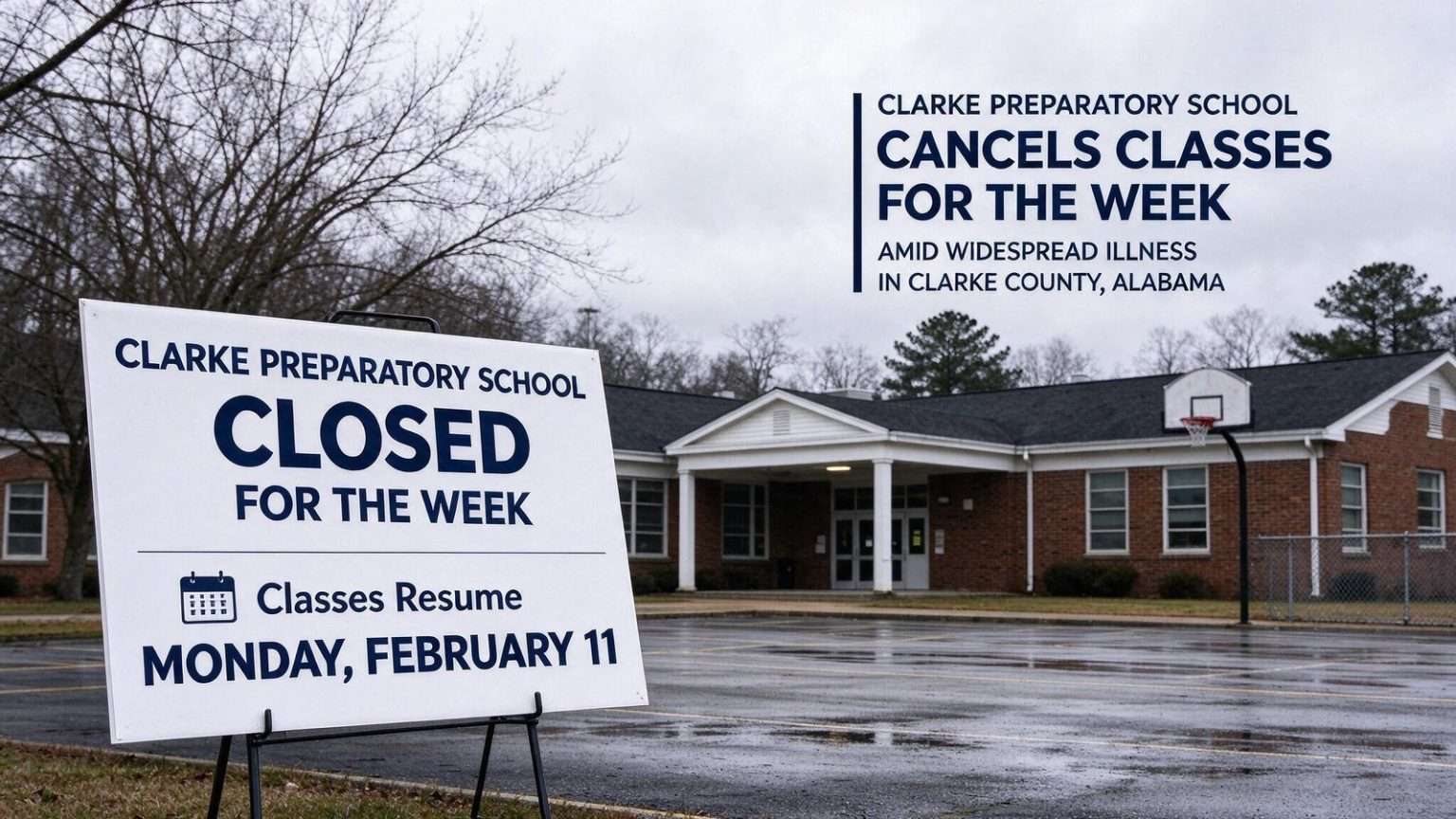
CLARKE COUNTY, Ala. — Clarke Preparatory School canceled classes for the rest of the week because of widespread illness and an extreme number of absences. The school said in a social media post that it felt the move was the best decision for the well-being of students and staff. Classes were set to resume Monday, Feb. 11, giving the school community a long weekend to recover as flu season battered the region.
The decision came after school officials watched absences climb through the week, with students and staff alike falling ill to the bugs circulating across south Alabama that winter. By the time the announcement was made, the school had reached a point where instruction was simply not practical — classrooms stood half-empty, and teachers who were well enough to work were stretched thin covering for colleagues who were not.
In its social media post, the school explained the reasoning plainly: with illness widespread and absences extreme, closing for the remainder of the week was the best decision for the well-being of students and staff. Administrators urged families to use the unexpected days off to rest, recover, and keep sick children home until they were truly well, hoping the break would break the cycle of infection passing through the hallways.
Clarke Prep and Its Community
Clarke Preparatory School serves families across Clarke County from its campus in Grove Hill, offering private education from elementary grades through high school. As one of the county’s independent schools, Clarke Prep draws students not just from Grove Hill but from communities across the rural county — Thomasville, Jackson, Coffeeville, and the small towns in between — making its student body a cross-section of the region and its campus a daily gathering point for families spread over many miles.
Independent schools like Clarke Prep occupy a special place in small-town Alabama life. Friday night games, pep rallies, school fundraisers, and church-linked activities knit the student body and its families tightly together. That closeness is a strength in most circumstances, but during an outbreak of flu or stomach viruses it becomes a liability — the same carpools, bleachers, and classrooms that build community also carry germs efficiently from home to home.
The cancellation announcement rippled quickly through that network. Families adjusted carpools and work schedules, athletes saw practices called off, and grandparents got unexpected visits from students with free afternoons. In a county where school events anchor the social calendar, several days of silence on the Grove Hill campus was a visible sign of just how sick the community had become.
A Hard Flu Season Across the Region
Clarke Prep’s closure fit a pattern that repeated across Alabama that winter, as influenza and related illnesses swept through schools in every part of the state. Health officials reported widespread flu activity, and school systems — public and private alike — resorted to periodic closures to slow the spread. When a critical mass of students and teachers is out sick, the arithmetic of keeping a school open stops working, and administrators are left choosing between instruction and health.
The biology of school outbreaks explains the pattern. Children are efficient carriers of respiratory viruses, shedding germs in classrooms where students share desks, supplies, and air. From there, the illness travels home to siblings and parents, then to workplaces and churches, and then back to school in an endless loop. A well-timed break in that cycle — even a few days — can blunt a peak that would otherwise run for weeks.
Custodial crews at schools that close often use the empty days for deep cleaning, wiping down surfaces, disinfecting classrooms, and airing out buildings in hopes of starting fresh when students return. For Clarke Prep, the run of days before Monday, Feb. 11 offered exactly that window — time to clean, time to heal, and time for the region’s illness numbers to turn the corner.
Looking Toward Monday
The school’s message to families was one of caution and care: rest, recover, and return healthy. Administrators emphasized that the days off were not a vacation but a public health measure, and that students who were still feeling ill when classes resumed should stay home rather than return too early. That guidance reflected the hard-learned wisdom of flu seasons past — that one student back too soon can restart the entire cycle.
For the Grove Hill community, the closure joined the long list of winter disruptions that south Alabamians take in stride — ice threats, storm cleanups, and sick seasons among them. Families made do, students caught up on rest, and teachers nursed themselves back to health with lesson plans waiting. By the time Monday, Feb. 11 arrived, the school’s hallways were ready to fill again, with everyone hoping the worst of the illness had passed through and moved on.
The episode stands as a snapshot of one south Alabama school’s response to a season of sickness — a private school in a rural county, watching absences soar, choosing its community’s health over its calendar, and telling families the truth: sometimes the best decision for students and staff is simply to close the doors, stay home, and get well.
How Schools Decide to Close
Closing a school is never a decision administrators take lightly. Behind a simple social media post lies a chain of considerations: attendance numbers day by day, how many teachers are out and whether substitutes are available, the guidance of county and state health officials, and the practical realities of families who depend on schools for structure and, indirectly, for child care during work hours. When absences reach a certain point, the educational value of staying open evaporates — you cannot teach a curriculum to a classroom that is mostly empty.
School leaders also weigh the message a closure sends. Staying open during a heavy outbreak can signal that attendance matters more than health, while closing can reassure families that the school takes their well-being seriously. In Clarke Prep’s case, administrators stated their reasoning openly: widespread illness and an extreme number of absences made closing the best decision for the well-being of students and staff. That transparency, delivered through social media where families would see it fastest, is now the standard playbook for schools across Alabama.
The makeup of a small private school adds its own considerations. With a compact student body, a handful of sick teachers can cripple coverage in ways a larger system might absorb. Clarke Prep’s administrators had to calculate whether remaining staff could safely and effectively supervise and instruct the students who were still well — a math problem that grows harder with each morning’s attendance report.
The Wider Sick Season in Clarke County
Clarke County in winter is a place where respiratory illness spreads readily — long school bus rides, tight-knit churches, basketball season gatherings, and the region’s swings between damp cold and warm days all play a role. When flu arrives in a rural county, it tends to move through the entire community rather than stopping at school doors, and clinics and pharmacies in Grove Hill and surrounding towns feel the surge alongside the schools.
Health guidance in such seasons is familiar by now: hand washing, covering coughs, staying home while feverish, and disinfecting shared surfaces. Doctors across south Alabama advised that flu seasons vary in severity from year to year, but the basic arithmetic holds — the illness burns through susceptible households until enough people have been sick or vaccinated that the spread slows. School closures accelerate that process by removing the largest mixing point in the community.
For employers in Clarke County, a school closure means juggling workers whose child care has vanished, another ripple of the same wave. Rural communities learn to absorb these disruptions with the help of grandparents, neighbors, and flexible bosses. The week Clarke Prep closed, the entire county was dealing with the same sickness at once — the school’s decision simply acknowledged it.
The Return to Class
When Monday, Feb. 11 arrived, the measure of the closure’s success would be written in the attendance ledger. If students returned healthy and absences fell to normal levels, the few days off would have done their job, costing a week’s instruction but buying back a healthy campus. If the illness persisted, administrators would face the same calculations again — a scenario schools in hard-hit seasons sometimes repeat more than once.
Teachers returning that Monday faced the familiar catch-up challenge: adjusting lesson plans, reworking tests, and helping students bridge the gap. In schools across Alabama that weathered similar closures, the seasons’ disruptions became part of the rhythm — lost days traded willingly for the health of the school family.
For Clarke Preparatory School, the canceled week of February closed with a message of gratitude to families for their patience and flexibility. The episode reflected the close bond between the school and the community it serves — a bond that shows up as clearly in a difficult decision to close as it does on any Friday night under the lights. Classes were set to resume Monday, Feb. 11, and the school community readied itself to return, rest and recovery behind it, to the ordinary business of a south Alabama school year.