National Camellia Show brings blooms, lectures and free admission to downtown Mobile
The American Camellia Society's National Camellia Show comes to Mobile Feb. 15-18, marking 60 years of the camellia as Alabama's state flower.
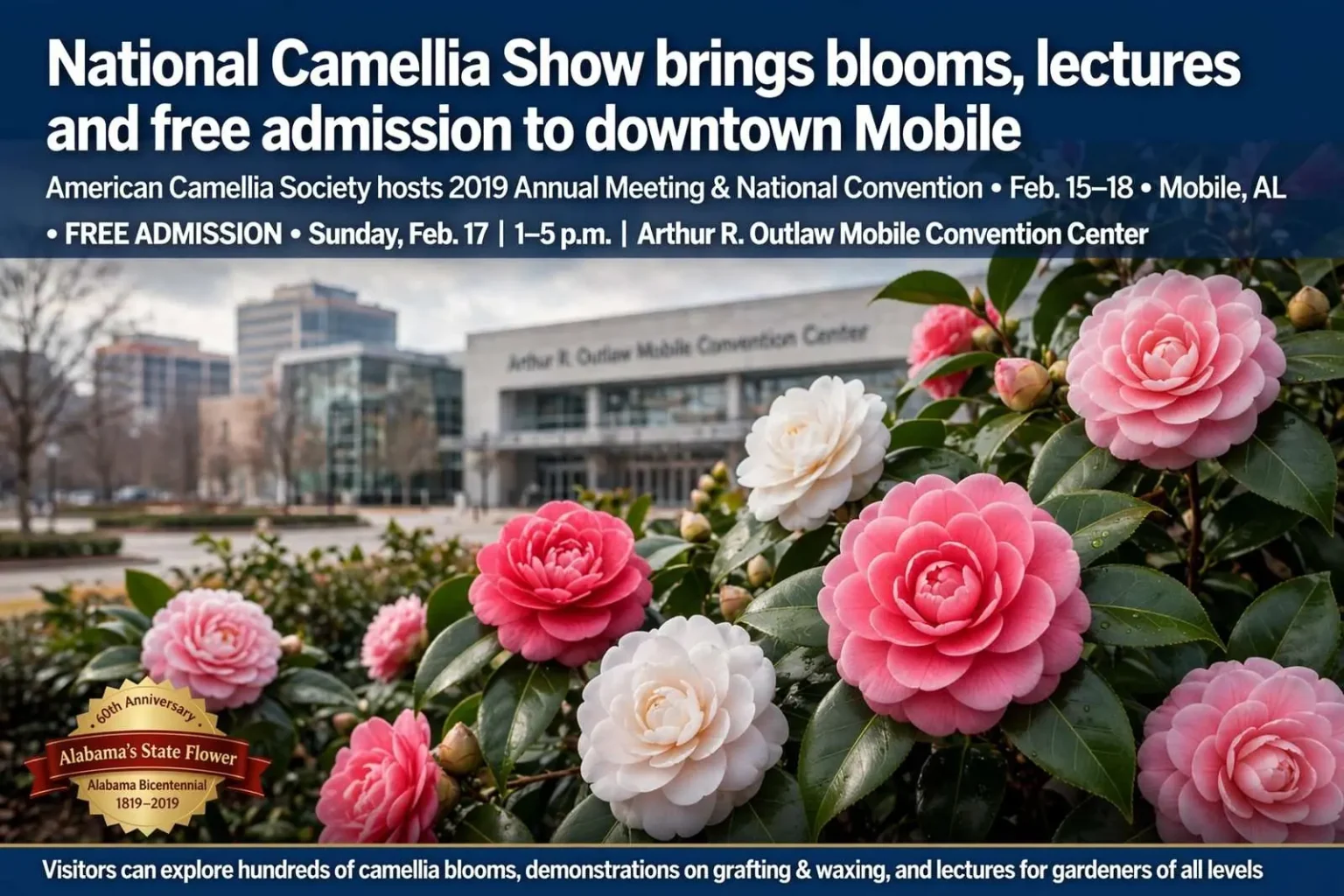
Mobile will roll out the welcome mat for flower lovers from across the country later this month when the American Camellia Society brings its 2019 Annual Meeting and National Convention to the Port City over the weekend of Feb. 15-18. For three days, downtown Mobile will be the center of the camellia world, as growers, hybridizers and garden club members from across the country gather for tours, meetings and one of the largest public flower shows of the season.
The timing is no accident. The gathering coincides with two milestones for the state: the 60th anniversary of the camellia’s official designation as Alabama’s state flower and Alabama’s bicentennial celebration. Statehood, the flower and the society’s convention all converge on the same February weekend, giving the event a significance beyond the blooms themselves.
A public show at the convention center
The highlight for the general public comes Sunday, Feb. 17, when the ACS Camellia Show takes over the Arthur R. Outlaw Mobile Convention Center downtown from 1 to 5 p.m. Admission is free. Visitors can expect displays of hundreds of blooms in every color and form the genus offers, from the formal doubles and anemone-form flowers that win blue ribbons to the species varieties that started it all.
Alongside the show tables, visitors can catch demonstrations and lectures on caring for camellias, along with how-tos on flower waxing and grafting — techniques Gulf Coast gardeners have long used to show off and preserve their best blooms. Waxing a camellia seals the bloom in a thin coat of melted paraffin, preserving it for days beyond what a cut flower would normally last, a trick that lets growers transport prized blooms to shows across the region. Grafting, meanwhile, is how new varieties are propagated and how a single plant can carry multiple cultivars on one rootstock.
Organizers from the Alabama Camellia Society, including Dr. Brenda Litchfield, have been spreading the word about the event across the region, urging gardeners and curious newcomers alike to come see what a well-grown camellia looks like at the height of the season.
The camellia’s deep roots in Mobile
The camellia has deep roots in Mobile, where mild winters let the evergreen shrub thrive in yards and public gardens. The city’s oldest gardens hold camellia plants more than a century old, descendants of the varieties that made the Gulf Coast a center of American camellia culture in the 19th and 20th centuries. Mobile’s climate — long summers, mild winters and acidic soil — suits the plant so well that camellias here bloom from autumn into early spring, when most of the country has nothing flowering outdoors at all.
That season is precisely the point of a February convention. While camellia growers in colder states keep their plants in greenhouses, Mobile’s blooms are at their peak outdoors, which is why the American Camellia Society has long brought its national meetings to Gulf Coast cities in winter. The convention gives northern members a chance to see open-grown camellias at full flower, and it gives local growers a chance to show off gardens that would be the envy of any visitor from a hardiness zone further north.
The legislature replaced the goldenrod with the camellia as the state flower in 1959, after decades in which the goldenrod’s designation had been contested by those who considered the wildflower a nuisance weed rather than an emblem. The camellia’s selection was a nod to the flower’s economic and cultural presence in south Alabama, where nurseries propagated and shipped camellias nationwide and garden clubs built their calendars around winter bloom shows.
Sixty years as the state flower
The 60th anniversary being marked this year gives the convention an extra layer for Alabama gardeners. In 1959, the legislature’s choice made the camellia one of the younger state flowers in the South at the time, but one rooted in a genuinely local tradition. Camellia shows had been fixtures of Mobile winters for generations, drawing exhibitors from across the Gulf Coast to compete for the best blooms of the season, and the designation put the state’s seal on a flower that had already become part of the region’s identity.
Since then, the camellia has remained a signature plant of Alabama gardens from the coast north through the Wiregrass and into the southern Piedmont. Gardeners prize the shrub for its glossy evergreen foliage, its willingness to grow in shade where few flowering plants thrive, and the sheer length of its bloom season. Modern varieties extend that season across the whole calendar of cool months, with early sasanquas opening in October and japonicas carrying the display into April.
The bicentennial backdrop
The convention’s collision with Alabama’s bicentennial added a celebratory cast to the weekend. Alabama marked 200 years since statehood in December 2018, and communities across the state spent the following year celebrating with festivals, historical programs and garden events. For the American Camellia Society’s members, the bicentennial made Mobile a fitting host: a city whose gardens and civic plantings have showcased the state flower for as long as the flower has been the state’s emblem.
Local organizers leaned into that history, tying the convention’s tours and programs to gardens and landmarks that tell the story of camellia culture in the region. Visitors to the Sunday show at the convention center will see the results of that tradition on the show tables, where Alabama growers compete alongside exhibitors from across the Southeast.
Southwest Alabama’s garden club tradition
Southwest Alabama garden clubs remain among the most active in the national organization, a distinction built on decades of shows, plant sales and civic plantings. Garden clubs in Mobile and Baldwin County have long anchored the camellia season, staging winter shows, maintaining public gardens and passing along the grafting and waxing techniques that were once guarded secrets of serious growers. Membership in the national society gives those local clubs a larger stage, and conventions like this one are where the two levels meet.
The educational side of the convention is where that knowledge transfers. Lectures at the convention center cover the fundamentals — planting, fertilizing, pruning and pest control — along with more advanced topics such as hybridizing, the patient art of crossing varieties to create blooms that have never existed before. New camellias can take years to reach flowering size after a hybridizer’s first cross, which is why the naming of a new variety at a national convention is a small event in its own right.
What visitors can expect Sunday
For the general public, the Sunday show is the accessible heart of the weekend. There is no admission charge, and the format welcomes browsers as much as experts. Judges score blooms by form, color, size and condition, and the winning table — the court of honor — assembles the finest flowers of the show in one display. Labels identify each variety, so gardeners who find something they like can note the name and look for it at local nurseries.
The demonstrations add a hands-on element. Watching a grower wax a bloom or graft a scion onto rootstock demystifies techniques that look arcane from the outside, and members of the Alabama Camellia Society will be on hand to answer the questions every new camellia grower eventually asks: why the buds dropped, when to prune, and what to do about tea scale.
More information about the convention and the Sunday show is available through the American Camellia Society. For Mobile, the weekend is a reminder of a horticultural inheritance the city has carried for nearly two centuries — a flower that became the state’s emblem, a season of blooms that arrives when the rest of the country is frozen, and a community of growers still doing what Gulf Coast gardeners have always done: showing off the best of the crop in February.
The economic footprint of the plant is easy to overlook. South Alabama nurseries built a national trade on camellias, shipping rooted cuttings and grafted plants to gardeners in states where the shrub could only survive with winter protection. That trade helped establish the Gulf Coast’s nursery industry more broadly, an agricultural sector that remains a significant part of the region’s economy today. The flower shows that fed the trade’s growth were, in a sense, its storefront — places where a gardener from Tennessee or Georgia could see a variety in full bloom and order one for the trip home.
Weather, as always on the Gulf Coast, will have a say in how the weekend’s blooms look. A late January freeze can nip early japonica blooms, turning flower edges brown and costing exhibitors their best entries, while a mild stretch can push fields of buds open at once. Growers heading into show season watch forecasts the way farmers do, covering prized plants with cloth on freezing nights and noting which varieties shrug off the cold. The blooms that make it to the show table in February have survived a season of that judgment, which is part of what the judges are rewarding when they score a flower’s condition.