Construction Bids Go Out for $600,000 Africatown Heritage House Museum
Construction bids have gone out for the $600,000 Africatown Heritage House, a museum building near Mobile's Clotilda discovery site, with History Museum of Mobile Director Meg Fowler detailing plans for its exhibit on the ship, its captives and the community they founded.
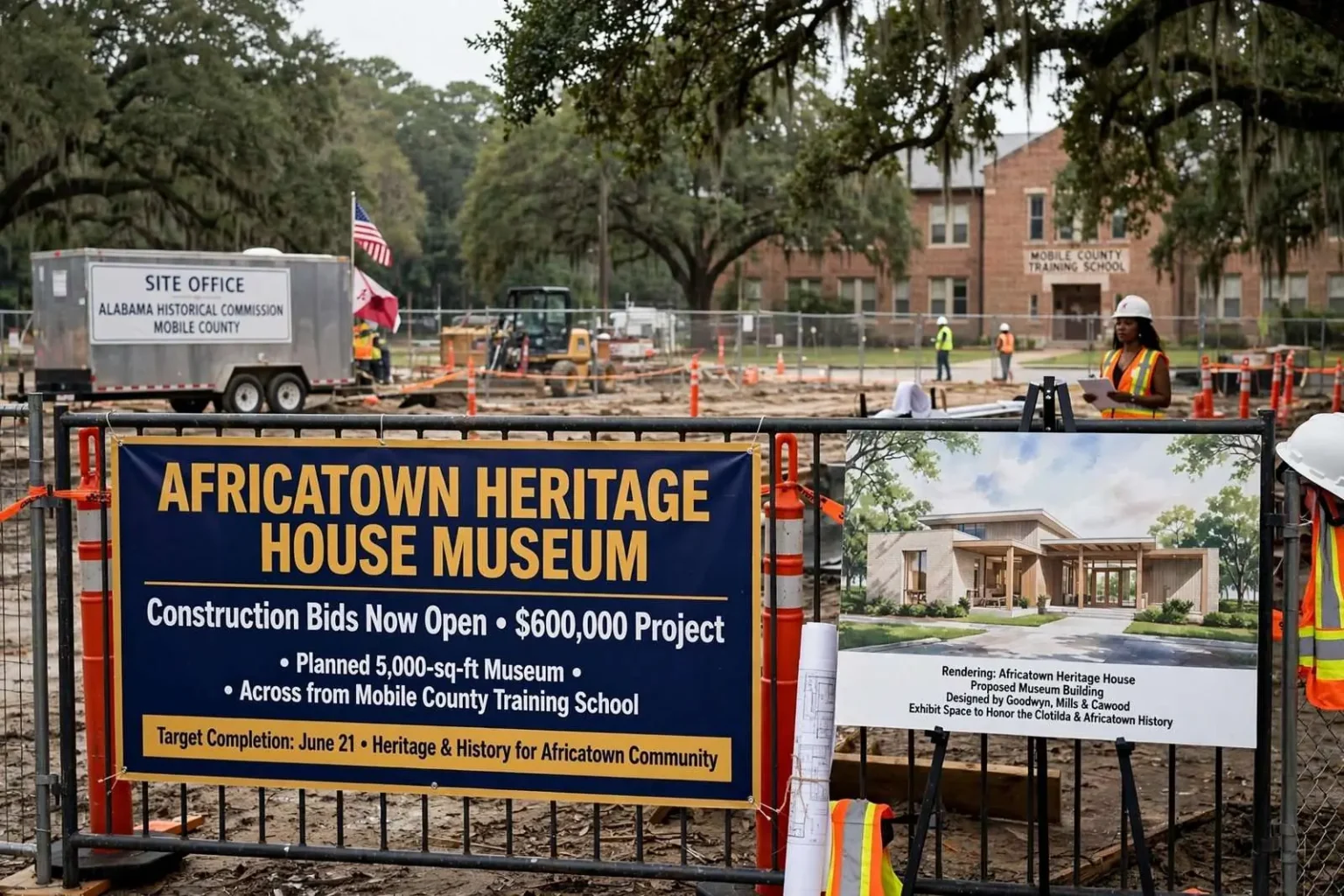
Construction bids went out this week for the Africatown Heritage House, a planned 5,000-square-foot museum building across from Mobile County Training School that will house a permanent exhibit on the history of Africatown and the slave ship Clotilda. The $600,000 project has a targeted completion date of June 21, with organizers hoping to open the exhibit to the public soon after.
The building is the latest tangible outcome of the 2019 discovery of the wreckage of the Clotilda in the Mobile-Tensaw Delta. The schooner illegally carried more than 100 captive Africans into Mobile Bay in 1860, decades after the international slave trade had been outlawed in the United States. Those kidnapped men and women later founded a tight-knit, self-reliant community just north of downtown Mobile that came to be known as Africatown.
The Heritage House is a joint effort of the Alabama Historical Commission, Mobile County and the city of Mobile, but organizers say the project’s direction is being shaped first and foremost by the people with the deepest personal connection to the story.
“Anything we do has to be very community and descendant-engaged, so we’re working very closely with an advisory committee and the Africatown Advisory Council of leaders within the community,” said Meg Fowler, director of the History Museum of Mobile.
Designing the Exhibit Space
The History Museum of Mobile is overseeing the layout of the exhibit inside the new building and is coordinating with Visit Mobile on a marketing campaign to draw visitors once it opens. Working from a floor plan prepared by the architecture and planning firm Goodwyn, Mills and Cawood, museum staff have had to figure out how to tell a sprawling, generations-spanning story within roughly 2,500 square feet of gallery space, a task Fowler described as challenging.
“At the end of the day, this is a story about people, not about a ship,” Fowler said. “The greater square footage is devoted to a remarkable story of resilience, persistence and the establishment of this remarkable community.”
Once the building itself is finished, the museum expects to need another eight to ten weeks to physically install the exhibit. That work is already well underway on paper, according to Fowler.
“We are already writing text panels, so we’re that far along,” she said.
Fowler walked through what she called a “rich, multi-sensory space” that will lean on audio recordings and layered visuals to carry visitors through the story. The exhibit is designed to open with a look at how Mobile’s export-driven economy created a local market for slavery, along with a broader examination of how enslaved life differed between rural plantations and the city itself.
“We get a surprising number of Americans and international visitors who really know very little of slavery history,” Fowler said.
The Story Inside the Exhibit
From there, the exhibit moves into African culture and daily life prior to captivity, emphasizing individual stories and biographies wherever historical records allow. Particular attention is paid to the Kingdom of Dahomey, in what is now the West African nation of Benin, where many of the Clotilda’s captives originated.
The ship’s final voyage across the Atlantic is covered in what Fowler described as a “dark and somber” gallery space with dramatic, deliberately unsettling lighting.
“You imagine the creaking of the ships and the smell of wood and linseed oil on the wood,” Fowler said. “It is probably the most moving portion, talking about what the Middle Passage experience is like, with primary sources as much as possible.”
Visitors will then reach a memorial wall meant to personalize the more than 100 people who survived the crossing aboard the Clotilda. Guests will be able to sit and listen to recordings of local community members reciting the names of the captives, including simply “unknown” for those whose identities were never recorded.
The exhibit also covers the legal case brought against Timothy Meaher, the Mobile businessman who financed the Clotilda’s illegal voyage, and the case’s ultimate failure to result in a conviction. Despite that injustice, the exhibit notes, the people he enslaved went on to build a community of their own even as many continued to long for the home they had been torn from.
Displaying the Clotilda’s Wreckage
Further along, visitors will see actual salvaged portions of the Clotilda’s wreckage, on loan from the Alabama Historical Commission. Displaying the fragile timbers requires special engineering, since exposure to air can cause the wood to disintegrate rapidly after more than a century and a half underwater.
“These artifacts will actually be underwater because if they are exposed to air, they will very quickly disintegrate,” Fowler said. “We have designed a tank system and will have to change the water and monitor its salinity and other things.”
The exhibit will also explain the underwater archaeology work that went into locating, documenting and ultimately verifying the wreck site, with organizers hoping the added public understanding will help discourage looting or disturbance of the actual site in the Mobile-Tensaw Delta.
“From that dark and dramatically lit part of the exhibit, you emerge into the final room that is bright and hope-filled that talks about Africatown today,” Fowler said.
How the Exhibit Will Evolve
Museum officials expect some portions of the exhibit to rotate or change roughly every six months, though most of the core narrative will remain in place. Visitor feedback collected after opening will help guide which sections evolve over time.
Mobile City Council members have also begun preparing new interstate signage to direct visitors to the site once it opens. City leaders have repeatedly pointed to the Equal Justice Initiative’s Legacy Museum and National Memorial for Peace and Justice in Montgomery, which has drawn hundreds of thousands of visitors from around the world since opening, as a model for what the Heritage House could become. Fowler said her team consulted with the Montgomery institution while planning the Mobile exhibit.
“Broader community participation is one thing EJI has done so well,” Fowler said. “We have to be prepared to kind of meet people where they are after a very emotional experience.”
The Africatown Heritage House sits near the Clotilda landing site and is expected to become a central stop for visitors seeking to learn about the community’s founding and its ongoing efforts at preservation and revitalization.
Why the Heritage House Matters to Mobile
For Mobile, the Heritage House represents a long-overdue public acknowledgment of the city’s role in the illegal slave trade and the resilience of the community that grew from it. The Clotilda was the last known slave ship to bring captive Africans to the United States, and the fact that Africatown’s founders preserved their identity, language and cultural practices for more than a century and a half after the Civil War is a story that has drawn increasing national and international attention since the ship’s wreck was identified in 2019.
Local organizers hope the museum will anchor a broader heritage tourism effort that brings visitors to Mobile, including to the site of the Clotilda landing and to the existing markers and structures throughout the Africatown community. The intersection of history, genealogy and place makes the area uniquely positioned among the country’s many African-diaspora heritage sites, and the museum’s June 21 completion target is meant to position the project for a full summer tourism season once the doors open.
The Clotilda’s Discovery and Its Aftermath
The 2019 identification of the Clotilda’s wreck in the Mobile-Tensaw Delta changed the public conversation about the slave trade in the United States. Researchers had long known that the schooner had made the illegal voyage in 1860, decades after the international slave trade had been outlawed, but the lack of physical evidence had allowed the ship’s story to drift toward folklore. The confirmed discovery of the wreck site, accomplished through a combination of historical records, oral histories collected from Africatown descendants and underwater archaeology, transformed that story into one of the most thoroughly documented last-act slave voyages in American history.
The discovery also created an obligation to share what had been learned. The Alabama Historical Commission, the History Museum of Mobile, the city of Mobile and Mobile County have all played roles in turning the research into a public-facing heritage site, and the Africatown Heritage House is the most ambitious of those efforts to date. The advisory structure that Fowler described — an advisory committee and the Africatown Advisory Council of community leaders — is meant to ensure that the descendants of the Clotilda’s captives remain central to decisions about how their ancestors’ story is told.
What Visitors Will Experience
Tourists who visit the Heritage House when it opens will move through galleries designed to evoke the arc of the Clotilda story, from the West African origins of many of the captives, through the Middle Passage and into the founding of Africatown. The exhibit’s deliberately dark lighting in the Middle Passage gallery, paired with audio recordings and primary sources, is meant to give visitors a sense of what the experience was like for those who endured it, while the memorial wall that follows personalizes the more than 100 captives who survived the crossing.
Beyond the emotional core of the exhibit, the museum also addresses the legal aftermath of the voyage, including the failure of the case against Timothy Meaher, the Mobile businessman who financed the illegal trip. The exhibit then moves into the founding and persistence of Africatown itself, and ends in a brighter gallery that focuses on the community today and the ongoing work of preservation and revitalization. The combination of historical depth, descendant engagement and contemporary relevance is what organizers hope will make the Heritage House a destination rather than a one-time stop for visitors to Mobile.