Bodycam Video Released in Pensacola Officer-Involved Shooting; No Charges for Officer
The State Attorney released bodycam video of a September Pensacola police shooting and will not charge Officer Caleb Henderson.
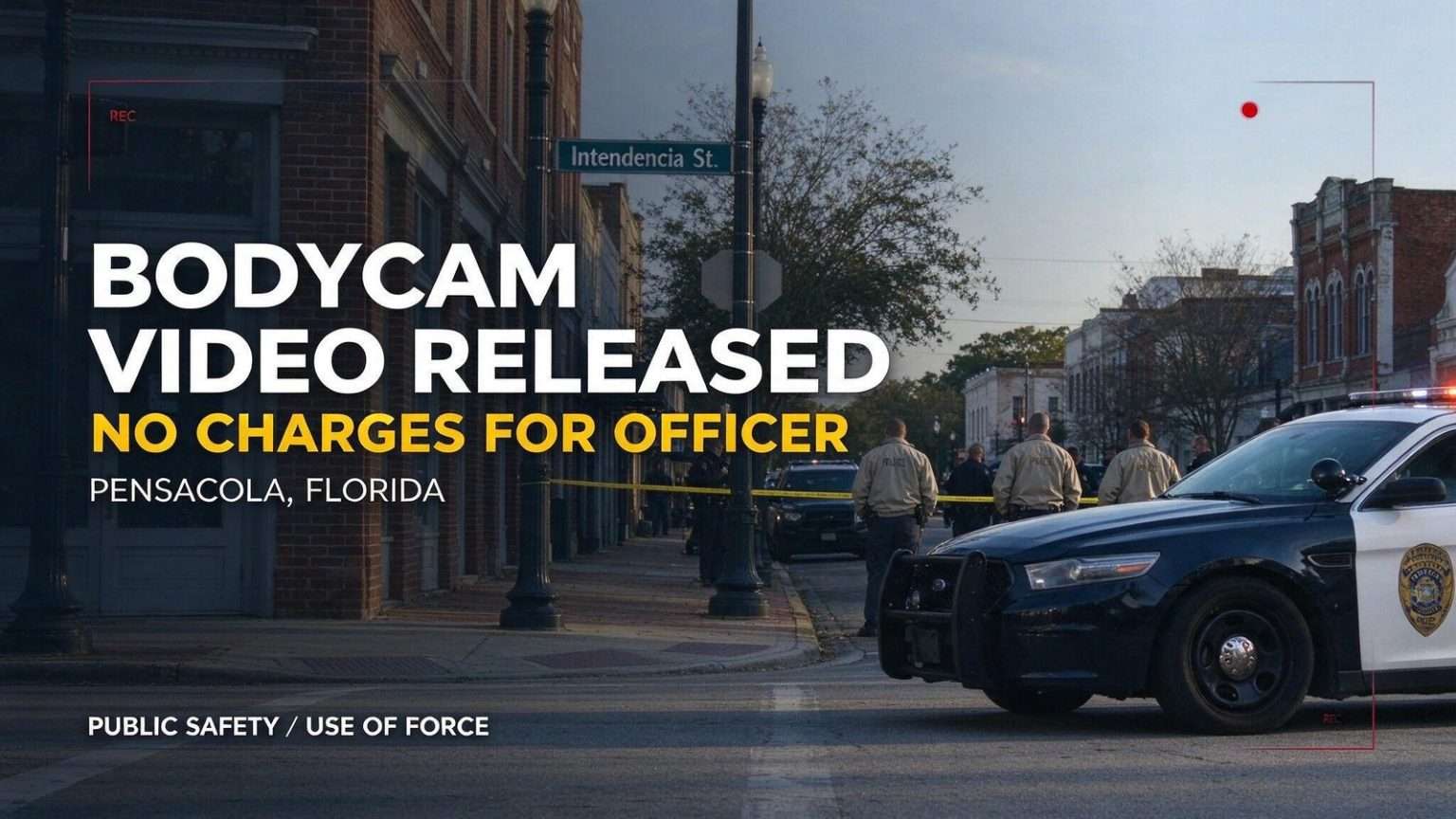
PENSACOLA, Fla. — The State Attorney’s Office released body camera footage of a September police shooting in downtown Pensacola and determined that no criminal charges would be filed against Pensacola Police Officer Caleb Henderson, closing the review of a daylight encounter that left one man wounded and facing serious charges of his own.
The video captured the September 18 encounter near 907 Intendencia Street, where Henderson pulled up to two men fighting on the side of the street just after 4 p.m. The footage shows the officer stepping out of his vehicle and repeatedly yelling “drop it” before firing.
The gun involved is difficult to see clearly in the video, according to reviewers of the footage — a limitation that shaped public discussion of the case even as investigators weighed the officer’s account of what he saw and believed in the seconds before he pulled the trigger.
Henderson shot Ke’Vontarius Wilson twice; Wilson survived after treatment at a local hospital. The officer told investigators that Wilson had the gun and that he believed Wilson was about to shoot the other man or someone else nearby — an account the State Attorney’s Office ultimately found supported by the evidence gathered in the review.
How the review unfolded
Officer-involved shootings in Florida follow a well-defined path after the ambulances leave. Detectives document the scene, collect physical evidence, canvass for witnesses, and process any weapons involved. The findings go to the State Attorney for the judicial circuit, who reviews whether the use of force was legally justified under Florida law — a review that weighs both what actually happened and what a reasonable officer in the same position would have perceived.
The release of the body camera footage alongside the charging decision reflected the growing practice of transparency in use-of-force cases, letting the public see the encounter for themselves even where the video cannot answer every question. In this case, reviewers acknowledged the footage’s central ambiguity: the gun that anchored the officer’s account is hard to make out in the recording.
That gap between what the camera shows and what the officer says he perceived is a recurring feature of bodycam evidence. Cameras capture a fraction of what an officer experiences — no peripheral vision, no tactile sense of a struggle, and often no clear image of a weapon moving fast in afternoon light. Prosecutors reviewing such cases weigh the video against witness statements, physical evidence, and the officer’s interview before reaching a conclusion.
What the video shows
The footage begins with Henderson’s arrival at the fight near 907 Intendencia Street, a block in downtown Pensacola’s historic core. Just after 4 p.m. on a September afternoon, the area would ordinarily carry steady pedestrian and vehicle traffic, and the encounter unfolded in plain view rather than in a dark or secluded place.
According to the released footage, the officer stepped out of his vehicle and repeatedly yelled “drop it” before firing — commands aimed at someone he believed was armed. The interval between arrival and shots was measured in seconds, the compressed timeframe that characterizes most officer-involved shootings and that makes after-the-fact judgment so contested.
Reviewers noted that the gun is difficult to see clearly in the video. Wilson survived the two gunshot wounds after treatment at a local hospital, giving investigators the rare advantage in shooting cases of a living subject who could be interviewed and charged.
The case against Wilson
While the State Attorney declined to charge the officer, prosecutors moved forward against Wilson, who faces counts of attempted first-degree premeditated murder with a firearm, aggravated battery while in possession of a firearm, and possession of a firearm by a convicted felon.
The charging package tells the prosecution’s theory of the encounter in three parts. The attempted first-degree premeditated murder count alleges Wilson intended to kill and took steps toward that end — the most serious charge on the list, carrying a potential sentence of life in prison if convicted. The aggravated battery charge addresses the harm or threatened harm to the other man in the fight, with the firearm allegation enhancing the offense. And the possession count rests on Wilson’s status as a convicted felon, which barred him from having a gun at all under Florida law.
Prosecutors pursuing all three counts signals that the State Attorney’s Office accepted the officer’s account of the encounter — that Wilson held the gun and posed an imminent threat to the other man or bystanders nearby. The felon-in-possession charge also means the case does not live or die on disputed perceptions of the fight itself; unlawful possession of the weapon stands on its own.
The legal standard for the officer
The decision not to charge Henderson turned on Florida’s framework for justifiable use of force by law enforcement. An officer is legally permitted to use deadly force when he reasonably believes it necessary to prevent death or great bodily harm to himself or others — a standard that asks not whether the threat was real in hindsight, but whether a reasonable officer could have believed it in the moment.
That distinction matters in cases like this one, where the video cannot clearly resolve whether the gun was visible. The review weighs the officer’s statements, his commands — the repeated “drop it” captured on the recording — the position and behavior of the people involved, and any corroborating physical evidence. A belief that a shooting was imminent, held honestly and reasonably, justifies the force even if events later prove the perception incomplete.
The State Attorney’s decision closes the criminal question for the officer, though civil litigation and internal departmental review remain separate tracks that use different standards and procedures. Administrative review of the shooting by the Pensacola Police Department examines tactics and policy compliance independent of criminal culpability.
Bodycam’s growing role on the Gulf Coast
The release added to the growing public record of body camera evidence along the Gulf Coast, where departments in Pensacola, Mobile, and across the Panhandle have equipped officers with recorders in the years since high-profile shootings nationwide made the footage central to public accountability.
Body cameras serve dual purposes: they document officer conduct and they capture evidence — commands given, timing, behavior — that resolves disputes when the recording is clear, and fuels debate when it is not. Departments’ release policies vary, but the trend has been toward publishing footage in significant cases, often alongside the prosecutorial decision, to give the community the fullest picture available.
Downtown Pensacola’s blocks
The encounter took place near 907 Intendencia Street, a block in the grid of downtown Pensacola where government buildings, businesses, and historic neighborhoods converge a short walk from Palafox Street’s restaurant row. Intendencia runs through the heart of the city’s core, and an afternoon fight on its sidewalk drew an immediate police response in a district that patrols closely.
Quick police arrival is part of the design of downtown public safety — concentrated patrols that can reach incidents within minutes. The September 18 call put Henderson at the scene while the fight was still underway, the timing that defined everything that followed.
The case underscores how quickly routine downtown incidents can escalate. A fight between two men is a common call for service; the presence of a gun transformed it into a deadly-force encounter measured in seconds, with a charged felony case, a prosecutorial review, and a released video as the aftermath.
What happens next
With the officer cleared, the case shifts to the prosecution of Wilson on the three felony counts. The proceedings will test the evidence in open court: the body camera footage, witness accounts of the fight, the weapon itself and its forensics, and the testimony of investigators who pieced together the September 18 afternoon.
Wilson’s defense will have its opportunity to challenge the state’s account, and the survivability of the charges — particularly the attempted murder count — will depend on proof of intent and on how jurors weigh the same ambiguities the State Attorney’s reviewers grappled with. The felon-in-possession charge, anchored in Wilson’s criminal history and the weapon’s recovery, presents a narrower evidentiary target.
For the Pensacola Police Department, the released footage and the cleared review close one chapter while reinforcing the practices — body cameras, rapid response, transparent prosecutorial review — that have come to define use-of-force accountability in Florida’s First Judicial Circuit.
A community weighs the video
The publication of the video gave Pensacola residents the chance to see the encounter for themselves, a transparency step that has become the community’s expectation in shooting cases. Viewers could watch the officer’s arrival, hear the commands, and form their own judgments — while wrestling with the same limitation reviewers flagged: the weapon at the center of the case is difficult to see clearly in the footage.
Community reaction to released shooting footage typically splits along the lines the evidence allows, and advocates on all sides use the video in the debate over policing, use of force, and the standards that govern split-second decisions. The State Attorney’s narrative — the fight, the gun, the belief that lives were in danger — now stands as the official account, tested ultimately in the prosecution of the man the officer shot.
What remains is the court process, where the September 18 encounter near Intendencia Street will be examined again — this time before a jury, with both sides fully heard, and with the released bodycam footage as the record around which the case will turn.