Taking Property Without Charges
Two local cases are drawing fresh attention to a legal practice that lets Alabama law enforcement agencies take cash, cars and other property from people who have never been charged with a crime. The cases, one involving a Georgia motorist stopped on Interstate 10 in Mobile County and the other a Mobile father whose car was seized by Prichard police, illustrate how civil asset forfeiture operates in Alabama and why critics across the political spectrum have called for the state’s laws to be overhauled.
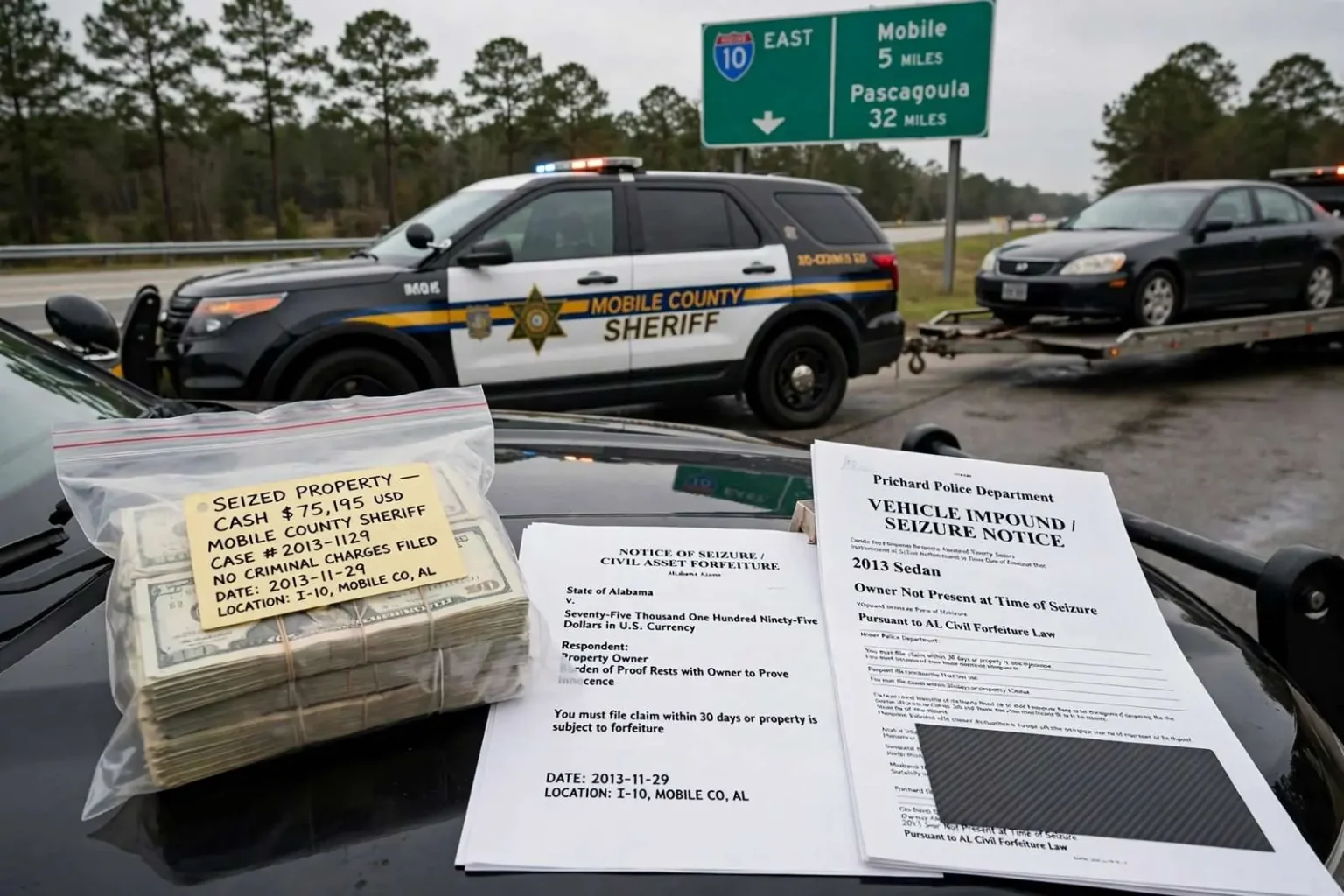
In one case, Mobile County sheriff’s deputies pulled over a Georgia man driving 10 mph over the speed limit on Interstate 10 back in 2013. During the stop, deputies seized more than $75,000 the driver said he intended to use to buy a Chinese restaurant in Louisiana. He was not arrested, not charged with any offense tied to the money, and not accused of any crime in connection with the stop. The cash, however, remained in the custody of law enforcement, and recovering it would consume the better part of a year of his life.
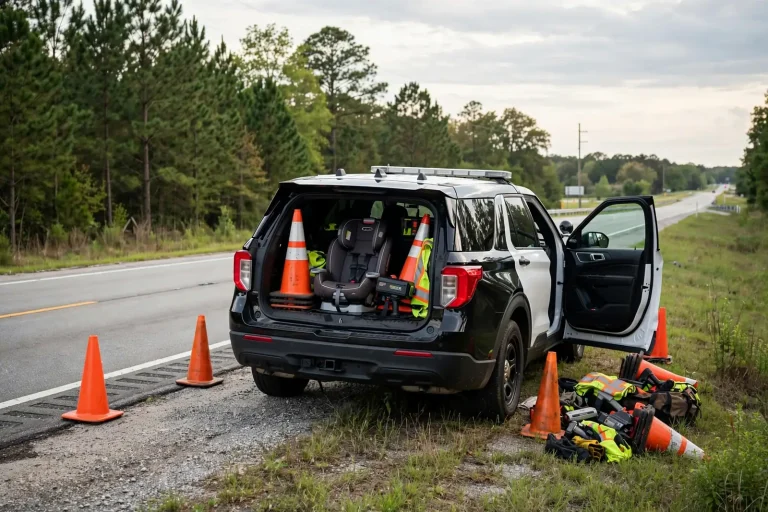
In a separate case last year, a Mobile man’s car ended up in a high-speed chase while his daughter’s boyfriend was behind the wheel. Prichard police seized the vehicle afterward. The owner of the car was not present during the chase and was never accused of criminal wrongdoing tied to the seized property. He faced the loss of a vehicle he needed for daily life simply because of what someone else allegedly did with it behind the wheel.
Under Alabama’s civil asset forfeiture laws, authorities can take control of money, vehicles and even houses without filing criminal charges against the owner. The practice differs fundamentally from criminal forfeiture, which can only follow a criminal conviction and requires the government to prove that the property in question was connected to that crime. Civil forfeiture, by contrast, treats the property itself as the defendant in the case, a legal fiction with roots in old English admiralty law that allows a proceeding to carry names such as State of Alabama v. one 2013 sedan. Because the case is technically against the object and not the person, the owner can be entirely innocent in the ordinary sense and still lose the property.
Critics argue that the practice has drifted far from its original purpose. Civil forfeiture expanded nationally during the war on drugs in the 1980s, when lawmakers reasoned that stripping trafficking organizations of their profits would do more damage to criminal enterprises than arresting individual couriers. Defenders of the laws maintain that forfeiture remains a legitimate tool for dismantling drug operations and that the overwhelming majority of seizures target genuine contraband. Reformers respond that the Alabama cases show how easily the same tool can be applied to ordinary citizens with no connection to any criminal organization.
The stakes extend beyond the individuals named in these cases. Interstate 10 carries commercial and private traffic through Mobile County by the tens of thousands of vehicles each day, and motorists traveling it with cash, whether for a business purchase, a home deposit, or savings being moved between banks, can find their property treated as suspect simply because it is present during a traffic stop. Once cash is seized, banks cannot vouch for it and receipts rarely satisfy prosecutors, so owners must build their case from tax records, withdrawal slips, and testimony.
A One-Sided Process
Darpana Sheth, an attorney with the Institute for Justice, spoke to a Mobile chapter of a national lawyers’ group this past week, telling the group the practice is rife with abuse and creates a troubling incentive structure for police departments, which are often permitted to keep seized property for their own agencies’ use. The Institute for Justice, a public interest law firm based in Arlington, Virginia, has litigated forfeiture cases around the country and published national studies examining how each state’s laws balance the interests of law enforcement against those of property owners. Sheth’s visit brought that national perspective to Mobile lawyers who encounter forfeiture cases in their own practices.
The local attorney who represented the Mobile man in the Prichard vehicle case took the case for free after his law office was mistakenly listed as the address for the prosecutor handling it. He said he was skeptical of his client’s account at first, but the more he examined the case, the more he realized just how one-sided the process was: police only had to clear a low bar to argue the vehicle had been used in a crime, after which the burden shifted to the car’s owner to prove he had no knowledge of any wrongdoing.
That burden structure is what separates civil forfeiture from nearly every other area of American law. In a typical criminal case, the government must prove guilt beyond a reasonable doubt and the accused is presumed innocent. In an Alabama civil forfeiture case, the government’s initial showing is minimal, and once it is met, the owner must affirmatively demonstrate his own innocence of any connection to the alleged offense, a burden that can be difficult to meet even for people with clean records and clear consciences.
The case eventually made its way through Mobile County Circuit Court, and police allowed the man to keep driving the car to his shipyard job in Pascagoula while it was pending. That arrangement spared him the loss of his livelihood, but it was a courtesy extended during litigation rather than a protection built into the law, and in many comparable cases owners lose the use of their vehicles from the moment of seizure. Still, resolving it took weeks and would have cost thousands of dollars in legal fees had the attorney not represented him without charge.
The Georgia man in the interstate stop fared worse, spending ten months and thousands of dollars in legal fees fighting to recover his $75,195, missing his opportunity to buy the restaurant in the process. The money he eventually recovered came too late for the business he had planned, and his legal costs consumed a substantial share of the funds he was trying to save. For property owners without means or without a lawyer willing to work for free, the arithmetic of fighting a forfeiture often makes surrender the only rational choice, which is precisely the incentive structure reformers want to eliminate.
Where Alabama Stands
According to an Institute for Justice analysis, Alabama ranks near the bottom nationally in forfeiture-law protections for property owners. The state’s burden of proof for authorities is the lowest allowed under the law, and in most cases it falls to the owner to prove innocence, except when the seized property is a house. The analysis compares states on criteria including the standard of proof required of the government, who bears the burden of proving innocence, whether owners are entitled to legal representation, and what safeguards exist before property is permanently forfeited.
Police departments that carry out the seizures keep 100 percent of the proceeds, with no requirement that they publicly account for how the money is spent. The direct flow of forfeiture revenue into the seizing agency’s own budget is the feature critics single out most often, since it rewards departments financially for the number and size of seizures they make. Under federal equitable sharing arrangements, agencies can also partner with federal prosecutors on cases and receive a share of federal forfeiture proceeds, an avenue that has drawn its own scrutiny from auditors and members of Congress over the years.
Supporters of the current system argue that forfeiture proceeds fund legitimate law enforcement needs, from equipment and training to drug treatment and victim services, and that the legal process provides adequate review through the courts. Judges presiding over forfeiture cases can and do dismiss weak claims, they note, and agencies must document probable cause for each seizure. Reformers counter that review comes only after the owner has been put to the trouble and expense of contesting the case, and that few owners are in a position to make that fight.
Reform advocates are pushing for changes including placing seized assets in a neutral fund rather than police department coffers, raising the state’s burden of proof, strengthening legal protections for innocent property owners, guaranteeing prompt court hearings, and requiring law enforcement to publicly report what they seize and how proceeds are used. Several states have already adopted versions of these reforms, shifting proceeds to general funds or education budgets, raising the government’s standard of proof, and in a few cases requiring a criminal conviction before property can be forfeited.
Similar proposals have surfaced in the Alabama Legislature in recent years, though none has yet transformed the state’s framework, leaving Alabama among the states with the fewest protections for property owners. In the meantime, cases like the Georgia man’s seized restaurant fund and the Mobile father’s contested vehicle continue to move through the local courts, and the lawyers who handle them say the two cases capture both the financial stakes and the human cost of a system in which the burden of proof rests on the person who has lost the property rather than the government that took it.