Mobile Defense Attorney’s Signature Closing Argument Wins Another Acquittal
Veteran Mobile attorney Dennis Knizley's trademark closing line helped win an acquittal for a Mobile County official in a federal corruption trial.
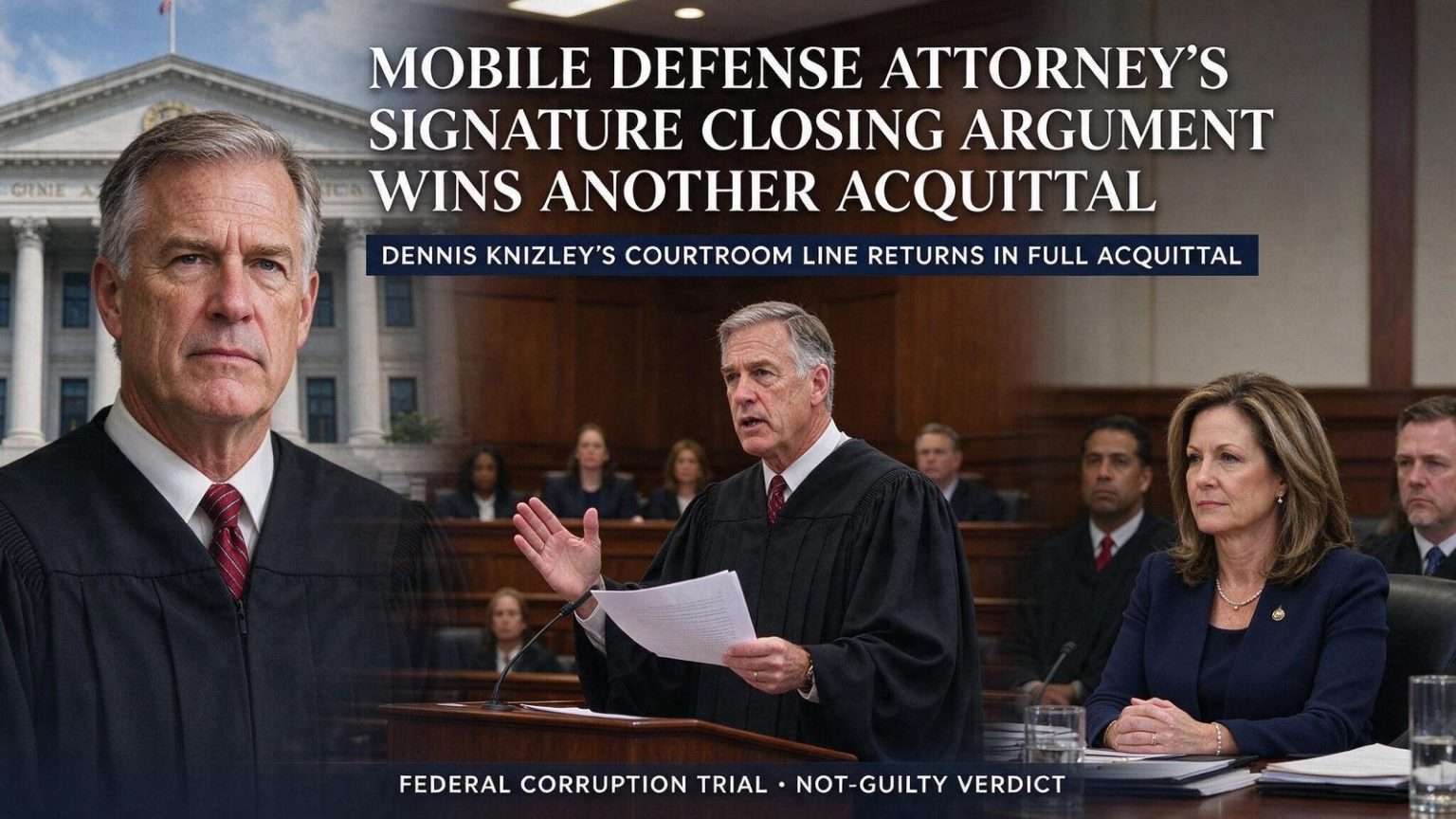
A familiar refrain from veteran Mobile defense attorney Dennis Knizley helped secure another not-guilty verdict, this time in the federal corruption trial of Mobile County Deputy License Commissioner Ramona Yeager. Jurors in U.S. District Court acquitted Yeager on nine corruption-related counts after a trial in which Knizley leaned on a closing-argument line he has used to notable effect throughout his three-decade career in Mobile and Baldwin County courtrooms.
“If they ask you to convict a wonderful, sweet woman like this, on the evidence of people like their key witness, we might as well burn the courthouse down because there is no justice,” Knizley told jurors.
The verdict marked another chapter in one of the more unusual traditions in Mobile’s legal community — a closing argument that has become, by the lawyer’s own acknowledgment, a signature. Few trial attorneys anywhere develop a line so closely associated with their name, and fewer still can point to verdict after verdict where the same words helped close the deal with a jury.
A line with a track record
It wasn’t the first time the phrase had worked in Knizley’s favor. He first used a version of the line in 1997, defending a client accused of attempted murder, and reprised it in 2001 during a murder trial in which he challenged a witness’s credibility. He used it again in his highest-profile case, the murder trial of former Mobile County Commissioner Stephen Nodine, which ended in a mixed verdict — a misdemeanor ethics conviction alongside a deadlocked jury on more serious charges.
“I actually had retired it with the Nodine case because of the notoriety,” Knizley said after the Yeager verdict. “But I brought it back with this case. I felt like this case deserved it, because this woman was so not guilty.”
The Nodine trial, one of the most heavily covered criminal proceedings in recent Mobile County history, made Knizley a familiar face to the public as well as the courthouse regulars. The case against the former county commissioner in the December 2009 shooting death of Angel Downs drew intense media attention along the Gulf Coast, and the mixed outcome — a conviction on the misdemeanor ethics count while the jury hung on the murder charge — kept Knizley’s name in headlines for months.
Why signature arguments work
Knizley’s willingness to reuse a proven closing line reflects a broader pattern among veteran Mobile trial lawyers, who often develop signature arguments that become associated with their courtroom style over the years. Repetition, veteran trial attorneys explain, is not laziness but craft: a line that has survived contact with multiple juries has proven something a fresh argument cannot — that it resonates with ordinary citizens asked to weigh another person’s liberty against the state’s evidence.
Prosecutors have their own recurring approaches as well, drawing on historical quotes or personal anecdotes to connect with jurors during closing arguments. District attorneys’ offices tend to pass rhetorical techniques from senior trial lawyers to newer ones, and experienced prosecutors likewise keep mental libraries of closings that have produced convictions. The result is a regional courtroom culture in which the final argument of a trial is often the most theatrical and personally crafted moment, delivered by lawyers who have spent decades refining what works in front of Mobile-area juries.
The Yeager case
The case that brought the line back ended with Yeager, a longtime figure in the Mobile County License Commissioner’s office, walking out of federal court acquitted on all nine corruption-related counts. Federal corruption trials are demanding defenses: prosecutors arrive with investigative files built over years, cooperating witnesses who have often accepted plea agreements in exchange for testimony, and documentary evidence juries find difficult to dismiss. Beating a nine-count indictment outright — rather than a partial acquittal — is an uncommon result in the federal system, where conviction rates exceed ninety percent nationwide.
Knizley’s closing aimed squarely at the credibility of the government’s key witness, the same target the line has served in every trial where he has used it. The argument’s logic is blunt: if the case depends on testimony the defense considers untrustworthy, convicting on it would itself be a failure of justice — a proposition he dramatizes with the courthouse-burning imagery that has become his trademark. Juries in four decades of cases have apparently found the framing persuasive often enough to keep the line in service.
Knizley’s line is unusual in another respect: it attacks the evidence rather than defending the client’s character directly. Many closings ask jurors to see the defendant sympathetically; the courthouse argument instead asks them to see the system itself, and to treat a verdict built on unreliable testimony as an insult to everyone in the room. That framing lets jurors acquit without feeling they have let a criminal go free — they have instead refused to be part of an injustice, which is a psychologically easier position to hold when the foreman reads the verdict.
Defense lawyers who study the craft say the most durable closings tend to share that quality: they give jurors a story about themselves, not just about the defendant. Knizley’s line tells twelve citizens that their decision defines the justice system they are temporarily part of. Delivered with the timing of a lawyer who has used it across four decades of cases, the effect has been remarkable consistent results in the trials where it appears.
The career behind the phrase
Knizley has spent his career in the criminal courts of Mobile and Baldwin counties, handling everything from capital murder defenses to white-collar and public corruption cases. He is part of a generation of Mobile defense lawyers — names long familiar from the courthouse and the local news — who built reputations in an era when the region’s most notorious trials were followed by the public the way big professional sports are followed elsewhere. His practice has spanned the full range of criminal defense work, and his courtroom style has been described by colleagues as equal parts preparation and performance.
Not all of Knizley’s clients have walked away acquitted — some have been convicted, and others, like Nodine, received split verdicts. But he said the line has proven effective across a range of cases because each new jury hears it fresh. The words that a courthouse veteran recognizes as a rerun arrive in the jury box as an original argument, and the reaction it produces has been consistent enough that Knizley has never been able to retire it for good — despite twice trying.
What it means for local criminal justice
The Yeager acquittal also registers in the practical world of Mobile County government, where the License Commissioner’s office processes the vehicle tags, titles and registrations that every driver in the county requires. A deputy commissioner’s federal corruption trial is not a routine criminal case; it touches an office that residents interact with directly, and the not-guilty verdict closes the matter without the office suffering the reputational damage a conviction would have brought.
For the defense bar, the verdict is a reminder of the enduring value of trial skill in an era when most criminal cases end in plea agreements. Jury trials — particularly federal jury trials ending in full acquittal — have become rare enough that each one draws attention from lawyers across the region, and Knizley’s result in the Yeager case will circulate among defense attorneys as evidence that a well-built closing can still turn a case that looks lost on paper.
A trademark that outlives the cases
Signature arguments are a small but telling feature of courthouse culture. In communities with long-established legal communities, the great closings get retold — in law offices, at bar meetings, in courthouse hallways — until the argument becomes part of local legal folklore. Knizley’s courthouse line has reached that status in Mobile, where even lawyers who have never used it can recite its premise: that convicting on untrustworthy testimony would dishonor the building the jury sits in.
The lawyer himself has been characteristically matter-of-fact about it. Having retired the line once and been drawn back by a case he felt deserved it, Knizley has left open the question of whether the phrase will appear again. Juries in Mobile and Baldwin counties, meanwhile, keep delivering the verdicts that keep the question alive — and as long as it does, the most famous closing argument on the Gulf Coast will remain exactly what its author made it: not a script, but a trademark.
For young lawyers watching from the gallery — and there are always young lawyers watching in Mobile when Knizley closes — the lesson being taught is about more than one memorable sentence. It is about knowing a jury well enough to know what it will respond to, being willing to repeat what works without embarrassment, and having the standing that three decades of courtroom work confers when the moment to deliver it arrives. The line will age out eventually, as all trademarks do. Its author’s record, and the acquittals attached to it, will not.