The Longest-Serving Referee: 24 Years at Mobile County Juvenile Court
With the retirement of Circuit Judge Ferrill D. McRae, Juvenile Court Referee Andrea Pennington became the most experienced presiding officer in any Mobile County courtroom, a distinction earned far from the spotlight.
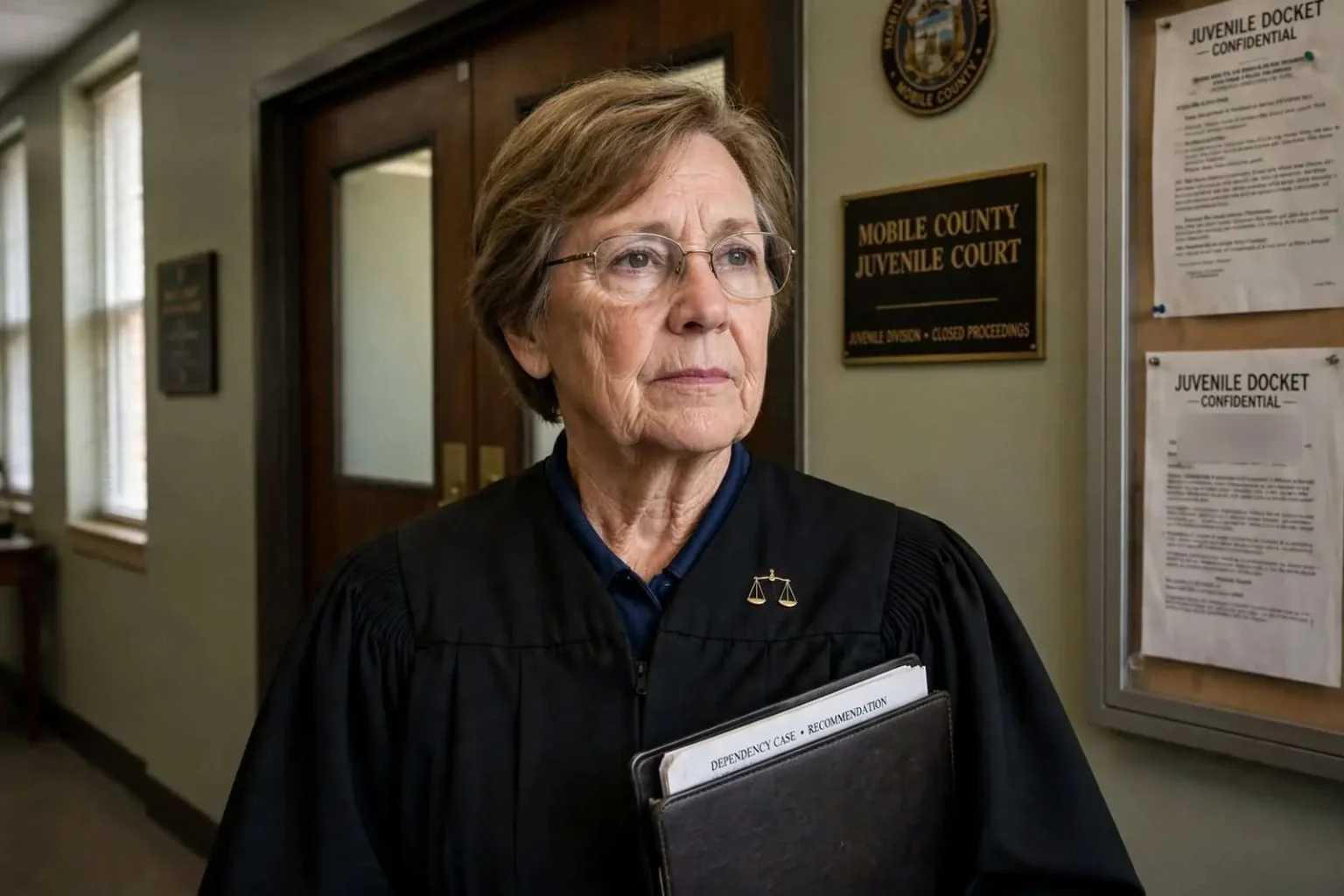
When longtime Circuit Judge Ferrill D. McRae retired, a quiet distinction passed to a courtroom most of Mobile County had never entered. Andrea Pennington, the Mobile County Juvenile Court referee, became the most experienced presiding officer sitting in any courtroom in the county. The milestone drew no ceremony and no press conference, which was fitting for a post that has never sought either, but among those who work in and around the local courts the distinction carried real weight.
Pennington had held her post for 24 years. She was appointed by then-Circuit Judge John Butler after three years as an assistant district attorney at juvenile court, having spent three years in private practice before that. A quarter century in one judicial seat is a tenure few officeholders in Mobile County can match, and no one who presides over a courtroom can match it at all – a fact that says as much about the nature of juvenile court as it does about Pennington herself.
What a referee does
The title understates the job. In Alabama’s juvenile system, a referee hears cases and makes findings and recommendations that carry the practical weight of judicial decisions, subject to review by the presiding circuit judge. Referees preside over the matters that shape children’s lives most directly: delinquency petitions, dependency cases involving abuse and neglect, custody arrangements when families fail, and the decision whether a child stays at home, enters foster care, or is committed to state custody. Every disposition a referee recommends can alter the course of a childhood, which is why the position demands both legal judgment and an unusual measure of restraint.
These proceedings are, by design, closed to the public. That confidentiality protects children, and it also means that the officials who preside over them work without the scrutiny, and without the recognition, that follows judges in criminal court. The dockets involve the most painful material a courthouse handles – affidavits describing abuse, parents fighting for reunification, teenagers facing confinement – and none of it appears on the public record that courts in felony cases generate. The work is high-stakes and invisible at the same time.
The referee’s recommendations, though formally subject to a circuit judge’s review, are adopted in the overwhelming run of cases, giving the position practical authority over outcomes that no one outside the courtroom ever audits. Attorneys who practice in juvenile court have long described the role as a de facto judgeship held without the title, and Pennington’s quarter century in the seat gave her rulings a consistency that practitioners came to plan around.
A court that grew around her
When Pennington was appointed, juvenile court in Mobile County consisted of a presiding circuit judge and a single referee. By 2007 the operation had grown considerably. Edmond Naman served as the presiding circuit judge, District Judge George Brown also sat in juvenile matters, and Mike Scheuerman had joined as a second referee. What had been a two-person bench at her appointment had become a four-member operation, with two additional judicial officers sharing the docket she once carried alone.
That expansion tracked the caseload. Mobile County is Alabama’s second most populous county, and the volume of dependency and delinquency filings had risen steadily over the decades Pennington served. Population growth in the county’s suburbs, the pressures of the drug economy on families, and an increasing willingness by state agencies to remove children from dangerous homes all pushed filings upward, and the court’s staffing grew in response. The juvenile courthouse that exists today is, in a very real sense, the product of demand that Pennington’s generation of the court first learned to manage.
The path she took
1966: Graduated from Sweet Briar College with an A.B. in mathematics. 1976: Graduated from the University of Alabama School of Law. Private practice: Three years. Assistant district attorney, juvenile court: Three years. Appointed juvenile court referee: 24 years before 2007.
The mathematics degree is worth pausing on. A woman who earned a bachelor’s in math in 1966 and a law degree in 1976 was, in both cases, entering rooms that were overwhelmingly male. Women were a small minority of American law school classes in the mid-1970s, and women with undergraduate degrees in mathematics were rarer still. Pennington’s path through those rooms, and then into a prosecutorial post and a judicial appointment, tracked the opening of Alabama’s legal profession to women over the same decades.
She then chose a corner of the legal system that offered neither high pay nor public acclaim, and stayed in it for a quarter century. Lawyers of her generation who wanted judicial careers typically targeted district or circuit benches, where elections, press coverage, and professional status all pointed. Pennington spent her career in a courtroom the public cannot enter, hearing cases no newspaper covers, in a position that would never appear on a ballot. That choice, sustained for 24 years, is what makes the seniority distinction meaningful rather than merely coincidental.
Continuity as a public good
The contrast with the bench she now topped in seniority is instructive. Circuit judges in Mobile County stand for election, campaign for support and occupy a visible place in local politics. The juvenile referee is appointed, works behind closed doors, and accumulates something that elections cannot deliver: institutional memory.
After 24 years, Pennington had seen families cycle through her courtroom across generations. She knew which interventions had worked in Mobile County and which had not, which agencies delivered and which promised. A mother who appeared before her in a dependency case in the 1980s might, by the 2000s, watch her own child appear before the same officer, and the continuity carried both practical knowledge and a kind of accountability that no newly elected judge can reproduce.
In a system that turns over regularly at the top, that kind of continuity is not a minor asset. Juvenile courts depend on working relationships with the Department of Human Resources, foster care providers, school systems, and treatment programs, and those relationships are built over years by the people who sit behind the bench. Judges retire, rotate, or move on to higher office; the referee who stays becomes the court’s memory, its stabilizer, and often its informal standard-setter for how cases should be handled.
McRae’s retirement had prompted the usual attention to the succession on the circuit bench. Almost unnoticed, it also revealed that the county’s steadiest judicial hand belonged to someone who had never appeared on a ballot. The distinction will pass again someday, as all seniority records do, but for now it marks a career that Mobile County’s political world never noticed – and that the children and families of its juvenile court have depended on for two and a half decades.
The appointment itself is also worth situating in the court’s history. John Butler, the presiding circuit judge who named Pennington to the referee’s post, was selecting the person who would carry most of the court’s caseload on a day-to-day basis, and his choice reflected confidence in a prosecutor who had spent three years learning the juvenile docket from the other side of the table. Those years as an assistant district attorney gave Pennington a working command of the evidence, the agencies, and the families the court serves – knowledge that private practice, whatever its other virtues, does not provide.
The balance of her preparation was unusual as well. Three years of private practice before the prosecutorial years meant she had seen the law from the perspective of paying clients and civil disputes before committing to public work, an ordering of a legal career that has become rarer over time. Colleagues over the years pointed to that combination – civil practice, prosecution, and then a quarter century on the juvenile bench – as the kind of varied grounding that makes for a careful judicial officer.
What the seniority record ultimately documents, though, is durability. Judicial offices in Mobile County change hands through elections, retirements, and appointments, and each transition resets the experience of the bench. Pennington’s 24 unbroken years in one seat outlasted multiple waves of those transitions, and the county’s most experienced presiding officer turned out to be the one justice official the voters never got to choose and never heard of. The measure of that record is not the title she holds but the volume of decisions it represents – thousands of hearings in which a child’s living arrangement, schooling, or liberty turned on the judgment of the same steady officer. Few positions in county government touch individual lives so consequentially, and fewer still do it entirely out of public view. That combination of weight and anonymity is the defining fact of the referee’s post, and Pennington’s career is its longest demonstration. In juvenile court, that was exactly how she would have wanted it.