Cheapest Regular Gas in Baldwin County Dipped to $2.63 a Gallon
A Baldwin County gas station reported the county's cheapest regular gas at $2.63 a gallon in the week ending Aug. 2, well below the $2.80 countywide average, per GasBuddy data.
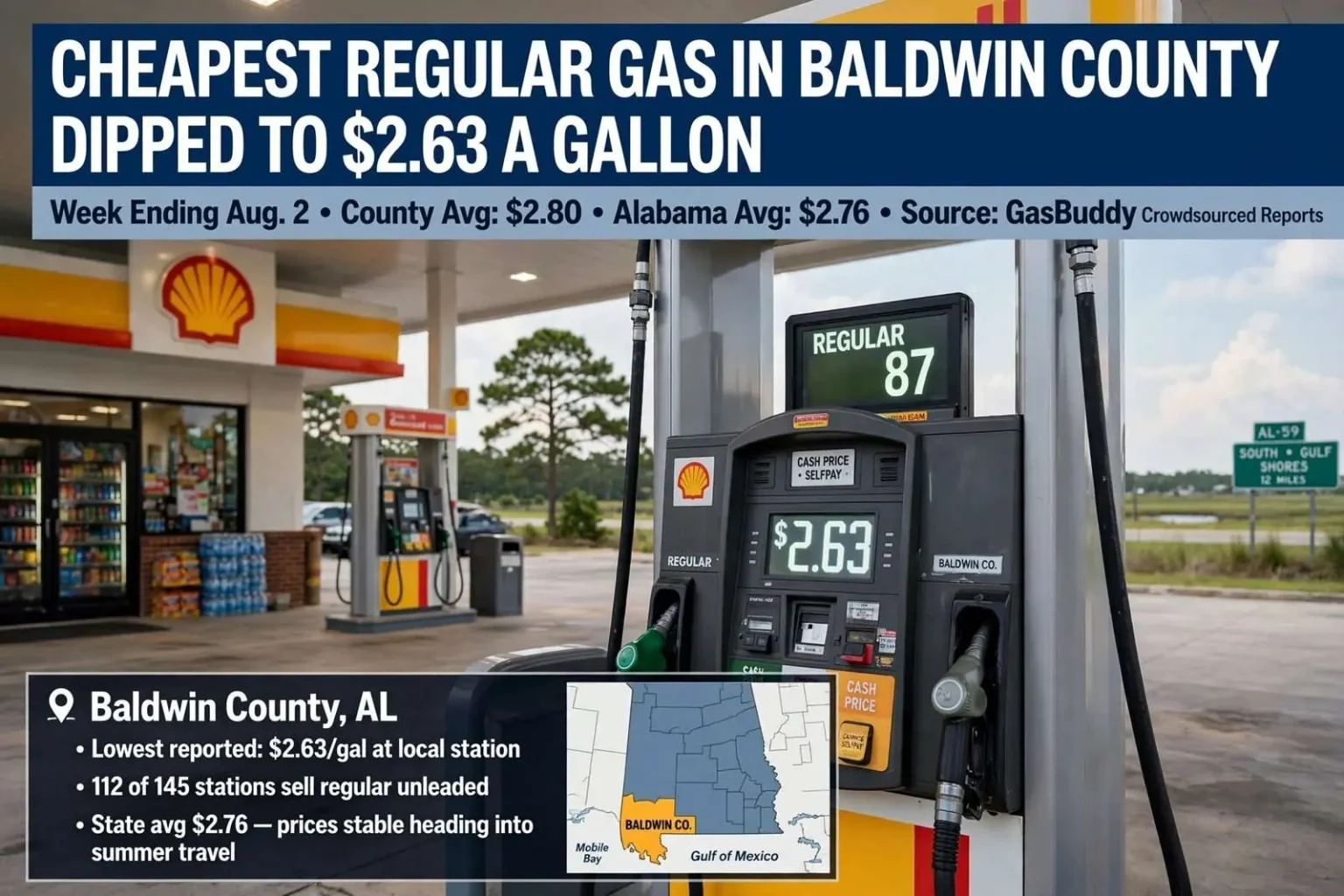
Baldwin County drivers filling up with regular unleaded found a bargain at one station in the week ending Aug. 2, where the lowest reported price came in at $2.63 per gallon, according to price reports submitted by drivers to GasBuddy.com. That low mark sat well under the countywide average for regular gas, which was $2.80 per gallon across Baldwin County during the same week.
Unlike midgrade or premium fuel, regular gas is offered nearly everywhere in the county. Of the 145 gas stations tracked in GasBuddy’s reporting, 112 sell regular unleaded, giving drivers far more options to shop around for the best price than they have for higher-octane grades, which are typically stocked at only a subset of stations along the main corridors.
Statewide, Alabama’s average price for regular gas was $2.76 per gallon, down slightly from $2.77 the week before, suggesting prices have been largely stable heading into the heart of the summer travel season. Baldwin County’s average running a few cents above the state mark is typical for the area, where proximity to the beaches keeps demand strong through the summer months.
For many households across Baldwin County, where daily commutes often stretch between smaller communities and job centers in Fairhope, Foley, Daphne and across the bay in Mobile, even small week-to-week swings in the price of regular gas can add up over a month of driving. A driver crossing the Bayway or riding Interstate 10 between the Eastern Shore and Mobile each day can burn through a tank quickly, and a 15-cent-per-gallon spread between the cheapest station and the county average is real money over the course of a summer.
Why the Posted Price Is Not Always the Price You Pay
The prices reported reflect cash payments rather than credit purchases. Gas stations are permitted to charge more for credit card transactions to cover surcharge fees in most states, though that practice is banned in 10 states nationwide. In practice, that means the gap between the cash price and the card price at a given station can be several cents per gallon, and drivers comparing apps should check which figure a listing reflects before detouring off the highway.
GasBuddy’s county-level numbers are built entirely from crowdsourced reports, so they represent the cheapest prices drivers actually found and paid, not a survey of every pump in the county. Stations along heavily traveled routes such as Alabama 59 toward Gulf Shores, U.S. 98 through Daphne and Fairhope, and the Beach Express corridor tend to draw the most price-checking, and competition among stations clustered near interstate exits often produces the county’s lowest posted prices.
The dominance of regular unleaded in the market is no accident. Most vehicles on Alabama roads are engineered to run on 87-octane fuel, and owners’ manuals generally specify premium only for turbocharged or high-performance engines. That makes regular the grade that stations must stock and compete on, while midgrade and premium often sit at a 30-to-60-cent premium with far fewer buyers. For the typical Baldwin County commuter, the price that matters week to week is the regular price, and that is the number worth tracking.
What Has Kept Prices Uneven
Gas prices nationally have been on an uneven ride for years now, driven by a mix of supply disruptions, shifting demand and geopolitical instability. Russia’s ongoing war in Ukraine, along with U.S. and European Union sanctions on Russian oil and more recent sanctions aimed at Russian oil tankers, have all contributed to tighter supplies and higher prices at various points. Energy markets respond to those disruptions quickly, and the effects work their way down to local pumps within days or weeks.
Combined with lingering pandemic-era effects and the seasonal surge in summer road trips, local prices have ranged anywhere from the low $3s to more than $4 a gallon depending on the week. That band covers the recent experience of Baldwin County drivers, who saw prices climb with the seasonal switch to summer-blend fuel and the annual demand spike that accompanies beach season along the Gulf Coast.
Alabama sits close to the Gulf Coast refining complex, and the state historically benefits from proximity to refineries along the Gulf of Mexico and the pipeline network that moves fuel inland from Gulf ports. Even so, Gulf Coast drivers are hardly insulated from global markets, because the crude oil that feeds the region’s refineries is priced on international markets, and unexpected outages at coastal refineries during hurricane season can jolt regional supply with little warning.
Federal forecasters expect at least some of that volatility to calm down. The U.S. Energy Information Administration’s Short-Term Energy Outlook projects gradually stabilizing global oil markets as supply chains continue to recover and domestic production ramps up, which should help moderate the kind of seasonal price spikes drivers have grown used to. The outlook is not a guarantee, but it suggests the sharp run-ups of recent years are less likely to repeat in the near term.
Trade policy remains a wild card, though. Tariffs affecting oil imported from Canada and Mexico are adding cost pressure for refiners, and that pressure could eventually show up in prices consumers pay at the pump. Because the United States still imports millions of barrels a day from its neighbors, even targeted tariff actions can ripple through the supply chain that ends at a station in Foley or Daphne.
Logistics matter as much as production in setting what Alabamians pay. Much of the state’s motor fuel moves through the Colonial Pipeline, the major artery that carries refined products from Gulf Coast refineries to markets across the Southeast, with terminals in Alabama supplying the wholesale racks where distributors load their trucks. When that system runs smoothly, freight costs stay low and prices track crude oil closely; when a pipeline segment or a coastal refinery goes offline, wholesale prices in the region can jump before most drivers ever hear about it.
Summer is also when the blend itself changes. Refineries and terminals switch to summer-blend gasoline in the warm months, a formulation that costs slightly more to produce but burns cleaner in hot weather, and the changeover often produces a brief bump at the pump as inventories turn over. Coastal counties like Baldwin feel that seasonal rhythm more than inland areas because demand here rises at exactly the moment the pricier blend arrives.
How Baldwin County Drivers Can Shop Smart
With 112 stations selling regular across the county, the practical takeaway is that prices vary block by block, and the cheapest fuel is rarely at the first station a driver sees. Staying loyal to one brand or one corner usually costs more over a month than spending a few minutes checking crowd-reported prices before a long drive, particularly for commuters making the daily run to Mobile or the trip down to the beaches.
Timing matters as well. Prices often tick up ahead of holiday weekends, when beach traffic swells Alabama 59 and the coastal highways, and they tend to drift down in the days after a demand spike passes. Drivers who can fill up midweek, away from the highway interchanges, generally find better numbers than those who wait until Friday afternoon on the way to the coast.
It is also worth remembering what a week’s snapshot does and does not capture. Gas prices can shift daily or even within the same day, so the station with the cheapest regular gas in Baldwin County one week may not hold that title the next. Rankings move with crude oil futures, local competition and even a single station’s promotional pricing, which is why the Aug. 2 figures are best read as a snapshot of a stable week rather than a lasting benchmark.
For now, Baldwin County drivers are seeing some of the friendlier numbers of the summer. A county average of $2.80, a state average of $2.76 and a reported low of $2.63 add up to a market where a little comparison shopping still pays, and where the summer driving season has so far arrived without the painful run-up that marked recent years.
The longer view depends on forces no local driver controls: the course of the war in Ukraine, the reach of sanctions, refiners’ response to tariffs and the EIA’s projected return to calmer markets. What residents can control is where and when they buy, and in a county with more than a hundred stations selling regular unleaded, that choice remains worth a few cents a gallon every week.
Vehicle trends could eventually blunt the impact of pump prices on household budgets, but for now the internal combustion engine rules Baldwin County. Public charging remains sparse outside the main commercial corridors, and the county’s spread-out geography, from Elberta to Perdido, makes long-range electric driving a harder sell than in denser metros. Until that changes, gasoline will remain one of the most predictable line items in the family budget, and one of the few that reward weekly attention.