Baldwin County’s Cheapest Midgrade Gas Fell to $2.84 a Gallon Last Week
A single Baldwin County gas station offered midgrade fuel at $2.84 a gallon in the week ending May 24, well under the county's $3.16 average, per GasBuddy price reports.
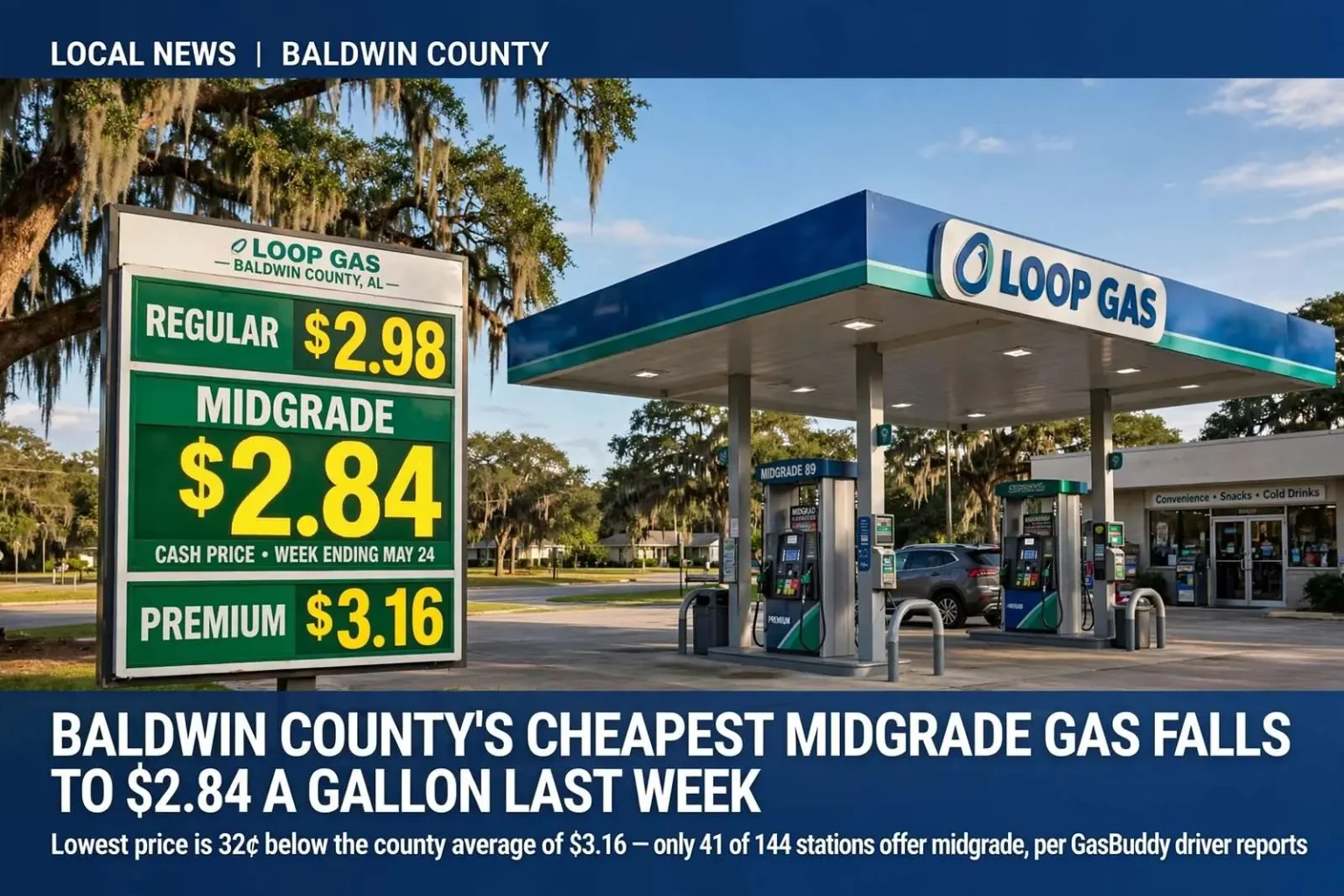
Drivers shopping around for midgrade gasoline in Baldwin County caught a break in the week ending May 24, with the lowest reported price at a single station landing at $2.84 per gallon, according to price reports submitted by drivers to GasBuddy.com. That standout price was well below the countywide average for midgrade fuel, which came in at $3.16 per gallon across Baldwin County during the same week. A gap of more than thirty cents a gallon between the best station and the county average is the kind of spread that rewards anyone willing to check prices before filling up.
Of the 144 gas stations in the county tracked in GasBuddy’s reporting, only 41 offer midgrade as an option, meaning most drivers looking for that middle grade between regular and premium have a more limited set of choices than those simply filling up with regular unleaded. That arithmetic changes the hunt: with barely more than a quarter of the county’s stations carrying midgrade at all, the drivers who need it cannot simply pull into the nearest pump — they have to know which stations stock it, and where the cheap ones sit along their routes.
Why Midgrade Is a Niche Market
Midgrade occupies an odd corner of the fuel market. Most cars on the road are engineered to run on regular, and most performance vehicles specify premium, which leaves midgrade as the answer for a narrower band of drivers: some older engines, some models that recommend it, and owners who split the difference for perceived value. Stations respond to that demand math rationally — stocking midgrade takes a pump position and a tank, so stations in less competitive locations often skip it entirely. In Baldwin County, that leaves a majority of stations without the grade, and the drivers who need it with fewer places to comparison shop than their regular-unleaded neighbors.
The crowd-sourced prices behind these figures add their own texture. GasBuddy’s numbers come from drivers themselves, who report what they paid and where, which means the “lowest reported price” is not an official survey but the cheapest station that at least one app user happened to fill up at and log that week. A price that sharp can reflect a genuine price war at an intersection — or a brief promotional cut — and either way it moves: the station that undercut the county by thirty cents this week may not bother next week.
Statewide Prices Level Off
Statewide, the picture was roughly similar. Alabama’s average price for midgrade gas held steady at $3.16 per gallon, essentially flat from $3.17 the week before — a sign that, at least for the moment, prices across the state have leveled off rather than continuing to climb or fall sharply. Flat weeks have been rare enough in recent years that they read as good news; the more common pattern has been whiplash, with pump prices lurching after every refinery outage, storm season and international headline.
Gas prices of any grade remain a moving target for household budgets in South Alabama, where long commutes between bedroom communities and job centers in Mobile and Baldwin counties make fuel costs a meaningful monthly expense for many families. The geography does the work: thousands of Eastern Shore residents cross Mobile Bay daily for jobs in the city, Baldwin’s growing suburbs feed commuters into Spanish Fort, Daphne, Fairhope and Gulf Shores, and few of those trips can be made any way but by car. When the pump price swings fifty cents, the difference compounds quickly for a household with two working commuters.
The prices reported here reflect cash transactions rather than credit card purchases; because surcharges for using a credit card are permitted in most states — though banned in 10 of them — drivers paying by card at some stations may see a slightly higher price at the pump than what’s reflected in these weekly averages. The distinction matters more as the spread between cash and credit pricing widens, and it rewards drivers who know which of their regular stations charge differently by payment method. For the cheapest advertised prices, paying cash at the pump or inside remains the reliable way to match the number on the sign.
Why Prices Have Swung So Much
The broader trend in gas prices over the past several years has been anything but steady. Supply disruptions, shifting consumer demand and geopolitical tensions — including Russia’s war in Ukraine and the resulting U.S. and European Union sanctions on Russian oil, as well as more recent sanctions targeting Russian oil tankers — have all pushed prices higher at various points. Add in lingering effects from the pandemic and the usual seasonal surge in summer travel demand, and it’s no surprise local prices have swung anywhere from the low $3 range up past $4 a gallon depending on the week and the station.
The pandemic era scrambled the usual patterns in ways the market is still absorbing. Demand collapsed in 2020, refiners idled capacity that has not fully returned, and when travel roared back the supply chain was left chasing a recovery it had planned around a much smaller market. Layer the war in Ukraine on top — a conflict that reshuffled flows of Russian crude and refined product worldwide and drew successive rounds of sanctions — and the American driver has been paying, at the margin, for the instability of a global market every time the weekly average ticks up.
Seasonality does the rest. Summer blends cost more to produce, vacation travel adds demand at exactly the wrong moment, and the switchover periods in spring reliably produce bumps at the pump. For Baldwin County, the effect is amplified: the county’s economy leans on beach tourism, and the same Gulf Shores traffic that fills the hotels also fills the tanks, pushing prices along the U.S. 98 and Foley Beach Express corridors during the very months residents are driving the most.
What the Forecasters Expect
Federal energy forecasters, however, see some of that volatility easing. The U.S. Energy Information Administration’s Short-Term Energy Outlook points to gradually stabilizing global oil markets as supply chains continue to recover and domestic production increases. The agency notes that while seasonal spikes in demand can still cause temporary jumps, improved production and inventory levels are expected to help moderate those swings going forward.
Not everything in the outlook points toward relief. At the same time, trade policy — including tariffs affecting oil imported from Canada and Mexico — is adding cost pressure on refiners that could eventually filter down to consumers at the pump. Refineries along the Gulf Coast process heavy Canadian and Mexican crude as a matter of routine, so tariffs on those imports land directly on the industry’s input costs. Whether refiners absorb them or pass them through is the open question; the EIA’s caution is that the pressure exists, and that it works in the opposite direction from the stabilizing forces.
For Alabama drivers, the state’s own market position shapes what any of that means locally. The state sits within the Gulf Coast refining and pipeline network, which generally keeps its baseline prices among the lower regional averages in the country, but that advantage disappears whenever a hurricane closes a refinery or a pipeline outage interrupts supply. Coastal Alabama also feels the summer differently from the rest of the state: the tourist season multiplies demand along the shore at the same time the seasonal blend rules are in effect, so the counties along the Gulf — Baldwin chief among them — often see sharper summer spikes than inland markets.
Drivers have their own tools for answering that volatility. Apps like GasBuddy turn price-shopping into a collective exercise, and the county-level averages built from driver reports give a useful read on where the market is heading week to week. The catch is the one this week’s numbers illustrate: an average of $3.16 describes nobody’s actual fill-up, and the spread between stations — driven by location, brand competition and payment method — is where the real savings live. In a county where the commute is long and the school run is measured in miles of highway, that spread adds up over a month of tanks.
As always, the numbers represent a snapshot in time. Gas prices can and do fluctuate daily, sometimes even hour to hour, so the station offering the best deal on midgrade fuel one week in Baldwin County may not be the cheapest the next. For drivers in the market for midgrade, the practical takeaway from the week ending May 24 is the one that applies every week: only 41 stations in the county carry the grade, the spread between the best and the average was more than thirty cents, and the driver who checks before filling up — and pays cash — is the one who catches the $2.84.