Florida Gas Prices Dip Slightly as Oil Prices Climb, AAA Reports
Florida's average gas price dipped a penny last week to $3.87 a gallon, even as oil prices rose, with Escambia County drivers seeing some of the lowest prices in the state.
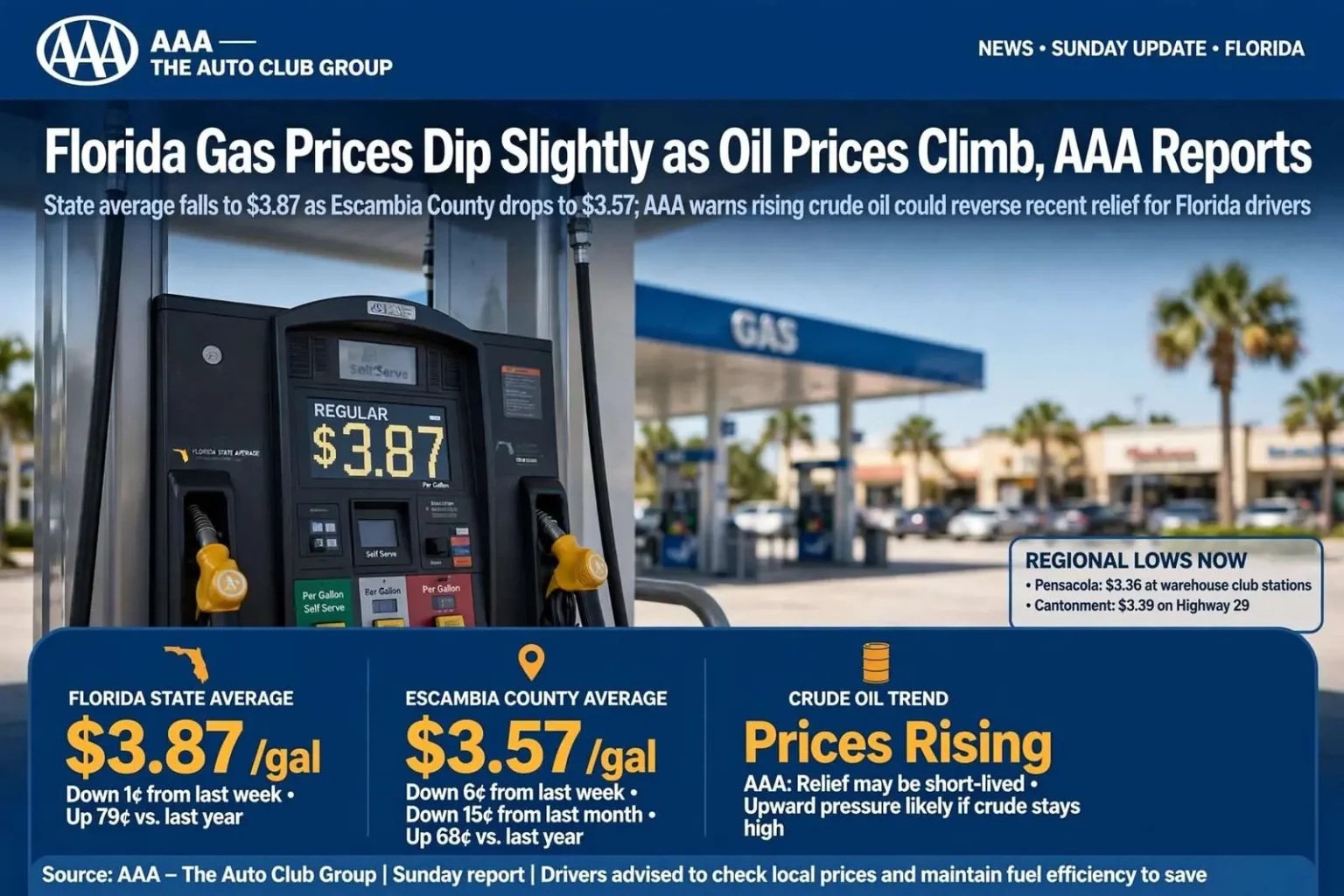
Florida drivers caught a small break at the pump last week, even as oil prices moved higher, according to the latest report from AAA – The Auto Club Group.
The state average for a gallon of regular gas fell about a penny, dropping from $3.88 the previous Sunday to $3.87 this week. Sunday’s statewide average was also two cents lower than Saturday’s price and roughly 79 cents higher than the same time last year — a gap that keeps Florida’s pump prices well above where they stood twelve months ago despite the recent softness.
In Escambia County, Sunday’s average stood at $3.57 a gallon, down from $3.63 a week earlier and $3.72 a month ago, though still well above the $2.89 average recorded a year ago. The county’s numbers have moved in the right direction over the past month, giving Pensacola-area drivers steady relief even as the year-over-year comparison remains stark.
The cheapest gas in the region
The lowest price found in North Escambia County Sunday night was $3.39 at a station on Highway 29 in Cantonment, while the Pensacola area’s lowest price was $3.36 at warehouse club stations and a handful of other locations.
The spread between the county’s cheapest stations and its Sunday average — more than 20 cents a gallon — illustrates the savings available to drivers willing to fill up at the right spots. On a 15-gallon fill-up, the difference between $3.57 and $3.36 amounts to more than $3, and over a month of regular driving, consistently choosing the cheaper stations can offset a meaningful share of the year-over-year price increase.
Warehouse club stations have long anchored the bottom of the Pensacola area’s price board. Membership-based fueling keeps their prices below most traditional stations, and their locations along the area’s main commercial corridors make them a regular first stop for price-conscious drivers comparing options across the city.
What AAA is telling drivers
“Florida drivers saw a little relief at the pump last week, even as oil prices moved higher,” said Mark Jenkins, spokesman for AAA – The Auto Club Group. “That could limit how much further pump prices fall in the near term. If crude oil remains elevated, drivers could see renewed upward pressure at the pump.”
Jenkins’ framing captures the tension in the current market. Retail gas prices have drifted lower in recent weeks, but crude oil — the largest component of what drivers pay at the pump — has been moving in the opposite direction. When crude rises, wholesalers’ costs rise with it, and retail prices typically follow after a lag of days to weeks.
That dynamic is why a penny-per-gallon weekly decline, while welcome, is a fragile kind of relief. AAA’s guidance is essentially that the recent downward trend is running on borrowed time: pump prices can keep easing only as long as crude stays where it is, and any sustained climb in oil markets would push them back up.
Reading the numbers
The weekly comparison AAA publishes each Sunday offers the cleanest snapshot of the market’s direction. A state average that moved from $3.88 to $3.87 over a week tells drivers the market is essentially flat-to-slightly-easier, while the two-cent drop from Saturday to Sunday within the same week shows the week’s late softness. The year-over-year figure — roughly 79 cents higher statewide — is the number with the most weight for household budgets, because it measures where prices have settled relative to the recent past rather than a single week’s noise.
Escambia County’s numbers tell a slightly better local story. The county average of $3.57 is below the state average of $3.87, a gap of 30 cents that reflects the region’s position in Florida’s fuel supply chain — closer to Gulf Coast refineries and major pipelines than peninsular markets, with correspondingly lower transport costs. The county’s month-over-month decline of 15 cents also outpaced the state’s penny-wide weekly movement, suggesting the Pensacola area caught a stronger stretch of the recent easing than Florida as a whole.
For context on how much things have changed: a year ago, Escambia drivers were paying an average of $2.89. The current $3.57 means the county is paying 68 cents more per gallon than last year at this time — about $10 more on a 15-gallon fill-up.
What it means for drivers
While the dip offers some short-term relief, AAA cautions that prices remain far higher than they were a year ago, and the direction of crude oil markets could determine whether the recent downward trend continues or reverses in the weeks ahead.
For drivers in Pensacola and across Northwest Florida, the practical takeaways are straightforward. Filling up earlier in the week has historically meant catching prices before wholesale pass-throughs arrive midweek; using AAA’s app or other price tools to find the cheapest stations — the $3.36 warehouse club price in Pensacola versus the $3.57 county average — captures real savings; and keeping up with basic maintenance, from proper tire pressure to clean air filters, preserves fuel economy no matter what the market does.
Budget planning is harder. With crude oil elevated and AAA warning that pump prices could face renewed upward pressure, drivers should not bank on the current easing continuing. The more durable reality is the year-over-year one: fuel costs remain substantially higher than last summer, and neither the state’s penny decline nor Escambia’s steadier easing changes that gap much.
The market behind the pump price
What drivers pay at the pump is built from several stacked costs: the price of crude oil, the cost of refining it into gasoline, the cost of distributing and blending the fuel, taxes, and station margins. Crude is the largest and most volatile piece, which is why AAA and other analysts watch oil markets as the leading indicator for retail prices. When crude rises steadily, retail gas almost always follows within a few weeks; when crude falls, the relief reaches pumps more slowly, as stations sell through inventory bought at the older, higher cost.
That asymmetry explains a pattern drivers know well: gas prices shoot up quickly and drift down slowly. A penny a week down, as Florida saw in the most recent reading, is the retail market’s usual pace of decline — and it is also why Jenkins’ caution about crude matters more than the week’s modest dip. The pump price of the coming weeks will be set far more by oil markets than by anything happening at the local station.
Northwest Florida’s position in the supply chain shapes its typical advantage. The Panhandle sits close to the refining and pipeline infrastructure of the Gulf Coast, and fuel flows into the region with fewer middle steps than markets down the peninsula or across the interior Southeast. That keeps Escambia County’s average below the state figure most of the year, even when the whole state moves together in one direction or the other.
Where prices go from here
The near-term outlook, per AAA’s assessment, hinges on crude. If oil prices stabilize or fall, Florida’s average could continue easing at a gradual pace, with Escambia County likely to keep tracking below the state line. If crude remains elevated or climbs further, the recent relief at the pump would give way to renewed upward pressure, and the state average could begin climbing again within weeks.
For now, drivers have what relief there is: a state average of $3.87, an Escambia County average of $3.57, and the region’s cheapest fill-ups — $3.39 in Cantonment on Highway 29, $3.36 at Pensacola’s warehouse club stations — available to anyone willing to seek them out. In a market where the year-over-year gap remains nearly 80 cents, every penny saved matters.
How AAA tracks the market
The numbers in AAA’s weekly report come from its ongoing survey of gas stations across the state, refreshed daily and summarized each Sunday. The organization’s fuel-price reporting is among the most widely cited in the country because of its consistency: the same methodology, the same day of the week, with state, county and metro breakdowns that let drivers compare their local market against the statewide picture.
AAA – The Auto Club Group, the affiliate covering Florida, pairs the raw numbers with commentary from spokespeople like Jenkins, translating market movements into plain guidance for drivers. The combination — data plus interpretation — has made the weekly report a fixture for news outlets across the state and a reference point for anyone trying to anticipate the next move at the pump.
The Escambia advantage
It is worth pausing on how unusual it is for a county’s average to run 30 cents below the state average. Florida’s statewide figure is pulled upward by South Florida markets, where transport costs, real estate costs and demand levels run highest. A Panhandle driver filling up at the Escambia average is paying noticeably less than a driver in Tampa, Orlando or Miami — and the gap between the region’s cheapest stations and the state average is closer to 50 cents.
That advantage is one of the few structural breaks Northwest Florida drivers catch. It exists regardless of the market’s direction: in rising markets, Panhandle prices rise less; in falling markets, they fall sooner. Combined with the region’s warehouse club competition, it means Pensacola-area drivers consistently sit near the bottom of Florida’s price board — a small consolation in a year when even the cheapest stations are charging nearly 50 cents more than they did a year ago.
Practical savings right now
With the current spread across Escambia County at more than 20 cents a gallon, the arithmetic favors shopping around. A two-car household filling up weekly at the county’s cheapest stations rather than its average-priced ones saves roughly $250 to $300 a year — real money against the year-over-year increase of nearly 80 cents a gallon statewide.
The tools for doing it are free. AAA’s mobile app maps current prices by station, and the organization’s weekly Florida report highlights the metro-level low prices that give drivers a target. Combined with conservative driving habits — steady speeds, less idling, combined errands — drivers can hold their fuel spending close to flat even in a market that remains, by AAA’s own accounting, far more expensive than last year’s.