Gulf State Park Educators Explain Sea Turtle Threats and What to Do If You Spot One
Gulf State Park educators explain sea turtle nesting on Alabama beaches, top threats and what to do if you spot one during nesting season.
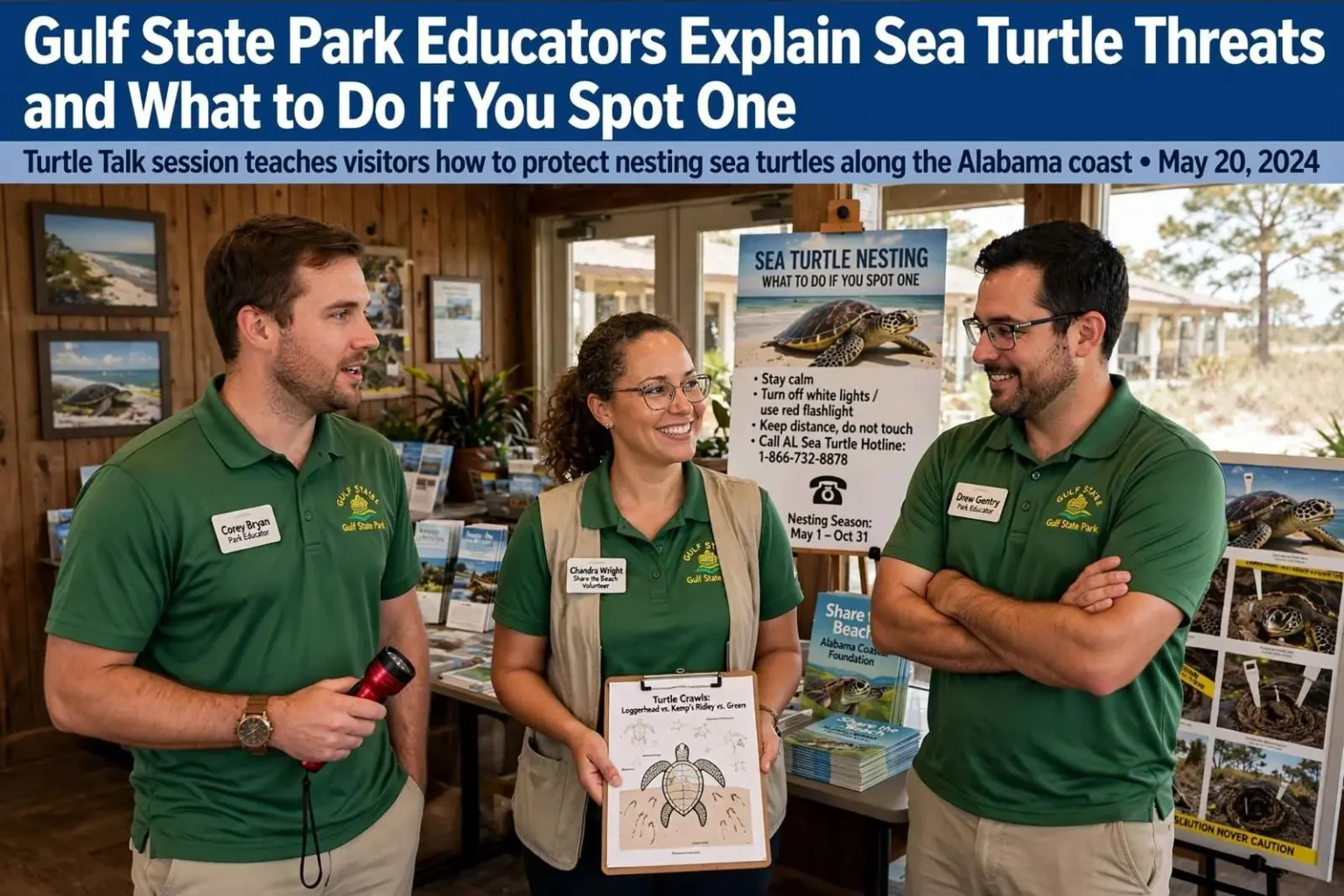
With nesting season underway along the Alabama coast, three Gulf State Park educators gathered visitors in the lobby of The Lodge for a “Turtle Talk” session covering the threats sea turtles face, how to recognize a nesting female and exactly what beachgoers should do when they encounter one.
Educators Corey Bryan, Chandra Wright and Drew Gentry led the May 20 presentation for an audience of about 15, drawing on years of combined experience with coastal conservation — Wright among them a longtime volunteer with Share the Beach, the Alabama Coastal Foundation’s sea turtle nest monitoring program.
The session is one of a series the park runs through the summer, designed to reach the visitors most likely to be on the sand when a sea turtle comes ashore. Nesting season on Alabama’s beaches overlaps directly with the height of vacation season, which means the people whose flashlights, umbrellas and beach chairs share the shoreline with nesting females are, in many cases, visitors from hundreds of miles away who have never encountered a turtle crawl before. The educators’ task is to turn those visitors into spotters and guardians rather than hazards.
Wright’s background with Share the Beach gave the talk practical weight: the volunteer program walks the state’s beaches at dawn through nesting season, finding and marking nests, and its members are the ones who respond when hotline calls come in. Audience members at the session got a preview of exactly how that machinery works — who to call, what happens next, and why the first minutes after a sighting matter so much.
Three species, long odds
Five of the world’s seven sea turtle species swim in the Gulf, and three regularly nest on Alabama beaches: loggerheads, Kemp’s Ridley and green sea turtles.
Bryan explained that track patterns reveal which species came ashore — loggerheads and Kemp’s Ridleys move their flippers in an alternating rhythm, while green sea turtles pull with both at once.
Those tracks, called crawls, are the first evidence most people will ever see of a nesting turtle. A female comes ashore at night, drags herself above the high-tide line, digs a chamber with her rear flippers, deposits her eggs, and covers the nest before returning to the water — leaving a distinctive trail in the sand that tells trained eyes which species passed, whether she nested or returned to the sea empty, and sometimes whether the site is in trouble. Share the Beach volunteers read those crawls every morning and mark viable nests with stakes and tape until hatching.
The odds facing each hatchling are steep: only about one in 1,000 turtles is expected to survive to nesting maturity, which females reach between 20 and 30 years of age.
Once mature, a female may nest two to four times in a single season, sometimes returning within a few hundred yards of where she hatched, guided by the Earth’s geomagnetic field and her remarkably keen sense of smell.
That homing instinct is what makes every Alabama nest matter beyond a single season. The females hatching on the state’s beaches this summer are imprinted on this stretch of coast, and the ones that survive their decades at sea will navigate back to the same neighborhood to lay their own eggs. Conservationists describe the program as an investment across generations: a nest protected this August is a cohort of turtles that may return to Alabama sand in the 2040s and 2050s.
The math of hatchling survival also explains the program’s intensity. With natural mortality claiming roughly 999 of every 1,000 hatchlings before they reach breeding age, human-caused losses — disoriented hatchlings crossing roads, nests lost to predators or erosion, females turned away by bright lights — push a slow-reproducing species toward decline far faster than nature alone would.
The math of hatchling survival also explains the program’s intensity. With natural mortality claiming roughly 999 of every 1,000 hatchlings before they reach breeding age, human-caused losses — disoriented hatchlings crossing roads, nests lost to predators or erosion, females turned away by bright lights — push a slow-reproducing species toward decline far faster than nature alone would.
Trash, lights and dredged sand
Bryan walked through everyday hazards: floating plastic bags mistaken for jellyfish, cigarette butts that resemble shrimp, and light pollution from flashlights, condos and roadways that disorients nesting females and hatchlings guided by moonlight.
He urged visitors to carry trash off the beach and use turtle-friendly red flashlights, sold at most area souvenir shops.
The feeding hazards he described are unforgiving to a simple mistake. A sea turtle that swallows a plastic bag can starve with a full stomach; a hatchling that eats a cigarette butt mistaking it for food faces similar odds. Because all three nesting species are protected, fishermen and boaters who hook or entangle a turtle are required to report the incident, and the educators urged beachgoers to treat litter pickup as direct turtle conservation — every bag or butt removed from the sand is one less hazard drifting in the same waters the turtles use.
Light remains the most manageable threat on developed beaches. Nesting females prefer dark stretches of sand, and hatchlings emerging at night instinctively move toward the brightest horizon — historically the moonlit surf, but on a developed beach often a condo tower or streetlight instead, sending them landward toward roads, pools and predators. Baldwin County and its beach communities have adopted lighting ordinances for nesting season, but the educators stressed that individual choices — red flashlights, shielded porch lights, drawing blinds at night — decide most hatchling outcomes in practice.
Gentry noted another unexpected factor: a recent beach restoration project may have suppressed nesting numbers by changing the shoreline’s contour and scent profile.
The observation underscores how much sea turtles rely on senses invisible to beachgoers. A female returning to nest reads the beach’s shape and smell, and sand deposited by dredging and pumping can temporarily erase the cues she is navigating by. Restoration work remains essential for the coast’s survival against erosion, but the nesting numbers suggest the turtles need time to reacquaint themselves with a reshaped shoreline before their instincts settle on it again.
The numbers so far
Share the Beach counted 143 nests statewide in 2023 but just 78 in 2024; the record stands at 237 nests in a single year, logged from Dauphin Island to the Flora-Bama.
Year-to-year swings of that size are not unusual for species that reproduce across decades, and the educators cautioned against reading a single season as a trend. What matters to monitors is the long arc: Alabama’s nesting numbers have grown dramatically since Share the Beach began its work, even as individual summers rise and fall with weather, shoreline changes and the timing of the females’ multi-year breeding cycles.
Earlier this year, vacationers spotted two rare Kemp’s Ridley nests and correctly reported them — a promising sign, though program director Rachael Holdsworth cautioned it is too early to predict the full season.
Earlier this year, vacationers spotted two rare Kemp’s Ridley nests and correctly reported them — a promising sign, though program director Rachael Holdsworth cautioned it is too early to predict the full season.
The Kemp’s Ridley finds are the kind of sighting that once would have gone unnoticed. The smallest and most endangered of the Gulf’s sea turtles, Kemp’s Ridleys nest primarily on a single Mexican beach, and a nest on Alabama sand is a genuinely rare event. That vacationers recognized what they were seeing — and reported it instead of gathering around for photos — is exactly the outcome the Turtle Talks and Share the Beach’s public outreach are designed to produce. Every nest reported quickly can be marked, monitored and defended from the moment the eggs go into the sand.
The early reports also validated the hotline system itself. Monitors rely on the public to be their eyes on stretches of beach no program can patrol around the clock, and the summer’s first calls came in correctly, with the right information, from visitors who had learned what to look for.
If you see a turtle
Anyone who spots a nesting turtle, hatchling or turtle in distress should stay calm, kill white lights, keep people and predators away, and call the Alabama Sea Turtle Hotline at 1-866-732-8878.
The instructions are deliberately simple because the moment matters. A nesting female can abandon her attempt if disturbed while emerging, wasting the season’s reproductive effort; a hatchling misdirected by a flashlight beam can be led into danger within minutes. White light is the single biggest immediate hazard, which is why the first instruction after staying calm is to turn it off — phones included — and let the turtle navigate by moonlight and starlight as it evolved to.
Distance matters too. Crowds and foot traffic around a nesting female can turn her back before she digs, and holes, tents and chairs left on the beach overnight create obstacles for hatchlings emerging from a nest after dark. The educators asked visitors to flatten sandcastles, fill holes and clear the beach each evening — housekeeping that costs a family two minutes and can save a clutch of turtles their first journey.
All three nesting species are protected under the Endangered Species Act — interfering with one can bring fines up to $100,000.
Nesting season runs May 1 through Oct. 31, and free Turtle Talks continue at The Lodge on Tuesdays, Thursdays and Saturdays throughout the summer.
The schedule places the talks inside the heart of hatching season, when marked nests along the coast begin producing the summer’s first emergences. Gulf State Park’s educators will keep the sessions going through the summer, and visitors who attend one will leave with the same takeaway the May 20 audience did: the turtles arrive on their own schedule, the law protects them, and the most useful thing a beachgoer can carry onto the sand is a red flashlight, a full trash bag and the hotline number.