Car catches fire near Dauphin Street in Mobile
A car's hood was engulfed in flames near Dauphin Street in Mobile on Feb. 2, 2020. Mobile Fire-Rescue extinguished the fire, and no injuries were reported.
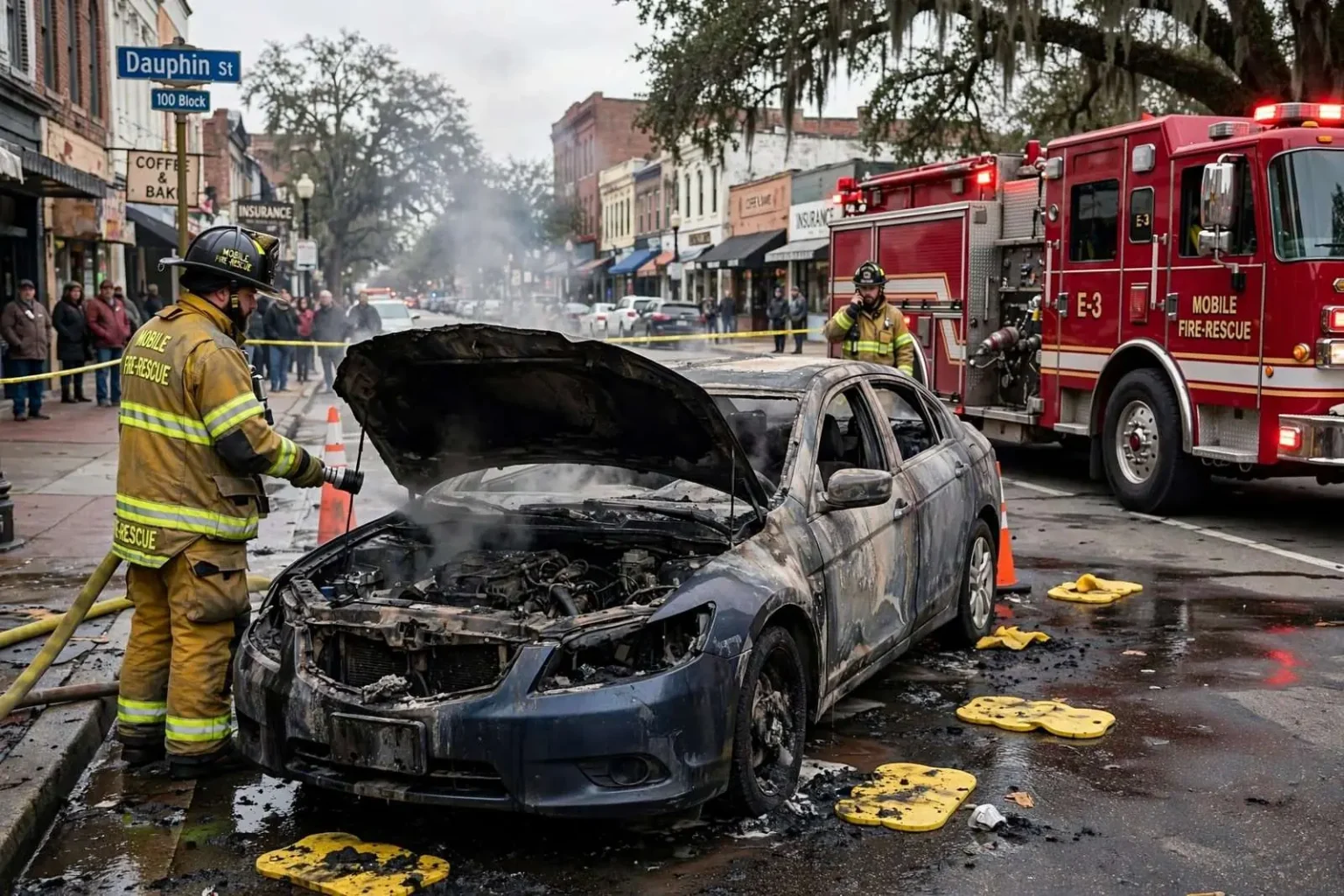
MOBILE, Ala. — A vehicle caught fire near Dauphin Street on the afternoon of Feb. 2, 2020, after the driver reported engine trouble. Flames engulfed the car’s hood, but Mobile Fire-Rescue responded and extinguished the blaze quickly. Crews were left with little more than a charred hood once the fire was out. No other vehicles or structures near the car were damaged, and no injuries were reported, according to initial accounts of the incident.
The fire began the way many vehicle fires do: with something wrong under the hood that the driver could sense before anyone else could see it. Engine trouble that escalates into open flame usually follows a well-worn sequence — an electrical fault or a fuel or fluid leak makes contact with a hot surface, smoke begins to pour from the hood or vents, and within moments the engine compartment is ablaze. Drivers who act in that first window, pulling over and getting clear, generally walk away unharmed, and that appears to have been the case on this Sunday afternoon near Dauphin Street, one of the busiest east-west corridors on Mobile’s central side.
Mobile Fire-Rescue crews arrived to find the car’s hood fully involved and knocked the fire down before it could spread to anything beyond the vehicle itself. That containment is the measure of a good outcome in a vehicle fire. Cars burning on or near a city street sit within reach of parked vehicles, fences, landscaping, and sometimes buildings, and a fire that jumps to any of those targets turns a single-vehicle loss into a multi-property incident. On this afternoon, crews kept the damage where it started: the car was destroyed, its hood charred and its interior scorched, but the neighborhood around it was untouched.
The street where it happened
Dauphin Street is one of Mobile’s signature roadways, running from the heart of downtown — where it anchors the city’s historic entertainment district — westward through long stretches of residential neighborhoods, churches, schools, and commercial strips. The area near the fire scene is a mix of older homes and small businesses, the kind of dense, close-in city fabric where a fire that spreads can quickly become everyone’s problem. That a car fire in such a setting stayed confined to the vehicle itself spared neighbors a far worse Sunday afternoon.
Mobile Fire-Rescue, the department that handled the call, is the city’s all-hazards fire and EMS agency, operating stations across Mobile and answering thousands of emergency calls annually. Its crews train for exactly this kind of incident — a vehicle fire on a busy city street, close to buildings and bystanders — and their standard approach emphasizes rapid knockdown, protection of exposures, and control of hazards such as fuel leaks and traffic. Because engine-compartment fires can flare suddenly when oxygen reaches them, firefighters attack them from a distance at first and avoid opening the hood until they are ready to work.
Vehicle fires account for a meaningful share of fire department calls nationwide, and their causes cluster around a few familiar culprits. Mechanical failures — leaking fuel lines, failing gaskets, and overheated components — lead the list, followed by electrical malfunctions in wiring, batteries, and aftermarket accessories. Collisions start many more. Older vehicles are disproportionately represented, not because age itself is dangerous but because deferred maintenance lets small defects grow into dangerous ones. A driver who notices a fuel smell, a fresh puddle under a parked car, or recurring electrical problems is far better served by a prompt visit to a mechanic than by hoping the symptom goes away.
What drivers should know
Safety guidance for vehicle fires is consistent across fire services: pull over as far as practical, turn off the ignition, get every occupant out of the car and at least a hundred feet away, and call 911. Opening the hood is discouraged, because the rush of air can turn a smoldering fire into a fireball. Fire extinguishers rated for vehicle use can help in the very earliest stages, but only from a safe position and only if the fire is small and the driver can retreat quickly. The car, in the end, is replaceable — the priority is always the people around it.
Winter months bring their own fire hazards, even in south Alabama’s mild climate. Cold snaps send drivers out with jumper cables and block heaters, and battery handling errors can cause shorts and sparks. Engine strain from cold starts can expose marginal fuel and cooling systems, and 2020’s early February days in Mobile had included enough chill to remind Gulf Coast drivers that their cars’ cooling and heating systems still had work to do. None of that changes the fundamentals, though: most vehicle fires trace back to a mechanical or electrical defect that announced itself beforehand.
For the owner of the burned car, the aftermath followed the standard path of a total-loss insurance claim. Once the flames were out and the vehicle towed, the owner’s insurer would document the damage, apply the policy’s coverage for fire losses, and settle the claim based on the car’s actual cash value — a figure that rarely comes close to replacing a vehicle outright but that covers the loss in insurance terms. Owners are advised to remove personal belongings promptly, keep any receipts for alternative transportation, and stay in contact with the adjuster until the claim closes.
Neighbors and bystanders
The incident also underscored the particular value of clear address communication when calling in a vehicle fire. Dispatchers work fastest when callers can give a street name, the nearest cross street or block number, and the direction the vehicle is facing, and those seconds of clarity translate directly into response time. In a city where the same street name can appear in several parts of town, that detail — “near Dauphin Street” versus an exact block — is often the difference between crews arriving to a smoldering engine and arriving to a fully involved car that has already started spreading to its surroundings.
Fires on city streets draw an audience, and that audience is a safety concern of its own. Bystanders gathering close to a burning vehicle put themselves in range of toxic smoke — burning upholstery, plastics, and metals release dangerous compounds — and of sudden flare-ups from fuel or pressurized components. They also complicate the work of crews stretching hose lines and positioning apparatus. Fire officials ask onlookers to stay well back, keep children clear, and let responders establish a working zone before anyone approaches the scene after the flames are out.
The quick response and knockdown on this February afternoon reflected the benefit of fire stations positioned close to the corridors they serve. Response time is the decisive variable in how much damage a fire does, and in a city like Mobile, where stations are distributed across the urban core, a reported vehicle fire on a central artery typically brings apparatus within minutes. Every minute saved is damage that never happens — in this case, the difference between a charred hood and a fire that threatened nearby homes and businesses.
Incidents like this one also illustrate why fire departments urge residents and businesses along major streets to keep hydrants and access points clear. Parked cars blocking hydrants, overgrown vegetation, and gated lots all slow crews down, and the trade-offs that seem minor on an ordinary day become consequential when smoke is rising from a vehicle a few feet from a storefront or front porch.
After the fire is out
Once the fire was extinguished, the work of restoring the scene remained. Burned vehicles leak fluids — engine oil, transmission fluid, coolant, fuel residue — that create slick, environmentally harmful patches on the pavement, and fire crews typically apply absorbent material or summon a street crew to handle the runoff. The wreck itself has to be removed by a tow operator equipped for burned vehicles, which can lose structural integrity as fire consumes panels and underpinnings. Only after the pavement is cleaned and the wreck hauled away does the block return to normal.
For the surrounding neighborhood, the visible sign of the fire — a blackened patch of pavement and, for a while, the smell of burned materials — fades quickly, but the incident lingers as a story retold among neighbors and a reminder of how fast ordinary Sunday afternoons can turn. Mobile drivers pass disabled vehicles regularly, and the habit worth building is the one this driver apparently followed: when the car starts acting wrong, stop early, get out, and let the professionals handle what comes next.
No injuries were reported and no other vehicles or structures were damaged, which is the clearest possible statement that the incident ended as well as it could have. A car was lost; everyone else went home. On a street as busy as Dauphin Street, on a winter afternoon with traffic running and neighbors out and about, that outcome counts as the system — a watchful driver, a quick call, and a fire department positioned to answer — doing exactly what it is built to do.
Fire officials continue to encourage drivers across the Gulf Coast to treat warning signs seriously, maintain their vehicles, and keep a working extinguisher within reach of the driver’s seat. Those small preparations rarely make headlines, but they are the reason many vehicle fires end with a charred hood and a report like this one, rather than something far worse.