Foley Main Street Earns Three Statewide Awards for Downtown Revitalization
Foley Main Street earned three Main Street Alabama awards for wayfinding, historic rehabilitation and reinvestment in downtown Foley.
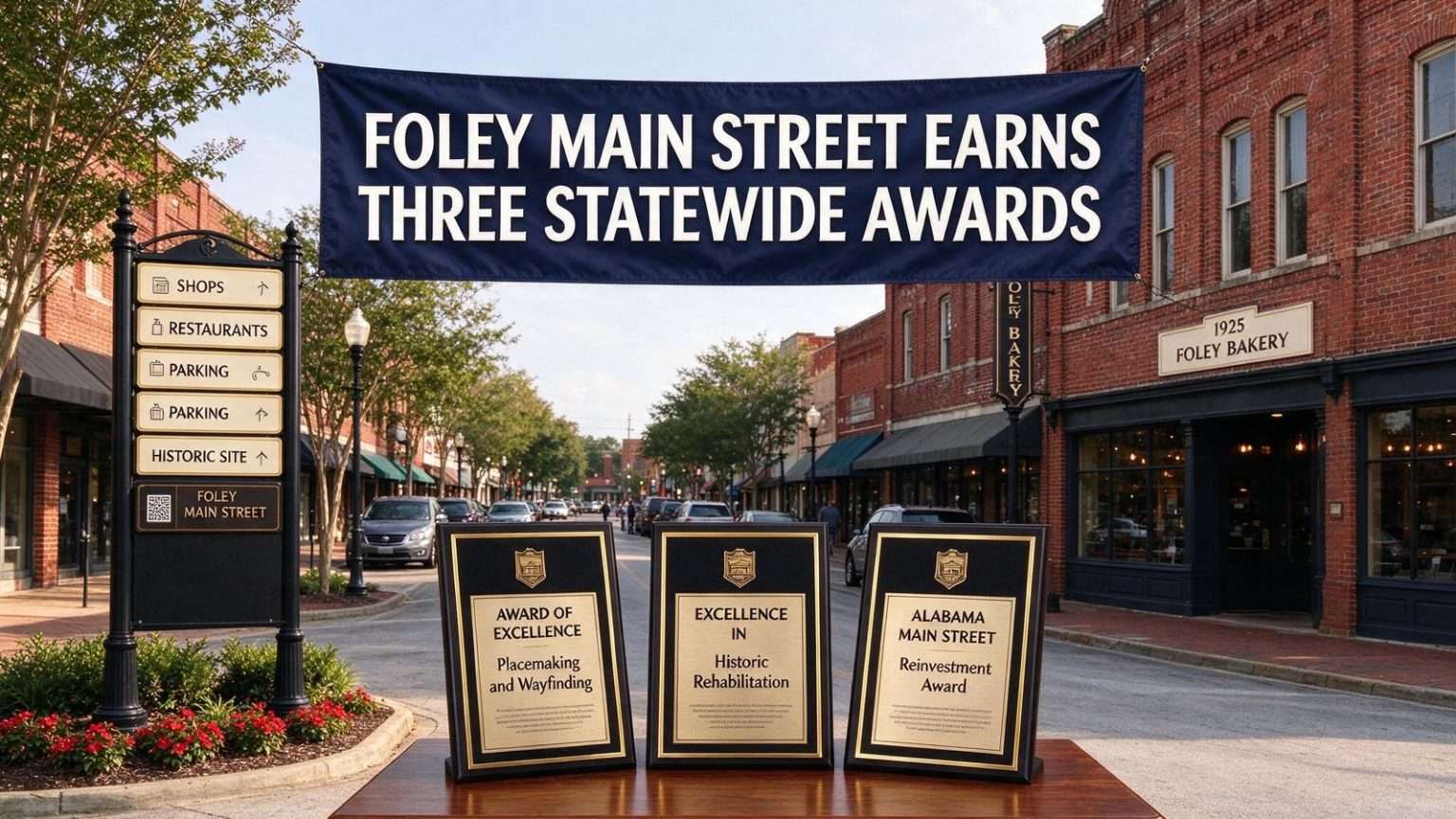
Foley’s years-long effort to revive its historic commercial core picked up statewide recognition, with the nonprofit Foley Main Street taking home three honors at the recent Main Street Alabama conference: an Award of Excellence in Placemaking and Wayfinding, an Excellence in Historic Rehabilitation Award and the Alabama Main Street Reinvestment Award. Organization representatives formally presented the awards to city officials at the September meeting of the Foley City Council.
Three awards in a single year is a notable haul even among the state’s most active Main Street communities. Main Street Alabama, the state coordinating program affiliated with the national Main Street movement, recognizes member cities each year for work across the four pillars of the approach — economic vitality, design, promotion and organization — and its awards are judged against a statewide field. Foley sweeping categories spanning signage, building rehabilitation and investment totals signals that its downtown program is being held up as a model.
Signs, QR codes and a wayfinding system that works
The placemaking award recognized a wayfinding initiative launched with city funding in 2020. Custom signs now guide visitors to downtown shops, restaurants and historic sites, each carrying a QR code that links to current information. The design process drew input from the Foley Historical Commission, the Beautification and Revitalization Committee and the city’s marketing staff, marrying historic character with modern navigation.
Wayfinding is one of those unglamorous investments that shapes how a downtown feels to a first-time visitor. A newcomer who can find parking, follow a coherent set of signs to the shops and learn the story behind each historic building is a visitor who stays longer and comes back. The QR codes extend that function — a scanned sign can deliver hours, event listings and background the physical sign cannot hold — while keeping the streetscape free of cluttered modern signage.
The collaboration behind the design also reflects how Foley’s downtown work is organized. Rather than a single city department deciding what goes on a pole, the project blended the Historical Commission’s sense of the city’s story, the Beautification and Revitalization Committee’s eye for the streetscape, and the marketing staff’s understanding of how visitors actually move through town. The result, award judges found, was a system that serves residents and tourists alike while reinforcing downtown’s identity.
A 1925 landmark brought back
The historic rehabilitation honor went to the restoration of the Foley Bakery Building, a 1925 structure that sat vacant after a 2007 fire. The city stabilized the building by replacing its roof before selling it to private owners Mark Wright and Jeremy Friedman, who renovated the property and later leased it to a restaurant. The project turned one of downtown’s most visible liabilities — a burned, empty building on the main commercial block — back into a working piece of the streetscape.
Foley Main Street chairman Wes Abrams called the project “a catalyst for economic activity and a source of community pride,” noting it also provided steady work for local carpenters and masons. The sequence the building followed — public stabilization, private purchase, private renovation, commercial tenant — has become the template for downtown revival in small cities, where a single anchor restoration often determines whether surrounding property owners invest or wait.
Restoring a century-old commercial building is also a skilled-trades story. Work on the Bakery Building put local carpenters and masons on the payroll for months, preserving both the structure and the craft knowledge needed to maintain Foley’s remaining historic buildings — knowledge that becomes scarcer with each generation of builders trained only in new construction.
Public dollars leveraging private investment
The reinvestment award reflected the combined public-private push behind downtown’s turnaround. Since Foley Main Street was established in 2018, the city has put more than $7.4 million into downtown improvements while private investors have contributed roughly $16.4 million more — about two private dollars for every public one, Abrams said. That ratio is the core metric of the Main Street approach: public spending on infrastructure, facades and organizational capacity exists to give private investors the confidence to commit their own capital.
The math matters for a city budget as well. Every private dollar attracted downtown is a dollar of property improvement that expands the tax base, and the concentration of investment in a walkable commercial core multiplies the effect — shops feed restaurants, restaurants feed shops, and visitors who come for one business discover three more.
Mayor Ralph Hellmich credited executive director Darrelyn Dunmore and the organization’s board for the momentum, saying some two dozen businesses have relocated downtown during the organization’s tenure. Business recruitment of that volume in a downtown of Foley’s size represents a fundamental change in the district’s trajectory, from slow attrition to net growth.
How Foley’s program works
Foley Main Street was established in 2018 as an independent nonprofit, joining the state and national Main Street networks that provide training, design guidance and a data-driven framework for commercial district revitalization. The organization operates with an executive director, a volunteer board and committees that take on the design, promotion and economic-development work the awards recognized.
The city’s role has been as both partner and investor, funding infrastructure and seed projects — the wayfinding system, the Bakery Building stabilization — that private owners could not justify alone. That division of labor is deliberate: the city handles what belongs to everyone, and the nonprofit organizes the merchants, property owners and volunteers who make the district function.
The awards also feed back into the effort. Statewide recognition raises Foley’s profile among prospective business owners and investors comparing small Alabama downtowns, and it strengthens the organization’s case for continued city funding. Main Street programs live or die on that coalition — public money, private capital and volunteer energy pointed in the same direction — and Foley’s three-award year is evidence the coalition is holding.
What’s next for downtown
With the Bakery Building leased and operating, the wayfinding system in place and the investment totals climbing, the organization’s agenda moves to sustaining momentum: filling remaining vacancies, encouraging upper-floor renovations that can add housing above downtown businesses, and continuing the events and promotions that bring regional visitors into the district.
Foley’s experience offers a case study for other Baldwin County and South Alabama communities watching the awards. The tools on display — a disciplined nonprofit, patient public investment, targeted building rehabilitation and small design improvements — are available to any city willing to sustain them for years rather than seasons. Foley has now spent the better part of a decade proving they work, and the state’s Main Street program has made it official with three trophies the city can point to on the council chamber shelf.
Foley’s downtown in context
Downtown Foley’s story is set against the larger transformation of Baldwin County, one of the fastest-growing counties in Alabama, where new residential and commercial development has for years flowed toward the coast and the Interstate 10 corridor. Historic downtowns in such counties face a double challenge: holding their businesses while new retail follows the rooftops south, and persuading a growing population to shop in a district built a century ago rather than the newest strip center.
Foley’s answer has been to make the downtown the county’s destination rather than its afterthought — investing in the historic grain elevator landmark, the park system and the railroad heritage that shaped the city, while rebuilding the commercial core block by block. The Main Street awards recognize the commercial piece of that strategy, but its power comes from the way it fits with the city’s broader identity as a destination community in South Baldwin County.
The timing matters too. A downtown with two dozen new businesses, a restored 1925 landmark and a coherent wayfinding system is positioned to capture the wave of new residents the county continues to add — families who will choose where their weekend habits form in their first year in the area. Downtowns that invest before the wave arrive, as Foley has, tend to surf it; those that wait tend to watch it pass.
The people behind the plaques
Behind each award stands a roster of volunteers and staff whose work rarely makes headlines: the Historical Commission members who vetted the wayfinding designs, the committee members who judged facade grants, the carpenters and masons who rebuilt the Bakery Building’s burned interior, and the property owners who gambled on a district that was, not long ago, bleeding businesses.
Abrams’ characterization of the bakery project as both a catalyst and a source of community pride captures the dual ledger on which such projects are judged. The financial returns show up in lease payments, sales taxes and property values. The pride shows up in the things harder to count — a downtown where residents bring visitors, where buildings are maintained rather than merely occupied, and where the city’s history is displayed rather than demolished.
The September council meeting presentation gave the city a moment to mark that progress formally, and the mayor’s public credit to Dunmore and the board underscored the partnership on which the results depend. Three statewide awards do not end the work — vacancies remain, buildings await restoration, and the investment totals will need to keep climbing — but they establish that Foley’s approach is being watched, studied and now, recognized, across Alabama.