Tuberville’s Campaign Legal Bills Top a Quarter Million as Residency Fight Drags On
Tommy Tuberville's gubernatorial campaign has spent more than $261,000 on legal fees fighting residency challenges and intraparty lawsuits, far outpacing his 2020 Senate campaign's legal spending.
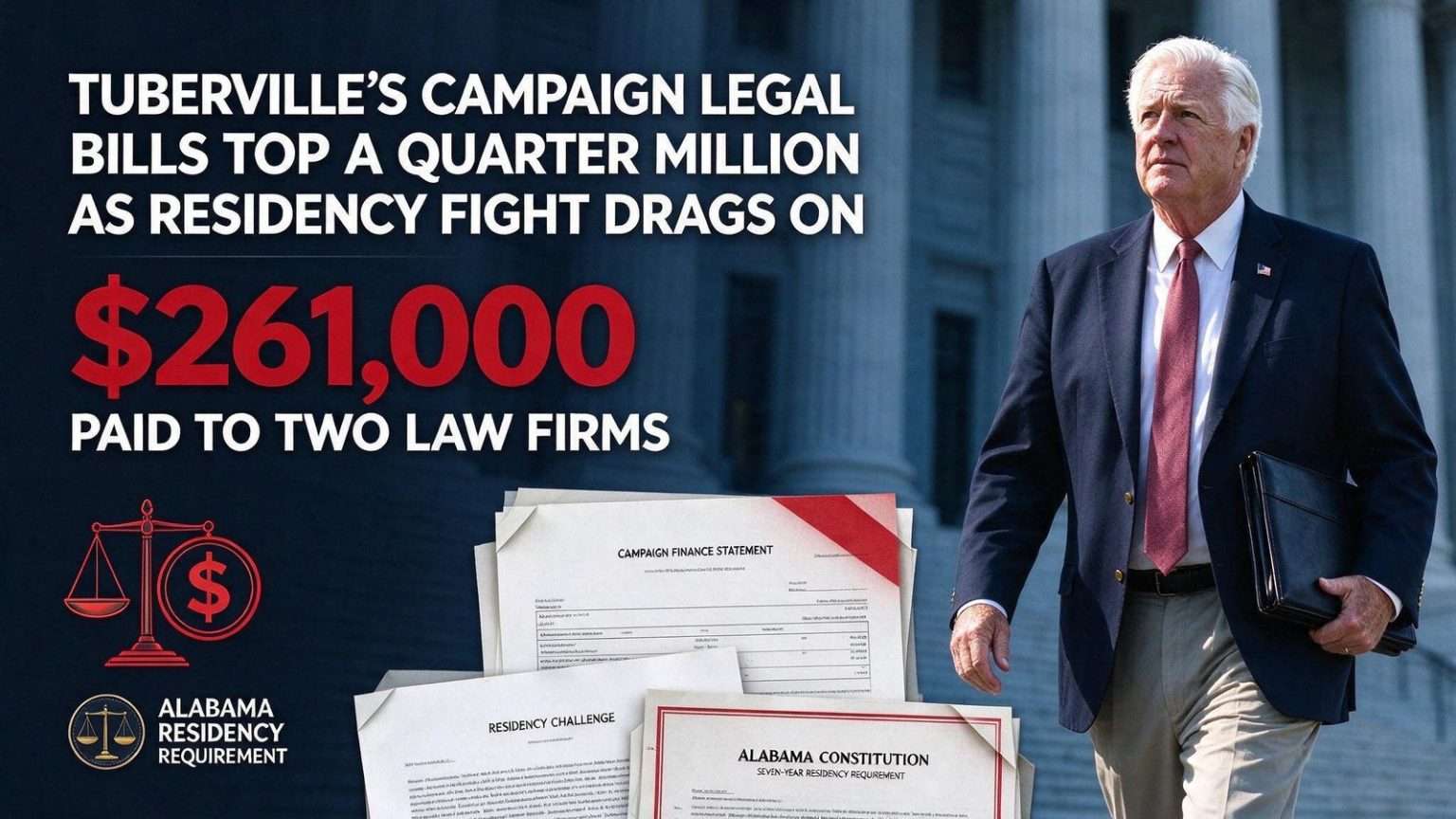
Lawyer and law firm spending for Tommy Tuberville’s gubernatorial campaign has now exceeded a quarter of a million dollars since the campaign launched last May, a total that already stands at roughly five times what he spent on legal fees during his entire 2020 U.S. Senate bid. The latest campaign finance reports show Tuberville has raised a commanding $13.7 million, and receipts attached to those reports show $261,000 paid to two law firms: Birmingham-based Wallace Jordan Ratliff & Brandt LLC and the national firm Lex Politica PLLC, according to a review of campaign finance records.
The legal spending has ballooned since the start of this year as Tuberville’s attorneys have fought off multiple rounds of intraparty challenges and lawsuits surrounding his candidacy. At the center of those fights is a persistent question: whether his continued ties to a home in Santa Rosa Beach, Florida, constitutionally disqualify him from holding the Alabama governor’s office.
The Residency Question at the Heart of the Fight
The dispute turns on a residency requirement that is easy to state and difficult to litigate. Alabama’s constitution requires seven consecutive years of residency in the state prior to the election for the office of governor. Challenges built on that clause have followed the campaign almost from the beginning, filed by would-be challengers within the Republican Party and pursued in court by outside litigants after the intraparty process ran its course.
Santa Rosa Beach sits in Walton County, along the Florida Panhandle east of Destin, close enough to the Alabama line that the drive to Montgomery takes only a few hours. Critics have seized on Tuberville’s ownership of a home there as evidence that his true legal residence lies outside Alabama. The campaign has maintained that Tuberville, a former Auburn University football coach who built his public life in the state, is and has been an Alabama resident, and the challenges mounted against him so far have not succeeded in knocking him off the ballot.
Defending that position has not been cheap. Each new challenge has required lawyers to draft responses, appear at hearings and manage the paperwork that accompanies election litigation in a state where candidate qualification disputes are a recurring feature of campaign season. The result is a legal bill that has grown month after month even as the campaign’s fundraising has continued to climb.
A Steep Climb From the 2020 Baseline
The scale of the current spending becomes clear only when set against Tuberville’s last campaign. Federal campaign finance records show he spent just $51,034 on legal fees during the 2020 Senate race, with payments going primarily to Warrenton, Virginia-based firm Holtzman Vogel Josefiak Torchinsky, a practice known for representing Republican committees and candidates in election-law matters. That race was contentious in its own right, yet it generated nothing close to the volume of legal work the gubernatorial campaign has absorbed in a matter of months.
In other words, Tuberville’s campaign has spent more on lawyers in the past seven months than it did during his entire Senate campaign. The quarter-million-dollar total is already more than five times the 2020 figure, and it reflects both victories in the challenges filed against him and ongoing legal fights that could keep those costs climbing through Election Day.
The reporting behind these numbers comes from two parallel systems. As a federal candidate in 2020, Tuberville filed with the Federal Election Commission, which itemizes disbursements in regular reports. As a candidate for governor, he now files with the Secretary of State under Alabama’s campaign finance law, and the receipts attached to those state reports are what allowed reviewers to identify the law firm payments and trace how they accumulated over the course of the year.
The Rematch With Doug Jones
The November general election will settle a rematch that carries a familiar name. Tuberville unseated Democrat Doug Jones in 2020 to win the Senate seat, and the two are now facing off again, this time for the governor’s office. Jones, a former U.S. Attorney for the Northern District of Alabama who won a special election to the Senate in 2017, has run a campaign structured very differently on the legal front.
Jones’s campaign shows $0 in identifiable direct payments to law firms over the same period, a stark contrast with the $261,000 in legal disbursements on the Republican side. The difference reflects the reality of the races each man has run: the challenges and lawsuits have been aimed at Tuberville’s qualification for the ballot, while Jones, having faced no comparable qualification fight, has had no need to retain election counsel at anything like the same scale.
Where the Money Went, and When
The timing of the payments tells its own story. About $179,523 of Tuberville’s legal fees were paid during June and July alone, coinciding with the bulk of the residency challenge litigation. Those two months captured the heaviest phase of the courtroom calendar, when filings, motions and hearings over his qualification for the ballot came in rapid succession and his attorneys were working on multiple fronts at once.
The two firms on the receiving end play complementary roles. Wallace Jordan Ratliff & Brandt is a Birmingham law firm whose litigation practice makes it a natural choice for defense of a statewide candidate in Alabama’s courts, where the challenges to his candidacy were actually filed. Lex Politica PLLC, a national firm focused on political law, handles the election-law dimension of the fight, the same specialized territory Holtzman Vogel covered for the campaign in 2020. Splitting the work between an in-state litigation shop and a Washington-oriented election firm is a common arrangement for campaigns that find themselves contesting ballot access rather than simply running against an opponent.
What the records do not show is any decline in the pace of the work. The campaign’s legal spending reflects both the challenges it has beaten and the ones still pending, and the documents filed in those cases make clear that additional hearings and rulings were expected as the general election approached. Every new filing carries a price tag, which is why the campaign itself has framed the possibility that costs will keep climbing rather than level off.
Why It Matters Beyond the Campaign
For Alabama voters, the residency fight is more than a footnote to the race. The governor’s office is the state’s chief executive position, and the constitutional standard a candidate must meet to seek it is one of the few qualifications written directly into the state’s founding document. When a leading candidate’s eligibility is tested in court, the outcome shapes the ballot that every voter ultimately sees, regardless of party.
The episode also offers a window into how campaign money is actually consumed. Much of the attention on fundraising totals centers on advertising, staff and travel, but a campaign facing active litigation can channel six figures into legal defense in a single summer without airing a single ad. Tuberville’s $13.7 million war chest has been more than sufficient to absorb the $261,000 in legal costs so far, yet the spending still represents resources not available for the traditional work of persuading voters.
The contrast with the 2020 Senate campaign is likely to remain the most cited comparison as the race goes on. That campaign ended with Tuberville unseating Doug Jones while spending barely one-fifth of what the current legal fight has already consumed. Whether the gubernatorial race ultimately requires another seven months of attorney time, or whether the remaining challenges resolve early, will determine how much higher the quarter-million-dollar figure climbs by the time the rematch is decided in November.
The broader pattern is one that political observers in Alabama have watched develop across several election cycles: candidate-qualification challenges have become a standard opening move in competitive statewide races, and the cost of answering them has become a standard line item in campaign budgets. A challenge that ultimately fails can still consume months of attorney time, and the candidate who prevails usually does so by outlasting the process rather than winning a single decisive ruling.
Tuberville’s campaign has done exactly that so far. Each round of intraparty objections and each civil suit has been answered and survived, leaving the former coach on the ballot and in a strong fundraising position heading into the fall. But the cumulative price of that endurance is now visible in the finance reports, and it distinguishes this campaign from nearly every other race on the November ballot, where neither candidate has had to defend their basic eligibility to run.
The coming weeks will show whether the legal spending plateaus or accelerates. If the remaining residency litigation winds down, the $261,000 total will stand as the cost of clearing the path to the ballot. If new challenges emerge, as the campaign’s own filings suggest is possible, the two firms will keep billing and the gap between this race and the $51,034 Senate campaign of 2020 will only widen.