A state representative from Daphne is reviving a fight to expand Alabama’s death penalty to cover some of the state’s most severe child sex crimes, just days after discussing the idea at the White House.
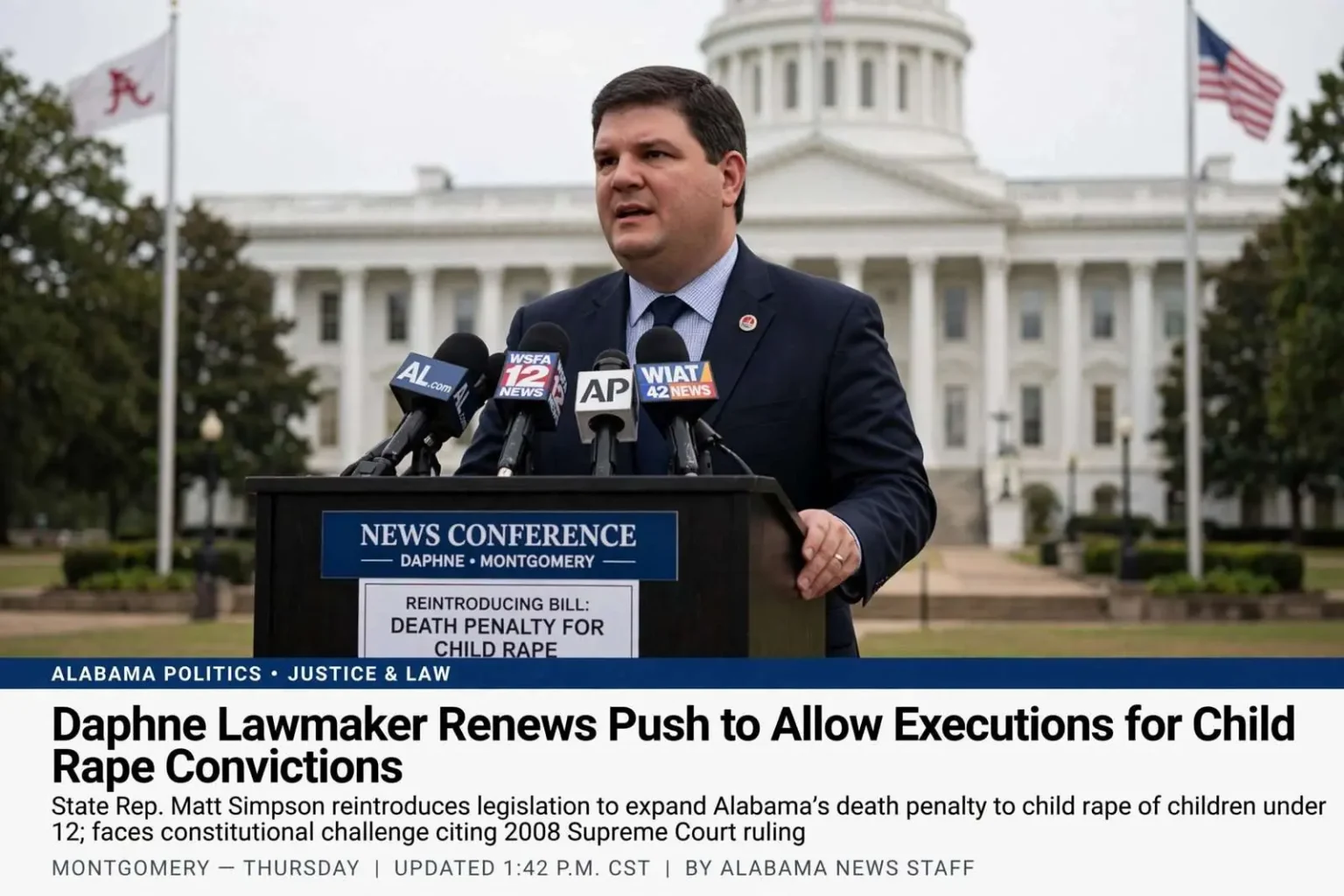
State Rep. Matt Simpson, a Republican who represents Daphne, told reporters at a Montgomery news conference Thursday that he plans to reintroduce legislation that stalled earlier this year. The bill would allow prosecutors to seek the death penalty against defendants convicted of raping or sodomizing children younger than 12.
“In my opinion, this is the worst of the worst of offenses,” Simpson said. “Taking advantage and taking the innocence of children under the age of 12 is one of the worst things — if not the worst — someone can do. Because it is one of the worst offenses, it deserves the worst of the worst punishments.”
Simpson will carry two death penalty bills into the 2026 legislative session. He has already prefiled separate legislation that would allow capital punishment for murders committed in places where multiple people are put at risk — a category aimed at killings during mass-casualty events and attacks in crowded public settings.
The two bills together would mark Alabama’s most significant expansion of capital punishment in a generation. Current Alabama law reserves the death penalty for capital murder — killings committed in defined circumstances such as during another felony, of a witness, of a child under 14 by an adult 18 or older, or by someone with a prior murder conviction. Simpson’s proposals would push the boundary of eligibility outward on two fronts: toward crimes that do not kill anyone, and toward killings whose aggravating feature is location rather than victim.
A constitutional obstacle
The child rape proposal faces a significant legal hurdle. The U.S. Supreme Court struck down a similar Louisiana law in 2008, ruling that executing someone for a crime that did not result in death was unconstitutionally “unusual” punishment.
That ruling — Kennedy v. Louisiana — remains the controlling precedent, and it did more than void one statute: the Court held that the Eighth Amendment’s evolving-standards test counted state legislation as evidence of a national consensus, and found that the overwhelming majority of states did not permit execution for child rape. Six states had such laws at the time; none does today in the form the Court struck down.
Simpson is betting that a wave of similar state laws could eventually change the calculus at the nation’s highest court. He pointed to laws already passed in Florida in 2023 and in Tennessee last year, along with newer statutes in Idaho, Arkansas and Oklahoma this year. “Alabama needs to be on this list,” Simpson said, arguing that if enough states adopt similar laws, the Supreme Court may eventually decide the punishment is no longer “unusual” and therefore constitutional.
The strategy has a track record in death penalty jurisprudence. The Court’s Eighth Amendment cases — including the 2008 Louisiana decision itself — have treated the number of states authorizing a punishment as a live measure of consensus, and a sustained shift from a handful of states to a dozen or more would give a future Court reason to revisit its own count. Legal observers have noted that the newest round of statutes, unlike the pre-2008 wave, arrives with legislative sponsors explicitly courting the constitutional question, in the hope of producing the test case that reopens it.
Alabama Attorney General Steve Marshall said his office is prepared to defend the law in court if it passes. “I can tell you that if it occurs during my tenure as attorney general, we will make sure” the state carries the defense, Marshall has said of the measure, framing the office’s role as making the statute survive the legal fight rather than merely pass. The attorney general’s office defends capital convictions on appeal as a routine part of its work, and a challenge to a new category of death-eligible crime would land there first.
Marshall described the purpose of the legislation in those same terms: “To be able to send a clear message about not only the intent of the Legislature in protecting kids, but the public policy in our state as to how we hold those who hurt our kids accountable.” The message-sending rationale is standard in capital punishment debates, but it carries a specific legal weight here: the evolving-standards test asks not only how many states authorize a punishment but what those legislatures’ stated purposes say about the punishment’s character.
The evidence problem
Advocacy for expansion runs into a body of empirical research on how the death penalty actually operates. Candidate Tova Cohen found that use of the death penalty in mass shooting cases has fallen sharply since the 1960s — a finding that complicates Simpson’s second bill, because it suggests that even the most notorious killings increasingly end in life sentences rather than execution.
Cohen said research on deterrence shows that the severity of a punishment matters less than how swiftly and certainly it is applied — and defendants often spend decades on death row, if they receive a death sentence at all. That conclusion, drawn from decades of criminological work, is the standard scholarly objection to expansion arguments: capital statutes add a punishment that is rarely used and rarely swift, and the certainty of apprehension and conviction — not the maximum sentence — is what moves deterrence.
One participant in the debate put the arithmetic bluntly: “But if 60 percent of those individuals are not receiving the death penalty, then I don’t see how we can move that into a space of non-life-threatening, but still extremely gross and violent crimes.” The point — that even in cases Alabama law already makes death-eligible, most defendants do not end up executed — frames the practical critique of Simpson’s proposal: a punishment applied in a minority of capital cases is unlikely to be applied at all in a category the Supreme Court has never allowed.
Despite those doubts from researchers, Simpson said the proposal has found receptive ears within the Trump administration.
“I was very honored to be in the White House on Tuesday, and this bill, this topic was discussed in the White House,” Simpson said. “They talked about this being part of the ‘America First’ agenda.”
The White House discussion matters for more than symbolism. Federal executive attention can shape the national debate over state criminal laws, and a topic floated inside the administration becomes part of the legislative conversation in statehouses where allied lawmakers are watching Washington’s priorities. For a state legislator carrying a constitutionally contested bill, a White House conversation is also a signal that the political environment — at least in one party — has moved in the direction his strategy requires.
Simpson’s bills will be among the measures lawmakers take up when the 2026 Alabama legislative session convenes.
Alabama’s capital punishment context
The proposals land in a state where capital punishment has been unusually active in recent years. Alabama carries out executions at rates among the highest in the nation per capita, resumed them in early 2024 after a yearlong moratorium prompted by problems with lethal injections, and introduced nitrogen hypoxia as a new execution method in a case that drew national and international attention. The state’s death row is among the largest per capita in the country, and its capital sentencing procedures — including a long-standing practice that allowed judges to override jury recommendations — have been the subject of repeated litigation.
Against that backdrop, expanding eligibility is politically familiar territory for the Legislature. Alabama lawmakers have repeatedly adjusted capital statutes in response to particular cases and public sentiment, and bills touching the death penalty typically move through the Legislature with strong majorities. The open question for Simpson’s child rape bill is not legislative passage — sponsors expect it — but what follows: an immediate federal constitutional challenge that the attorney general’s office would defend all the way toward the Supreme Court.
That path is the strategy’s real destination. A state law challenged in federal court moves through the district courts and the Eleventh Circuit before reaching the justices, and a statute that survives the intermediate courts on a novel theory gives the Supreme Court a clean vehicle for revisiting Kennedy v. Louisiana. Simpson has described the multi-state approach as deliberate for exactly that reason: no single state statute can move the Court, but a body of statutes, litigation and appeals could build the record that does.
What it means locally
For Baldwin County, the legislation carries practical weight in the work of its own courts. Prosecutors in Baldwin and Mobile counties handle a steady volume of child sexual abuse cases, and district attorneys across the state have supported broader penalty tools for the most severe offenses. A capital-eligible category for the rape of a child under 12 would give local prosecutors a sentencing option they have never had — and would place every such charging decision under the shadow of the constitutional fight that follows.
The defense bar’s concerns are equally concrete. Capital cases cost counties far more to prosecute and defend than non-capital ones, both in trial expense and in the appellate process that every death sentence triggers, and capital-eligible charges give defendants incentives to resolve cases with pleas that avoid the ultimate penalty. District attorneys would gain leverage in negotiations even if executions are never carried out under the new category — a dynamic supporters count as deterrence and critics count as coercive.
Whether the bill becomes a test case, a statute that stalls again, or both, its path through the 2026 session will be watched from Montgomery to Washington. Simpson has framed the choice in absolute terms — the worst offenses deserve the worst punishments — and the institutions around the bill, from the attorney general’s office to the Supreme Court’s evolving-standards doctrine, will now decide whether the law can say what he wants it to say.