Alabama Power-Linked PACs Poured Nearly $100,000 Into Local Legislative Races
Political action committees tied to Alabama Power spent nearly $100,000 on Mobile and Baldwin county legislative races in the 2018 election cycle, with spending accelerating further in 2019, state campaign finance filings show.
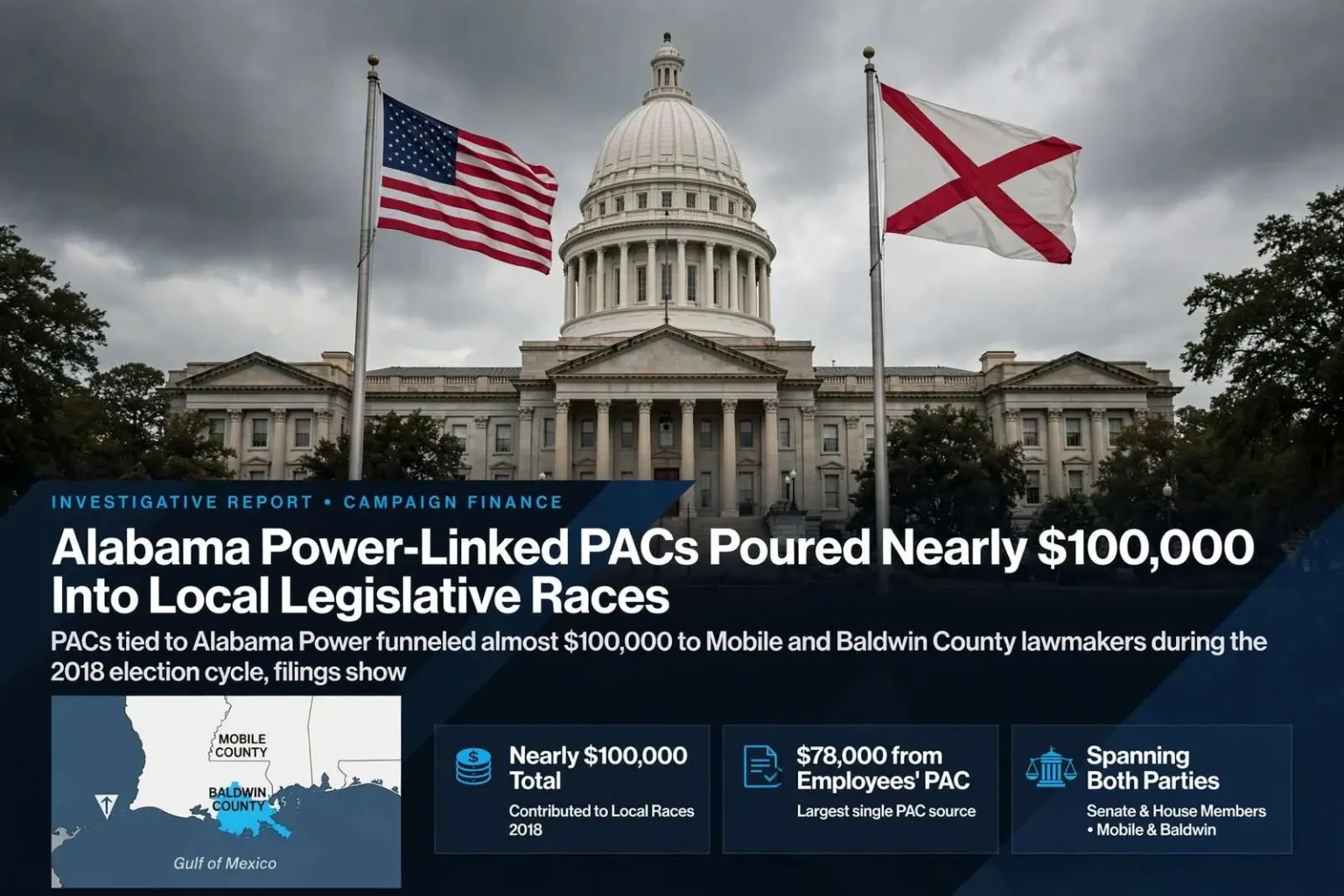
Political action committees tied to Alabama Power funneled almost $100,000 into the campaigns of state lawmakers representing Mobile and Baldwin counties during the 2018 election cycle, according to campaign finance filings maintained by the Alabama Secretary of State’s office. The utility and its affiliated PACs have continued spending heavily on state officeholders through the first half of 2019, filings show, making the company one of the most consistent donors to the legislative delegation that represents the two-county coastal region in Montgomery.
The bulk of the money — roughly $78,000 — came from a political action committee funded by Alabama Power employees. Smaller sums flowed to local candidates from three other PACs the utility supports: the Alabama Trucking Association, MACC PAC and Alabama Works PAC. The arrangement, in which the company, its employees and allied industry groups each maintain separate committees, spreads the utility’s political giving across multiple channels, and the combined effect is larger than any single committee’s filings would suggest.
The contributions reached nearly every state lawmaker from the two counties who holds statewide legislative office, crossing party lines in the process. Both Republican and Democratic members of the Alabama House and Senate benefited from money connected to the state’s largest electric utility, a pattern that reflects the company’s deliberate approach to maintaining goodwill in both parties and in every part of the state where it serves customers.
Where the money went locally
Republican Sen. Chris Elliott of Fairhope, who won his first campaign for the seat last year, took in more money from Alabama Power-linked PACs than any other local candidate. Elliott received $17,500 in four separate contributions from the employees’ PAC during his campaign. The Senate district Elliott carried includes much of Baldwin County’s fast-growing Eastern Shore, and the size of the support he drew in a first Senate campaign underscored the value the company places on the district’s new senator.
Fellow Republican Sen. Jack Williams of Wilmer was close behind, collecting $12,500 from the same PAC. Sen. David Sessions, R-Grand Bay, brought in $10,000 from the employees’ fund. Together, the three Senate members’ totals accounted for a large share of the local money, a distribution consistent with the company’s practice of concentrating its largest contributions on Senate seats, where tenure and district boundaries tend to make individual senators long-term players in state policy.
Six local Republican state representatives received smaller in-kind or cash contributions from MACC PAC: Alan Baker of Brewton, Harry Shiver of Bay Minette, Chris Pringle of Mobile, Victor Gaston of Mobile, Chip Brown of Mobile and Matt Simpson of Daphne. MACC PAC, affiliated with the Manufacture Alabama coalition of industrial employers, counts Alabama Power among its backers, and its contributions to the region’s House incumbents ran smaller than the Senate totals but reached more members.
On the Democratic side, Reps. Adline Clarke and Barbara Drummond, both of Mobile, each received contributions from Alabama Works PAC, a fund Alabama Power has supported in past election cycles. Former Mobile Mayor and current state Rep. Sam Jones, a Democrat, collected $2,500 from the Alabama Power-backed Alabama Trucking Association PAC, and his combined total of $7,000 from the truckers’ fund and the employees’ PAC made him the top recipient among area Democrats. Clarke followed closely with $6,500 in combined contributions, including $2,500 from Alabama Works and $4,000 from the employees’ PAC.
Statewide spending dwarfs the local totals
The sums flowing into Mobile and Baldwin county races are a fraction of what Alabama Power and its affiliated committees have spent on candidates statewide. Between November 2017 and November 2018, the company and its PACs put more than $700,000 into statewide campaigns, filings show. Gov. Kay Ivey alone received $51,000 in cash contributions from the employees’ PAC during that stretch, a figure that placed the utility among the governor’s most generous supporters in the 2018 cycle.
Spending has only accelerated since the start of 2019. Alabama Power and its associated PACs have reported $165,000 in contributions so far this year. The employees’ PAC has directed more than $100,000 combined to Ivey, Lt. Gov. Will Ainsworth and Attorney General Steve Marshall, while the utility itself has given $20,000 to Alabama Works and $35,000 to MACC PAC in 2019 alone. The early spending in a non-election year signals the company’s strategy of maintaining financial relationships between cycles rather than concentrating them in the months before an election.
The beneficiaries of that steady giving are not arbitrary. The governor, the lieutenant governor and the attorney general occupy offices that touch the company’s interests in different ways, from appointments and the legislative agenda to legal actions that can reach the utility’s operations. Campaign finance analysts have long noted that regulated companies tend to spread contributions across statewide officeholders precisely because it is impossible to predict, years in advance, which office will matter to a given issue.
A network built over decades
Alabama Power has long ranked among the most influential political donors in the state, maintaining relationships with elected officials across the political spectrum through a network of PACs that both employees and the company itself help fund. The company’s footprint in state politics has grown alongside its business: the Birmingham-based utility, part of the Southern Company system, supplies electricity to more than a million customers across Alabama, including every part of Mobile and Baldwin counties, and its rates, plant siting decisions and environmental compliance are all shaped by state policy.
The company’s political operation differs from most corporate donors in its structure. Rather than relying on a single corporate PAC, Alabama Power’s giving flows through the employee-funded committee, its own direct corporate contributions to other PACs, and allied industry committees like those of the trucking association and the manufacturers’ coalition. Each channel has its own officers, its own filings and its own donor base, which gives the company flexibility in how it supports a candidate and makes its total footprint harder to assemble from any one report.
Campaign finance records filed with the Secretary of State’s office allow the public to track individual contributions to candidates, though the full scope of a donor’s influence across multiple PACs and election cycles is not always easy to see in any single filing. The Mobile and Baldwin county totals, assembled by piecing together reports across the four committees, illustrate the point: no single filing shows the utility’s combined giving to the local delegation, and only by aggregating across committees does the pattern, nearly $100,000 in one cycle, become visible.
What the money buys, and what it doesn’t
No contribution in the filings is tied to a specific bill, vote or favor, and receiving money from the utility’s network of committees carries no legal consequence for the lawmakers who take it. What the contributions buy, in the view of political observers, is access and goodwill: a phone call returned quickly when an issue arises, a hearing granted on a friendly schedule, and the benefit of the doubt in the countless small decisions that shape utility policy before any bill reaches the floor.
Alabama’s utility regulation structure gives those relationships particular weight. The state’s Public Service Commission, a three-member elected board, sets the rates Alabama Power charges its customers, and the commission’s elections have historically drawn significant spending from the company’s side of the ledger. Legislative decisions matter too, from tax treatment of utility property to the state’s energy and environmental policy, and a delegation that includes allies in both parties provides the company with a wide base of support in Montgomery.
Consumer and good-government advocates have periodically called for tighter limits on contributions from regulated utilities to the officials who oversee them, arguing that the state’s campaign finance rules leave too much room for the appearance of purchased influence. Defenders of the current system, including many of the lawmakers who receive the money, respond that contributions are disclosed by law, that the company’s giving crosses party lines rather than consolidating on one side, and that Alabama Power’s reliability and rates are the real measures of its conduct in Montgomery.
The view from the coast
For residents of Mobile and Baldwin counties, the filings offer a practical lesson in following the money close to home. The delegation that represents the two counties in the Alabama House and Senate — from Elliott in Fairhope to Drummond and Clarke in Mobile — collected utility-linked support at levels that track seniority and chamber, with senators drawing the largest amounts and House members smaller but more widely distributed sums. Those totals place the coastal delegation within the company’s broader statewide giving, which topped $700,000 during the 2018 cycle and has already passed $165,000 this year.
The coastal region’s interests give the delegation particular leverage with a utility whose infrastructure runs through it. Alabama Power’s generating plants, transmission corridors and substations across south Alabama sit in the districts these lawmakers represent, and issues from storm restoration to the economic recruitment of energy-intensive industry along the Gulf Coast put utility policy directly in the path of local concerns. A delegation that includes well-funded supporters of the company is positioned to raise those issues with management in Birmingham as readily as with regulators in Montgomery.
As the 2019 filings continue to accumulate ahead of the next election cycle, the utility’s network of PACs will keep reporting its contributions one committee at a time, and the Secretary of State’s database will keep recording them one candidate at a time. The nearly $100,000 that reached Mobile and Baldwin county lawmakers in a single cycle is already on the record, and it stands as the clearest local illustration of how thoroughly one company’s political operation spans the statehouse, from the Gulf Coast to the governor’s office.