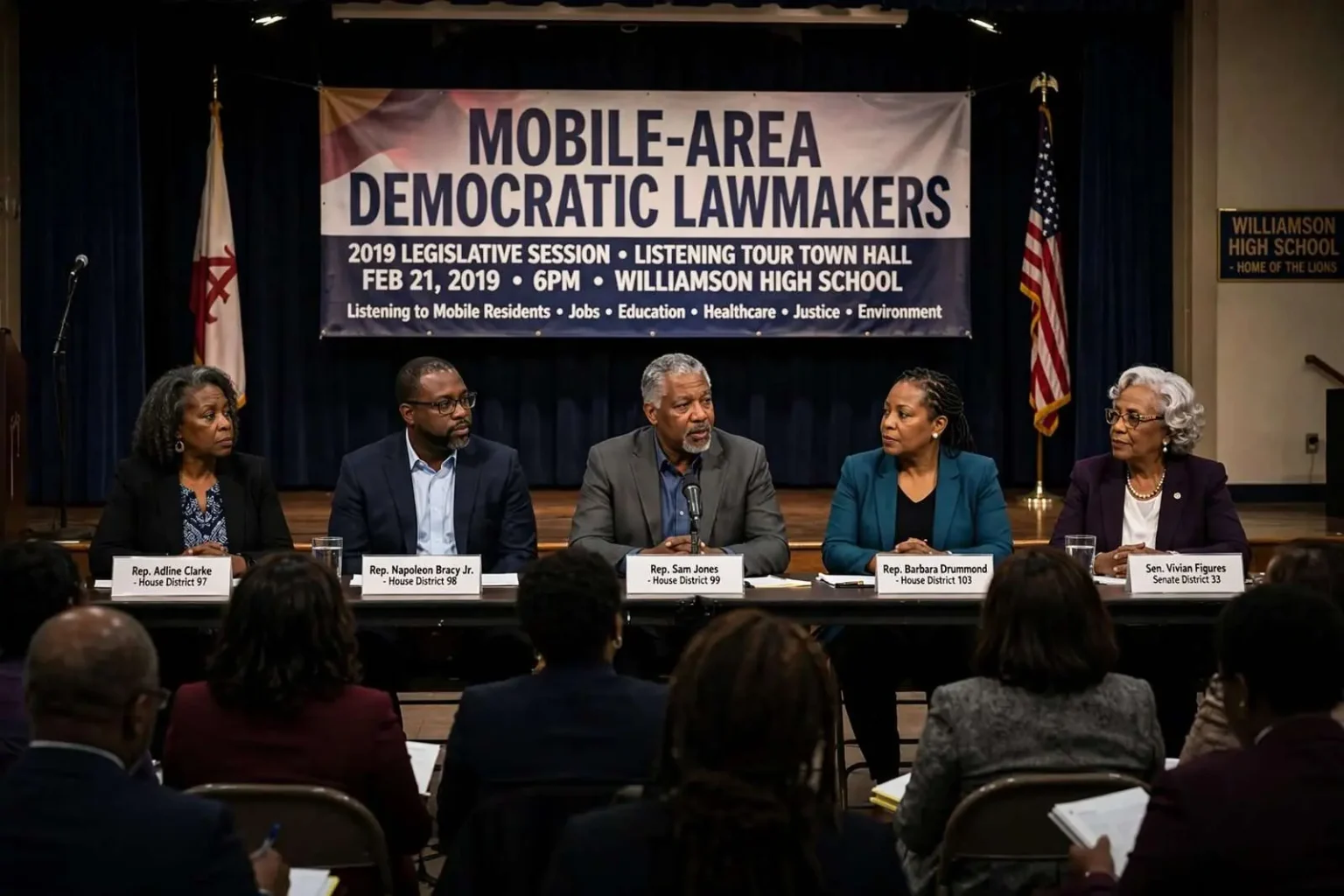
Democratic state lawmakers representing the Mobile area will gather with constituents Thursday evening for a town hall meeting, part of a statewide listening tour the party’s caucus has organized ahead of the upcoming legislative session in Montgomery. The meeting is scheduled for 6 p.m. Thursday, Feb. 21, at Williamson High School, located at 1567 E. Dublin Street in Mobile. The venue choice puts the event in the heart of the district landscape these legislators represent, in a part of the city where residents have direct daily stakes in the schools, roads and health systems the Legislature funds.
It will be hosted by state Reps. Adline Clarke, Napoleon Bracy Jr., Sam Jones and Barbara Drummond, along with state Sen. Vivian Figures, all of whom represent portions of Mobile and the surrounding area in the Alabama Legislature. Together the five lawmakers cover most of the city of Mobile and its surrounding neighborhoods in the State House and Senate, forming the core of the Mobile-area Democratic delegation. Each brings a different portfolio of committee assignments and seniority to the session, and each uses constituent meetings like Thursday’s to calibrate which local issues carry the most urgency back to Montgomery.
Organizers say residents are welcome to raise any topic of concern during the session, though promotional materials for the event have highlighted a handful of legislative priorities Democratic lawmakers plan to push during the upcoming session, including job creation, public education funding, criminal justice and prison reform, environmental justice issues and expanding access to healthcare. The list reads as a summary of the disparities Mobile residents most often cite: pockets of the city where unemployment, school funding, industrial pollution and healthcare access remain persistent concerns even as the broader regional economy grows.
The Listening Tour Format
Thursday’s gathering is the latest stop in a series of town hall meetings members of the Alabama House Democratic Caucus have held in communities across the state as they prepare for the 2019 legislative session, which convenes in Montgomery on Tuesday, March 5. The caucus, which holds a minority of seats in both chambers against a Republican supermajority, has limited power to pass its agenda but considerable ability to shape the public debate — and listening tours are how minority caucuses collect the constituent stories that ground floor speeches and amendments during the session.
Lawmakers have used the meetings to hear directly from voters about local concerns before bills are filed and committee work begins. The timing matters in the legislative calendar: the first weeks of an Alabama session are when bills get drafted, assigned to committees and scheduled for public hearings, so input gathered in February can still influence which bills get filed and which priorities get funded in the caucus’s budget requests. By March 5, the machinery of the session is moving, and the window for shaping the agenda narrows fast.
The format also reflects the realities of Alabama’s legislative geography. Mobile’s delegation travels roughly three hours to Montgomery for sessions that run through the spring, and the distance between constituents and the State House is a structural fact of representation. Town halls compress that distance for an evening, putting five legislators on a stage in their own districts where the questions come unfiltered and the follow-ups can’t be dodged.
The Priorities on the Table
Each highlighted priority maps onto live debates expected in the 2019 session. Public education funding returns to the calendar every year through the Education Trust Fund budget, where lawmakers decide how much of the state’s growth revenue reaches classrooms, teachers and school programs — a question with direct consequences for Mobile County’s public schools. Criminal justice and prison reform had been building toward legislative action, with Alabama’s prison system under sustained scrutiny over overcrowding, staffing and federal litigation risks that lawmakers in both parties acknowledged needed a legislative response.
Healthcare access is the priority with perhaps the widest constituent impact in Mobile, where rural hospitals across the broader region have closed and where the debate over expanding coverage has run through multiple sessions without resolution. Expanding access — whether through Medicaid expansion or narrower legislation — has been a standing Democratic priority in Montgomery, and town hall audiences consistently rank it among their top concerns. Environmental justice adds a distinctly Gulf Coast dimension to the list: Mobile’s industrial corridors, drainage infrastructure and storm exposure make the distribution of environmental burdens and protections a recurring local question, one that state-level regulation and funding decisions directly shape.
Job creation rounds out the list, and in Mobile it is inseparable from the port, the shipbuilding industry, the aerospace suppliers and the tourism economy that anchor the region’s employment. The delegation’s argument in Montgomery typically centers on directing workforce training dollars and infrastructure investment toward neighborhoods that the headline projects have bypassed, a framing residents will recognize from economic development conversations the city itself has been having.
Why Town Halls Matter
Town halls like Thursday’s give residents a rare chance to speak face-to-face with the legislators who represent them, rather than relying solely on phone calls, letters or social media to make their views known in Montgomery. The distinction is more than ceremonial. A constituent’s two-minute question in a school auditorium often carries more weight with a legislator than a stack of emails, because it comes with a face, a neighborhood and a story — and because other attendees hear it and nod, confirming that one complaint is actually a pattern.
Local political observers say such meetings can shape which issues lawmakers prioritize once the session gets underway, particularly on matters like education funding and healthcare access that routinely draw significant public interest in the Mobile area. Legislators are practical about this: the issues that fill a room are the issues that fill a constituent letter, a floor speech and a budget amendment. Thursday’s crowd size and question mix will tell the five hosts what Mobile wants them fighting for when the session’s budget debates begin.
The meeting’s structure follows the standard town hall pattern: brief remarks from each legislator on their session priorities, followed by open questions from the floor with no topic ruled out. Residents who want individual help with state agencies — driver’s license issues, Medicaid paperwork, unemployment claims — typically get a chance to connect with the lawmakers’ district staff after the formal program ends, which is one of the most concretely useful functions these evenings serve.
How to Attend
The event begins at 6 p.m. at Williamson High School, 1567 E. Dublin Street, and no registration or ticket is required. Residents planning to attend should expect parking around the campus to fill as the start time approaches, and those who want to ask a question are encouraged to arrive early enough to sign in. Williamson’s location east of downtown makes the venue reachable from both the city’s central neighborhoods and the communities along the Azalea Road and Government Boulevard corridors.
Additional information about Thursday’s town hall and other events hosted by the Alabama House Democratic Caucus was available through the caucus’s offices and the legislators’ district offices, which maintain schedules of constituent events through the session. For residents of Mobile who have ever wondered whether anyone in Montgomery is listening, Thursday evening offers a direct answer — five of them, in fact, sitting on a stage in their own districts with the 2019 session less than two weeks away.
The Delegation in Montgomery
Understanding what these five lawmakers can actually do requires a quick look at the structure they operate in. The Alabama Legislature meets in regular session for part of the year, with the House’s 105 members and Senate’s 35 members controlled by Republican supermajorities in both chambers. In that environment, the Mobile-area Democrats’ influence comes through committee work, amendments to majority bills, and the constituent-driven arguments they can make from the floor — plus the practical leverage that comes when their districts’ needs overlap with issues the majority also wants addressed, as with prisons and infrastructure.
Seniority matters too. Sen. Vivian Figures, one of the Senate’s longest-serving members, has carried legislation on a wide range of civil and consumer issues across decades in Montgomery, and her institutional knowledge of how budget negotiations unfold is an asset the delegation leans on. The four House members split committee assignments that touch education, health, local legislation and economic development, and each uses those seats to shepherd Mobile-specific bills — the local measures that affect only Mobile County — through the process that consumes much of every session’s calendar.
For constituents, the practical takeaway is that a town hall question can seed a local bill or a budget amendment within weeks. Legislators file hundreds of local acts each session — measures affecting a single county’s courthouse fees, school board boundaries or municipal annexations — and those bills usually originate in district conversations exactly like Thursday’s. The big statewide debates draw the headlines, but the local work is where a district’s daily problems get solved.
The Issues Mobile Brings to the Mic
Attendees at Mobile delegation town halls tend to raise a recognizable set of concerns, and the February meeting was expected to be no different. Streets and drainage top many lists in a city where heavy rains flood the same low-lying neighborhoods year after year, and residents know the difference between a city paving project and the state highway funding that determines what Montgomery can help with. School questions follow close behind, particularly around educator pay, classroom funding and the state tests that shape local school report cards.
Healthcare questions usually focus on access — clinic hours, Medicaid coverage, the cost of prescriptions and the distance to the nearest emergency room in neighborhoods where hospitals have consolidated. Criminal justice questions have grown in volume as the state’s prison crisis has dominated headlines, with constituents asking both about public safety and about the cost of the correctional system in a state budget that competes with education for every dollar.
Environmental concerns round out the expected topics, from industrial neighbors along the river and port to the long-running questions about stormwater, cleanup sites and who bears the burden of the region’s industrial growth. These are the issues where state regulation, not city ordinance, sets the rules, which is precisely why the delegation’s Montgomery seats matter to the residents asking about them.
Thursday’s meeting closes the delegation’s pre-session calendar in Mobile, and what comes out of it will surface in Montgomery within weeks — in the bills the five lawmakers file, the amendments they offer and the arguments they make when the 2019 session gives them the floor. For the residents of E. Dublin Street and everywhere else in the districts these five represent, that is the point of showing up: making sure the session that starts March 5 in Montgomery begins with Mobile’s voice in the room.