Man Hospitalized After Being Struck by Car Near Knollwood Drive in Mobile
A man was hospitalized after being hit by a car near Knollwood Drive and Oakleigh Trace Court in Mobile; injuries unknown.
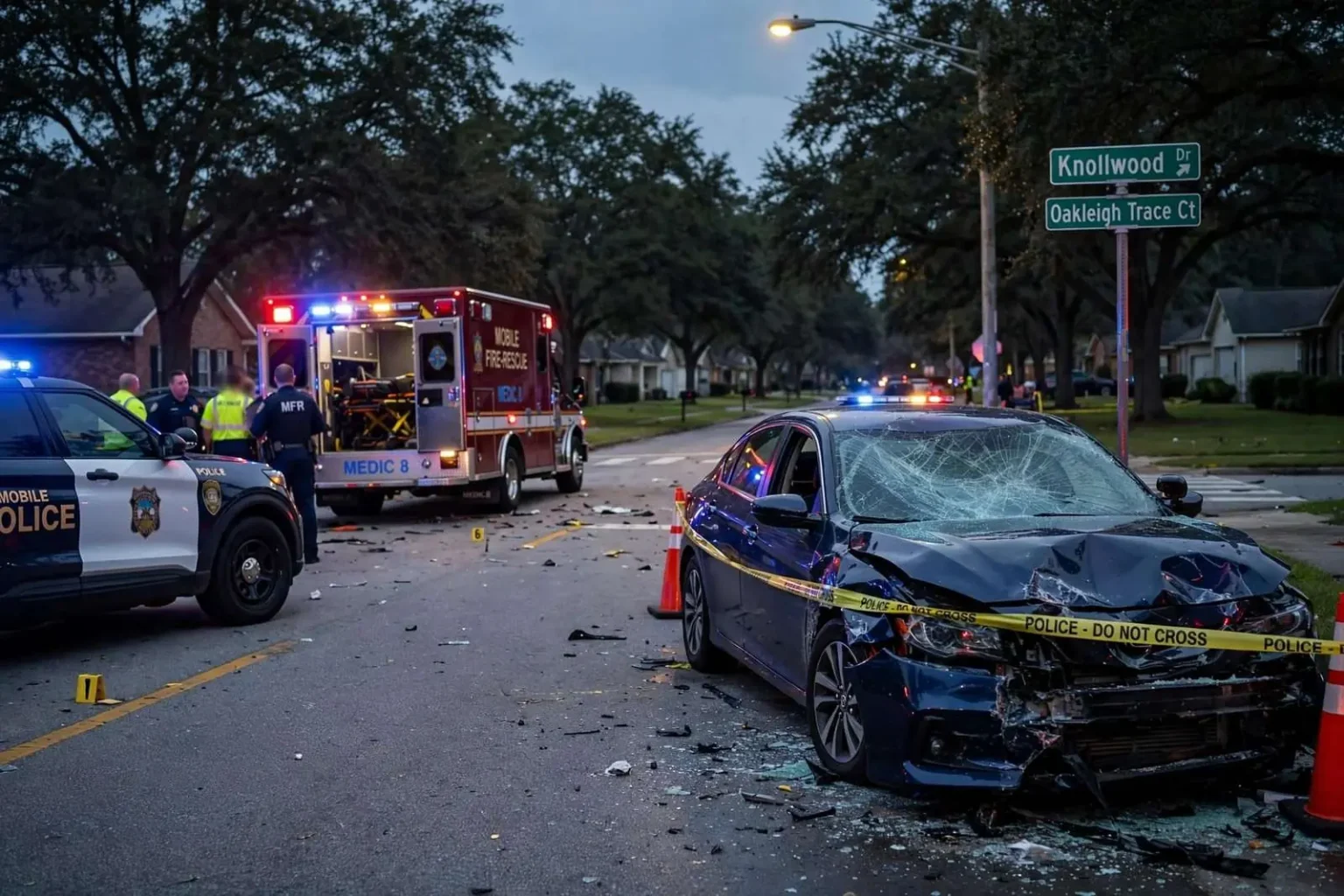
MOBILE, Ala. — A man was struck by a car near the intersection of Knollwood Drive and Oakleigh Trace Court, according to authorities.
Emergency crews rushed the victim to a hospital by ambulance after the crash. Officials did not immediately say how serious his injuries were.
The vehicle involved remained at the scene, with heavy damage to its front windshield, and investigators worked to determine what led to the crash.
No citations or charges had been announced as of early Tuesday morning, and the investigation remained ongoing.
The Scene Near Knollwood
The crash occurred in the Knollwood area of west Mobile, a district of established neighborhoods, schools and commercial strips threaded together by busy corridors. Knollwood Drive itself carries a steady mix of commuter and neighborhood traffic, connecting residential streets to the larger arteries that move drivers across the western part of the city. Oakleigh Trace Court, the residential street named alongside it, represents the quieter side of that equation — the kind of block where families live directly along the path of through traffic.
When a pedestrian is struck on or near such an intersection, the response unfolds quickly and in a familiar order. Dispatchers send police, fire and EMS units together; medics assess the victim on the scene; officers begin documenting the location before skid marks, debris and vehicle positions are disturbed. The ambulance transport reported in this case indicates that the man’s condition warranted immediate hospital care rather than treatment at the scene.
The heavy damage to the front windshield of the car that remained at the scene is the kind of physical detail investigators examine closely. Windshield damage in a pedestrian crash can indicate the point and force of impact, and it becomes part of the reconstruction that determines how fast the vehicle was traveling and in what direction. That the car stayed at the scene suggests the driver remained present rather than leaving, which authorities will factor into their assessment of the event.
How Mobile Investigates Pedestrian Crashes
Crashes involving pedestrians are investigated differently from ordinary fender-benders. Because the potential consequences are severe, investigators work to reconstruct the event: where the pedestrian was when struck, whether he was in a crosswalk or crossing mid-block, what the driver’s speed and line of sight were, and whether visibility, lighting or weather played any role. Officers typically canvass nearby homes and businesses for surveillance footage, which in west Mobile often captures stretches of roadway that lack eyewitnesses.
Statements from the driver and from the victim, once he is able to give them, become central. Toxicology results are standard in serious-injury crashes involving either party. The findings from all of this work determine what, if anything, is charged — from traffic citations for failure to yield to more serious offenses if impairment or recklessness is found.
The absence of any citation or charge announced by early Tuesday does not mean none will come. It means the investigation had not yet reached a conclusion. Mobile police, like agencies across Alabama, generally withhold that determination until the evidence has been reviewed, particularly in cases where a victim’s injuries prevent an immediate account from the person struck.
Pedestrian Safety on Mobile’s Corridors
West Mobile’s road network was built primarily around the automobile, and wide, fast corridors like those crossing the Knollwood area have long presented challenges for people on foot. Crossing distances are long, traffic volumes are high, and marked crossings can be spaced far apart — conditions that transportation safety advocates identify as contributors to pedestrian crashes nationwide. Alabama consistently ranks among the states with the highest per-capita pedestrian fatality rates, a statistic shaped by roadway design, dusk-to-dark travel patterns and seat-belt and impairment factors on both sides of the windshield.
The response from emergency crews in cases like this one also reflects how the region’s system is designed to work. Mobile Fire-Rescue and private ambulance services operate under dispatch protocols that treat pedestrian-involved crashes as high-priority medical calls, and the decision to transport a patient by ambulance rather than treat and release signals that responders believed hospital evaluation was necessary. The short trip to a hospital from the Knollwood area gives trauma teams quick access to the patient, which is one advantage of a crash occurring in a built-up part of the city rather than on a rural highway.
For neighborhoods around Knollwood Drive, a serious pedestrian crash renews familiar questions: where children cross on the way to school, how fast drivers take the corridor, and whether additional crossings or traffic calming might prevent the next incident. City planners in Mobile have increasingly weighed such requests as the city updates its transportation plans, though changes typically follow lengthy study rather than immediate response.
The hours around dusk and darkness are statistically the most dangerous for pedestrians, and investigators in cases like this one will account for the lighting conditions at the time of the crash. Streetlight coverage, the clothing worn by the person struck and the orientation of the vehicle all enter the reconstruction, along with the more fundamental question of who had the right of way at the moment of impact.
What Happens to the Victim
A pedestrian struck by a car typically faces a distinctive pattern of injuries, from broken legs and hips to head, chest and abdominal trauma, depending on the vehicle’s speed and the height of the impact. Hospital care in such cases often begins with imaging and trauma evaluation, followed by surgery where fractures or internal injuries require it. Recovery can run from weeks to many months, and officials’ decision not to characterize the man’s condition immediately is common practice while medical assessment is still underway.
Names of injured crash victims are frequently withheld by authorities until family members have been notified, which is why early reports identify the man only by his injuries rather than by identity. His condition, once established, will be added to the public record as the investigation continues, and any change — from stable to critical, or the reverse — will shape how the case is ultimately handled.
The hospital also becomes part of the investigative chain. Detectives may seek to interview the victim once his condition allows, and medical documentation of his injuries becomes evidence in determining the mechanics of the crash. In serious cases, investigators sometimes return to the scene to re-measure and re-photograph once they understand more about the injuries sustained.
The Driver’s Side of the Investigation
The driver of the vehicle that remained at the scene will be a focus of the investigation from the start. Officers will document the driver’s account of what happened, check for impairment through field observations and testing where warranted, examine the vehicle for mechanical condition and review the driver’s license, insurance and record. The heavy windshield damage will be measured against the rest of the damage pattern to build the reconstruction.
Remaining at the scene is itself significant under Alabama law, which requires drivers involved in injury crashes to stop, provide aid and remain until authorities have responded. Leaving the scene of an injury crash is a serious crime; the fact that this vehicle was still there when investigators processed the scene keeps the case on a different track — one focused on determining fault rather than locating a driver.
The distinction matters for neighbors following the case. A crash that remains under investigation with no charges announced can still end in citations, in criminal charges, or in no legal action at all if the evidence shows the driver acted lawfully and the pedestrian stepped into the roadway unexpectedly. Each of those outcomes requires the same starting point: a careful, documented reconstruction of the moments before impact.
What Neighbors Can Expect Next
In the days after a crash of this kind, the intersection returns to normal even while the paperwork is far from finished. Investigators complete their reports, request any available video from homes and businesses nearby, and wait on medical and, if applicable, toxicology results before making a determination. In Mobile, that process commonly takes days to weeks, and updates are typically released only when a conclusion or a charge results.
Residents who saw the crash or its immediate aftermath may be contacted by investigators, and those who witnessed something are generally encouraged to come forward while recollections remain fresh. Statements about the vehicle’s speed, the pedestrian’s movements and the timing of events can each help confirm or correct the physical reconstruction.
For now, the known facts are the ones authorities have confirmed: a man struck near Knollwood Drive and Oakleigh Trace Court, transported by ambulance to a hospital, a damaged car that stayed at the scene, and no citations or charges announced as of early Tuesday morning. Everything beyond that remains under investigation, and the coming days will determine what the record ultimately shows about how a routine stretch of Knollwood Drive became the site of a serious injury crash.