Mobile Police Chief Urges State Board to Deny Early Parole for Two Violent Felons
Mobile Police Chief James Barber asked the Alabama Board of Pardons and Paroles to deny early release to two men convicted of violent felonies, citing long arrest histories that predated their convictions.
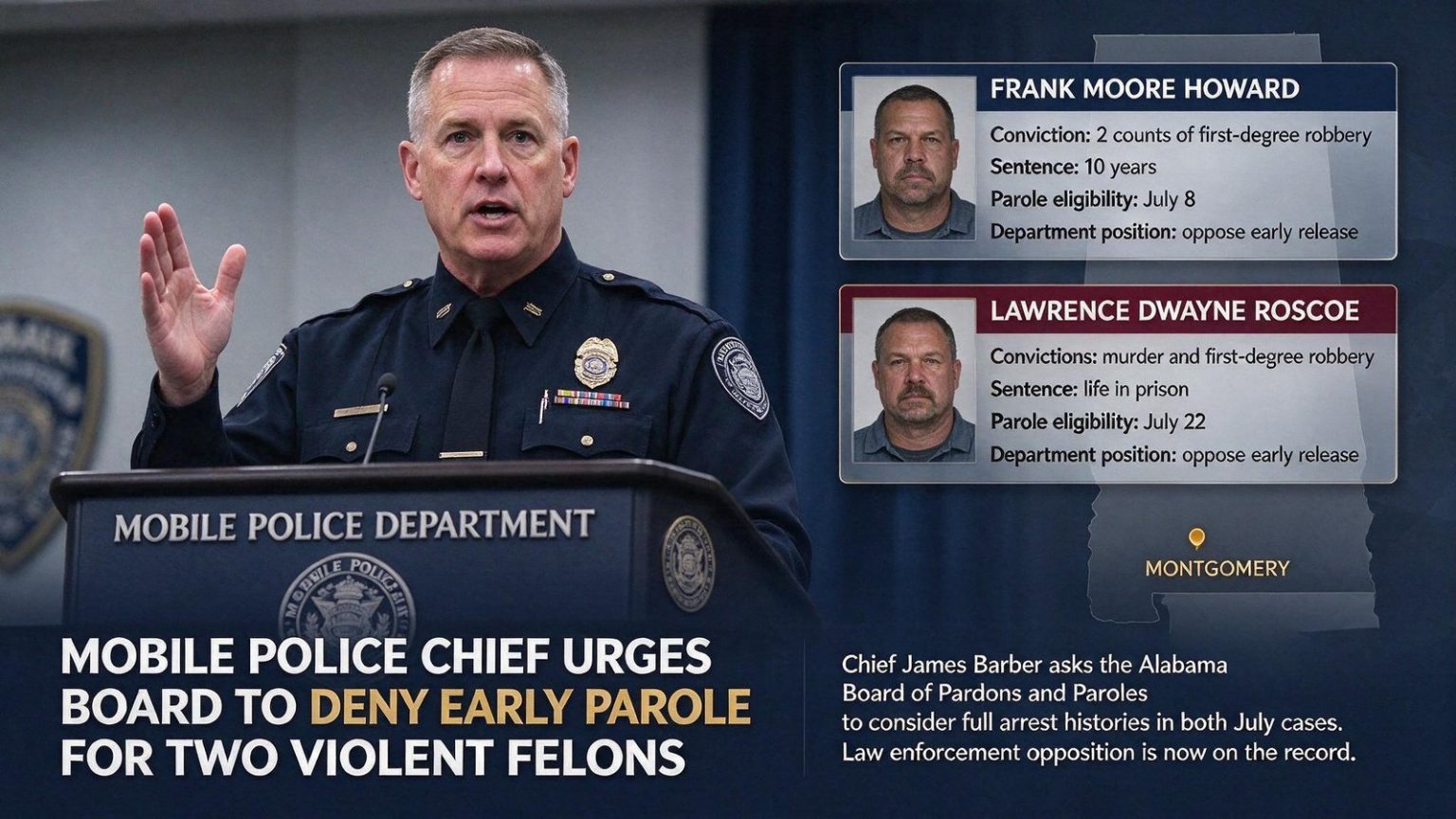
Mobile Police Chief James Barber asked the Alabama Board of Pardons and Paroles to deny early parole to two men convicted of violent felonies, both of whom were up for consideration during the month, according to the department. The request put the chief’s office squarely on record against releasing either man ahead of the sentences imposed at trial, and it reflected a department practice of tracking parole dockets for offenders with deep Mobile arrest histories.
In a release, Mobile Police Department public information officer Ashley Rains laid out the department’s objections to the release of the two men, pointing to extensive arrest records that stretched back nearly two decades. The department framed both cases as examples of offenders whose histories, in the department’s view, outweighed any argument for releasing them before their court-imposed terms had run their course.
The July eligibility date gave the department a specific docket moment to press that position before the board acted. Howard’s two robbery convictions arose from the same 2012 case, meaning the 10-year term represented the combined outcome of a single prosecution, and any early release would have applied across both counts at once.
The First Case: Frank Moore Howard
Rains said Frank Moore Howard was eligible for parole on July 8. In November 2012, Howard was found guilty of two counts of first-degree robbery and was ordered to serve 10 years in prison. First-degree robbery is among the most serious property-plus-violence offenses on Alabama’s books, involving the use or threat of force, and it carries substantial prison exposure under state sentencing law.
According to Rains, Howard had been arrested by Mobile police 16 times since 1995 before that conviction, five of those arrests involving violent felonies. She said he had also been named as the key suspect in 27 other cases, a history the chief cited in arguing against his early release. Taken together, the figures portrayed a man whose contacts with police far outnumbered the convictions that appeared on his formal record.
The department’s argument in Howard’s case rested on that pattern. A 10-year sentence imposed in 2012 meant early parole would have cut short a defined term, and the chief’s position was that the full sentence was warranted given both the offense and the long record behind it. The July eligibility date gave the department a specific docket moment to press that position before the board acted.
The Second Case: Lawrence Dwayne Roscoe
The second man, Lawrence Dwayne Roscoe, was eligible for parole on July 22. Roscoe had been found guilty of murder and first-degree robbery and was ordered to spend the rest of his life in prison, Rains said. A life sentence places the decision entirely in the board’s hands, because unlike a fixed-term sentence there is no date at which custody ends by operation of law.
Prior to that conviction, Roscoe had been arrested by Mobile police on eight other felony charges since 1996, three of them violent robberies, according to the department. As with Howard, the department presented the arrest history as a record of escalating and repeated contact with the justice system rather than a single offense followed by stable behavior.
For Roscoe, the stakes of the board’s decision were higher still. Early parole in a life sentence case means release into the community with no mandatory term remaining, and the department’s release made clear it regarded the combination of a murder conviction and a string of violent robbery arrests as disqualifying. The chief asked the board to weigh the entire history, not only the conviction that produced the life term. In such cases the board’s options are binary, and a denial simply returns the file to the docket for review at a future eligibility date.
The two eligibility dates fell within the same month, prompting the department to address both cases together in a single public statement. By pairing them, Mobile police signaled a broader message: that the department intends to appear, at least on the record, whenever offenders with extensive local histories reach the parole docket.
A Police Voice in the Parole Process
The chief’s request reflected a broader practice in which local law enforcement agencies weigh in when offenders from their jurisdictions come up for parole. The Alabama Board of Pardons and Paroles considers a range of factors in deciding whether to grant early release, and input from the arresting agency and prosecutors can figure into those deliberations alongside institutional behavior and program participation.
Parole decisions in Alabama turn on more than the original sentence. The board reviews an inmate’s conduct while incarcerated, the circumstances of the underlying offense and any objections raised by victims, prosecutors or law enforcement. Victims and their families are entitled to notice of hearings and to be heard, and the board’s hearings in Montgomery routinely include testimony or written statements from the agencies that made the original arrests.
Alabama’s parole system has drawn increasing attention in recent years as the board has grown markedly more cautious about granting release, with approval rates falling sharply and hearings becoming longer and more adversarial. In that environment, a formal objection from a police department the size of Mobile’s carries practical weight, giving board members a documented law enforcement position to consider alongside the state’s own file.
By publicizing the two cases, the Mobile Police Department signaled its intent to press its objections through official channels before the board acted. The statement also served a public-facing purpose, letting residents see that the department monitors the parole dockets of violent offenders and is prepared to advocate against release when it believes the record justifies that stance.
The department framed both men as repeat offenders whose records, in the chief’s view, argued against release ahead of the terms handed down at sentencing. Neither man’s case involved a new arrest or a new allegation; both objections were grounded entirely in the historical record the department had accumulated across the 1990s, 2000s, and into the current decade.
Chief Barber’s appeal placed the department squarely on the side of keeping both men incarcerated, at least for the near term. The release did not indicate whether victims’ families had filed their own objections, but the department’s decision to publish the cases made the city’s law enforcement position a matter of record either way.
Why Arrest Histories Matter at Hearings
The emphasis on arrest counts rather than convictions reflects how parole opponents build their arguments. An arrest is not proof of guilt, but a long series of contacts with police can still demonstrate a pattern of behavior that the board is permitted to weigh, particularly when several of the arrests involved violence. Departments compile those histories from their own records systems, which often reach further back and wider than a prosecution file alone.
Mobile’s approach also illustrates the division of labor in the process. The District Attorney’s office represents the state in opposing or supporting release, victims speak to the human cost of the offense, and the arresting agency supplies the street-level history. When all three line up on the same side, an inmate seeking parole faces an unusually complete record of opposition.
For the Mobile Police Department, the two July cases were part of routine business rather than an exceptional campaign. Large departments receive monthly parole docket lists, and staff review them for names with significant local histories. Where the record warrants it, the department sends a representative or files a written objection, a practice that has become standard in major Alabama cities.
The department did not detail what additional steps it planned to take beyond the public appeal, but the release made clear that the chief wanted the board to weigh the men’s full arrest histories, not just their most recent convictions, in reaching a decision. Whether the board granted or denied parole in either case, the department had ensured that its objections were formally before it when the decisions were made.
Both cases also date from an era when sentencing practices differed from today’s. The convictions came at different points in the last two decades, and parole boards reviewing those files must balance punishment that was lawfully imposed at the time against current release standards, which have tightened considerably. That tension between old sentences and new scrutiny is now a defining feature of Alabama’s parole process, and it shapes how objections from agencies like Mobile’s are received.
For Mobile residents, the episode offered a window into a part of the criminal justice system that usually operates without headlines. Parole hearings in Montgomery rarely draw local coverage, yet their outcomes determine when people convicted in Mobile courtrooms return to Mobile streets, which is precisely why the city’s police leadership has chosen to make its positions public whenever the stakes are highest.