Study Ranks Alabama Counties, and Flags Mobile’s Juvenile Arrests
An 80-page Alabama State University study ranked all 67 counties on economy, health care, public safety and education, listing Mobile County with the state's highest number of juvenile arrests.
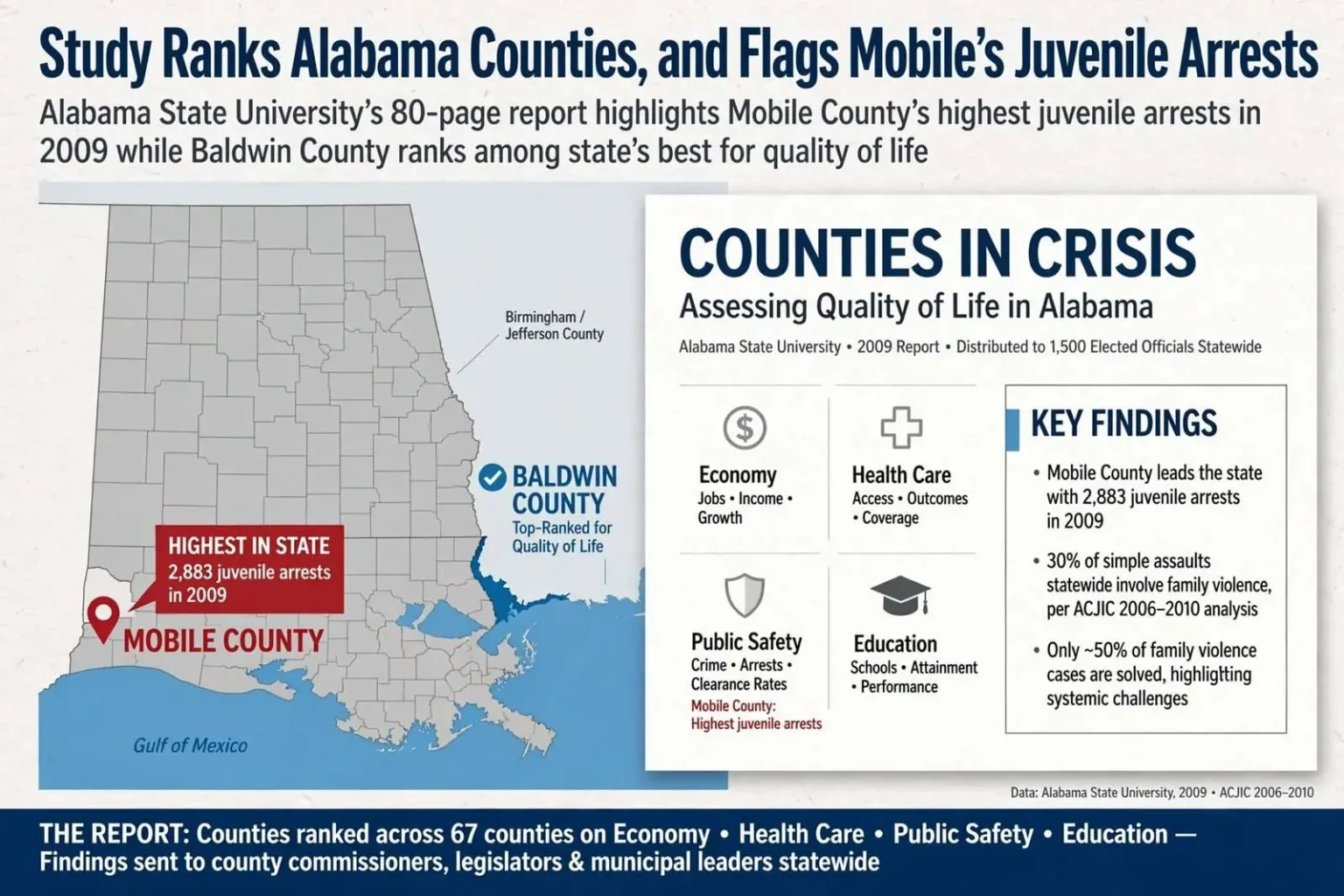
A wide-ranging study of Alabama’s counties, mailed to 1,500 elected officials across the state, drew fresh attention to public safety and quality-of-life measures, and it placed Mobile County atop the list for the number of juvenile arrests.
The 80-page report, titled Counties in Crisis: Assessing Quality of Life in Alabama and produced by Alabama State University, ranked all 67 counties on four indicators: economy, health care, public safety and education. Its distribution to officials statewide ensured that its findings would circulate widely among policymakers — county commissioners, legislators and municipal leaders received copies directly, putting a common set of statistics in front of every government that works on these problems.
Mobile County’s numbers
Among the study’s more striking figures, Mobile County was listed as having the highest number of juvenile arrests in the state, at 2,883 in 2009. The county also appeared among those with the highest number of reported rapes, a group that included Jefferson, Madison, Montgomery and Calhoun counties — the state’s major urban centers alongside Mobile.
The juvenile arrest figure stands out because of what it represents. Raw counts do not adjust for population, and Mobile County, with more than 400,000 residents, naturally produces larger numbers than smaller counties. But the volume of juvenile arrests still points to something real: thousands of young people moving through the justice system each year at ages when intervention, school attachment and family support matter most, and when an arrest record can begin closing doors instead of opening them.
Juvenile justice researchers have long noted that arrests concentrate in the teenage years and cluster around property offenses, disturbances and, increasingly, school-related incidents. How a community responds — whether through detention, diversion programs or school-based services — shapes not only the juvenile court docket but the trajectory of the young people behind the numbers.
The rankings offered a mixed portrait of the region. While Mobile County’s public safety figures drew notice, neighboring Baldwin County fared well overall, ranking among the highest-scoring counties in the state alongside Shelby, Madison, Jefferson and Limestone.
Baldwin’s high placement reflects the qualities that have made it one of Alabama’s fastest-growing counties: a broad economic base spanning tourism, agriculture and manufacturing, steadily expanding school systems, and growth that has brought both population and investment across the bay from Mobile. Shelby County, the state’s demographic benchmark for affluence, and Madison County, anchored by Huntsville’s research economy, led the list alongside Baldwin — a reminder that quality-of-life measures track economic opportunity closely.
A second look at violent crime
The university study was not the only report to land that week. A separate analysis released by the Alabama Criminal Justice Information Center examined crime reports from 2006 through 2010, and its conclusions underscored how much violence occurred within families.
According to that report, 12 percent of all violent offenses involved relatives harming one another, and fully 30 percent of all simple assaults involved family violence. The data also pointed to a troubling gap in enforcement: although victims and their attackers were often related, statistics showed that police solved only about half of those cases.
The ACJIC — the state agency that collects and standardizes crime data from law enforcement across Alabama — compiles these analyses so that police departments, prosecutors and policymakers can see patterns that individual agencies cannot. Family violence statistics are among the hardest to interpret: much of it is never reported at all, and what is reported tests the justice system in particular ways, because victims and offenders share homes, finances and often children.
The clearance gap the report identified — only about half of family violence cases solved — reflects those difficulties. Witnesses may be children. Victims may recant under pressure or reconcile with the offender. Evidence is often one person’s word against another’s inside a private home. Prosecutors who specialize in domestic violence work with these constraints daily, and the statistics show the system’s limits in stark terms.
What the numbers mean for the coast
For officials in Mobile and Baldwin counties, the reports provided both a benchmark and a warning. Rankings that compared counties against one another gave local leaders a way to see whether their communities were improving relative to the rest of the state — and the comparison carried a clear message that Mobile County’s juvenile justice volume and violent crime figures demanded attention.
Why counties get ranked at all
County-level studies like Counties in Crisis fill a gap in how Alabama understands itself. The state’s 67 counties vary enormously — from Birmingham’s urban core to Black Belt counties with shrinking populations and thin tax bases to the Gulf Coast’s fast-growing suburbs — and statewide averages hide that variation entirely. Ranking counties side by side on economy, health, safety and education gives legislators a map of where needs concentrate, and gives local officials an external reference point beyond their own budget cycles.
The four indicators the ASU report used are the standard dimensions of quality-of-life measurement. Economic indicators capture jobs and income; health measures reflect access to care and outcomes; public safety data track crime and the justice system’s response; and education figures encompass everything from school performance to attainment. No single number tells a county’s story, but together they sketch the conditions families live in — and where the next policy fight is likely to be.
Distributing the report directly to 1,500 elected officials was a deliberate choice. Research and statistics typically reach policymakers filtered through news coverage or advocacy; a physical report addressed to each official guarantees at least an initial audience, and studies of this kind are often cited in budget hearings and legislative sessions for years afterward.
The juvenile justice question
The juvenile arrest figure carries particular significance for Mobile County because of how the juvenile system works. Young people arrested in Alabama move through a separate court system designed — at least in principle — around rehabilitation rather than punishment, with intake officers, detention hearings and a range of diversion options. Communities with high arrest volumes strain that apparatus, and the decisions made at intake determine which young people enter formal proceedings and which are steered toward services instead.
Advocates in cities across the state have pressed for alternatives to arrest, particularly for school-based incidents that once would have been handled by principals rather than police officers. The distinction matters for the numbers as much as for the children: every arrest that becomes a diversion, a warning or a referral to a counselor is one that never appears in the county’s count — and, more importantly, one that does not follow a teenager into adulthood.
The combination of the two reports — one county-by-county, one focused on the structure of violence — gave Alabama’s officials a fuller picture than either alone. Mobile County leaders were left with a clear assignment: address the volume of juvenile arrests and the violent crime figures, and the family violence data showed where a portion of that violence originated. Baldwin County officials, by contrast, could take their high ranking as confirmation that growth and public investment were showing up in the quality-of-life measures that matter.
Reading rankings with care
Researchers caution against reading county rankings too literally. Crime counts rise and fall with reporting practices as much as with underlying conduct: a county with strong reporting relationships between victims and police can post higher numbers than a county where residents distrust the system and never call. Population differences complicate raw counts further, which is why analysts read figures like Mobile County’s 2,883 juvenile arrests as a starting point for questions rather than a verdict in themselves.
The value of the exercise lies in the questions it forces. Why does one county place near the top on health measures and near the bottom on safety? Why does a fast-growing county like Baldwin outperform its urban neighbor across the bay? Those questions — asked in budget hearings, commission meetings and legislative sessions — are what a study like this is designed to provoke, and the mailed distribution ensured they would be asked in every corner of the state.
The family violence findings in context
The ACJIC’s family violence figures deserve their own attention. That a third of simple assaults statewide occurred within families means the most common form of violence in Alabama is not the street crime that dominates headlines but the conflict behind closed doors between people who share an address. The 12 percent figure for violent offenses overall tells the same story across all serious crime: relatives were involved in a substantial share of everything from aggravated assaults to the offenses that fill dockets.
The roughly half-solved clearance rate for those cases has a downstream effect on everything else. Unsolved cases mean victims left without protection orders or prosecutions, offenders without intervention, and families cycling through the same violence until something worse happens. Domestic violence advocates argue that the answer lies in dedicated units, victim advocates embedded with police departments, and coordination between courts and shelters — investments that show up in clearance statistics when they are made and in repeat violence when they are not.
For the Gulf Coast, the two reports together set an agenda. Mobile County’s leaders could see exactly where their county stood on juvenile arrests and violent crime; Baldwin’s could see what its growth was buying; and every official who opened the mailed report saw the same four indicators laid out county by county — the state measuring itself, county by county, and handing the results to the people in a position to act on them.