

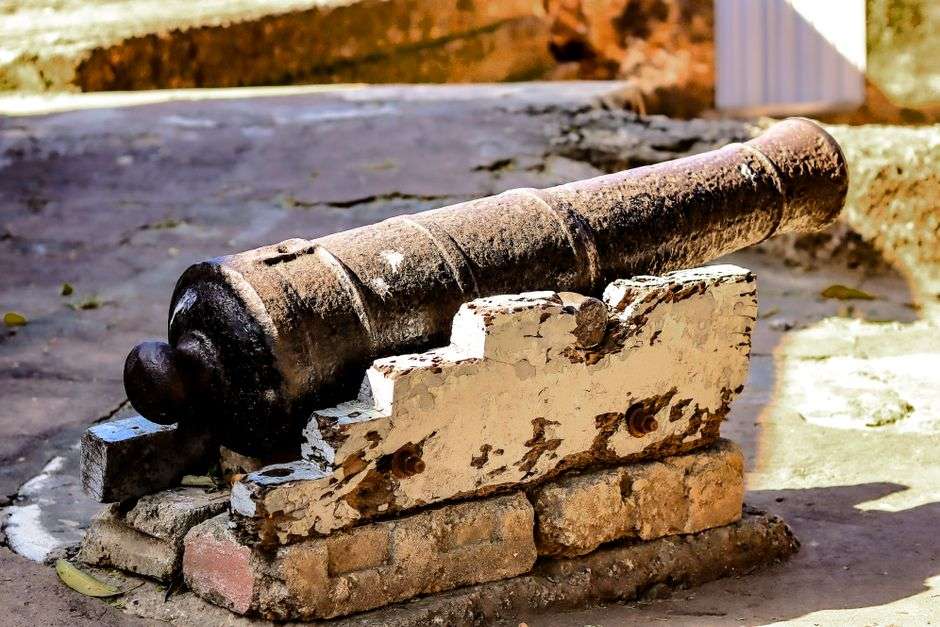
Historical context: This local-history report revisits events of 1780, when Mobile was part of British West Florida rather than the United States. Long before Alabama became a state, Mobile was caught in the struggle for control of the Gulf Coast during the American Revolution. The turning point came in March 1780, when Spanish forces besieged Fort Charlotte and ended British control of the town. The siege was brief by military standards, but its consequences reached far beyond a single fortnight of artillery fire, reshaping which empire would hold the mouth of Mobile Bay and setting the stage for the rest of the Gulf campaign.
Mobile under British West Florida
Mobile’s fort had begun as French Fort Condé, but Britain took possession of the region after the French and Indian War and renamed the installation Fort Charlotte. France had founded Mobile in the first years of the 18th century, and the fort at its heart was the reason the settlement existed at all. When the Treaty of Paris redistributed French territory in North America, the Gulf Coast fell to Britain, and the wooden-and-earth works guarding the town took on a new name and a new flag.
During the Revolution, the fort was a strategic British position in West Florida, guarding a port whose location connected the Mobile River and Mobile Bay to the Gulf of Mexico. Whoever held it could move goods, troops and intelligence between the interior waterways and the sea, which made the town a constant object of interest to every power with ambitions on the Gulf.
Mobile in the 1770s was a modest town of roughly 500 to 600 residents, a mix of French, British, other Europeans, Africans and Native Americans. It was a border town in every sense — linguistically, commercially and politically — and its small population belied its outsized strategic value.
British West Florida had its own royal governor, Peter Chester, and a colonial legislature that met in Pensacola with a representative sent from Mobile, though the arrangement never functioned as effectively as governments in the older Atlantic colonies. Distance, thin settlement and the constant realities of frontier life kept the province’s institutions modest, and Mobile’s voice in its own governance was largely channeled through a single seat in a legislature meeting more than 50 miles away.
Because Britain subsidized the Floridas through parliamentary grants, residents there did not share the tax grievances driving the other 13 colonies toward independence, and Loyalists fleeing the Revolution elsewhere often resettled in Mobile and the surrounding territory. The province’s population actually grew during the war, as families who wanted nothing to do with the rebellion moved south and west toward British protection on the Gulf.
In 1778, an agent of the Continental Congress named James Willing traveled through the region carrying copies of the Declaration of Independence for distribution; he was captured and imprisoned in Fort Charlotte for his trouble. Willing’s expedition down the Mississippi had stirred pro-American sentiment among some settlers, but in British-held Mobile it ended with the agent behind the fort’s walls, a reminder that the Gulf Coast was part of the wider war even if no battlefield had yet appeared there.
That same year, the naturalist William Bartram passed through and described a town already showing wear, “near a mile in length, though now chiefly in ruins, many houses vacant and mouldering to earth,” alongside a handful of well-kept homes owned by French, English, Scottish and Irish merchants engaged in the deerskin trade with the Chickasaw, Choctaw and Creek nations. Bartram’s account is one of the clearest surviving snapshots of Mobile on the eve of the siege: a long, thinning row of buildings along the river, buffered by a small but energetic merchant class trading with the interior.
Spain enters the war
Spain entered the wider war against Great Britain in 1779, allied with France and with its own ambitions to recover territory lost earlier in the century. Bernardo de Gálvez, the governor of Spanish Louisiana, began a Gulf Coast campaign against British positions after earlier victories along the Mississippi River. Gálvez had already proven himself an aggressive commander, and Mobile became his next major objective after the Mississippi valley fell under Spanish control.
A two-week siege
Gálvez departed New Orleans early in 1780 with a fleet and troops. Spanish forces reached Mobile and began their siege of Fort Charlotte in March. Moving troops and artillery across the open Gulf waters and through the bay’s channels was itself a logistical achievement, and the speed of the operation caught the British garrison before help could arrive from Pensacola.
The British garrison, led by Capt. Elias Durnford, faced an opponent with a substantial numerical advantage while trying to defend an aging fortification. Durnford was more than a soldier; as surveyor and lieutenant governor of British West Florida, he personally held more than 52,000 acres in the region, including his roughly 5,000-acre Belle Fontaine plantation on the bluffs above Mobile Bay near present-day Montrose. Few men in the province had as much of their fortune tied to the ground the siege was about to decide.
When Gálvez demanded Fort Charlotte’s surrender on March 1, 1780, Durnford refused despite commanding fewer than 200 men, and Mobile’s residents fled into the fort as British troops burned parts of the town, including a prominent house belonging to Major Farmar, to deny the Spanish any cover. The deliberate destruction of buildings outside the walls was standard siege practice, but it meant that whatever survived the fighting would emerge in a town already half in ruins.
Spanish artillery eventually opened breaches in the fort’s walls. On March 14, 1780, Durnford surrendered the garrison after roughly two weeks of siege operations. The surrender brought the western shore of Mobile Bay under Spanish control and established what became known as the Mobile District, the administrative unit through which Spain would govern the town for the remainder of the war and for years afterward.
Gálvez allowed the defeated British troops passage to a British port on the promise they would not fight Spain again for 18 months. The terms were generous by the standards of the era and typical of Gálvez, who preferred to move quickly to his next objective rather than manage a stream of prisoners. Durnford himself returned to Britain, later resumed his military career fighting the French in the Caribbean, and died of yellow fever in Tobago in 1794.
The 1781 British counter-offensive
The fall of Fort Charlotte did not end the fighting on the eastern side of the bay. In January 1781, British Gen. John Campbell marched troops out of Pensacola to attack “The Village,” the settlement that would later become Daphne, in an attempt to reclaim ground from the Spanish. The attack failed, and Campbell’s forces retreated to Pensacola. The skirmish left a permanent mark on the map: the eastern shore of Mobile Bay still carries the name of the Spanish presence that followed, and the modern city of Spanish Fort traces its identity to the defensive works of this era.
Spanish authorities in Cuba, alarmed by the attempt, sent reinforcements to secure Mobile and later built a new defensive post, Spanish Fort, on the eastern shore to guard against further incursions from British-held Pensacola. The post watched the water approaches and the overland routes that connected Pensacola to the bay, effectively locking the eastern shore against another British landing.
Gálvez went on to capture Pensacola itself in May 1781, finally ending the British threat to Spanish Mobile. The Pensacola campaign was the largest single operation of the Gulf war, drawing soldiers, ships and supplies from across Spain’s American empire, and its success removed the last major British stronghold in West Florida. With it, the entire coastline from the Mississippi to the Florida peninsula swung out of British hands.
Why the siege still matters
The fall of Fort Charlotte did more than change the flag over Mobile. It removed a British position that could threaten Spanish Louisiana and strengthened Spain’s path toward Pensacola, the remaining major British stronghold in West Florida. In the arithmetic of the American Revolution’s Gulf theater, a two-week siege of a small garrison helped set up the campaign that would decide the whole province.
Today, the 1780 siege is a reminder that Mobile’s history was shaped by French, British, Spanish and American eras long before modern city boundaries existed. The story of Fort Condé — first French, then British, then Spanish — is preserved at the reconstructed colonial fort that stands in downtown Mobile today, built on the footprint of the original works and open to visitors who want to walk the ground Durnford defended.
The site of Fort Charlotte remains central to understanding why Mobile’s port and bay made the community strategically important for generations, and the short-lived British attempt to retake the eastern shore in 1781 helped give present-day Daphne and Spanish Fort their own place in that Revolutionary-era history. The siege of 1780 belongs to all of them — the moment the Gulf Coast’s map began to look like something a modern resident of Mobile County would recognize.