Fort Condé Living History Festival Marks 50 Years Since Mobile Rebuilt Its Colonial Fort
Colonial Fort Condé's free Living History Festival on Nov. 14 will feature musket firing, drills and colonial life demonstrations marking 50 years since the fort's 1976 reconstruction.
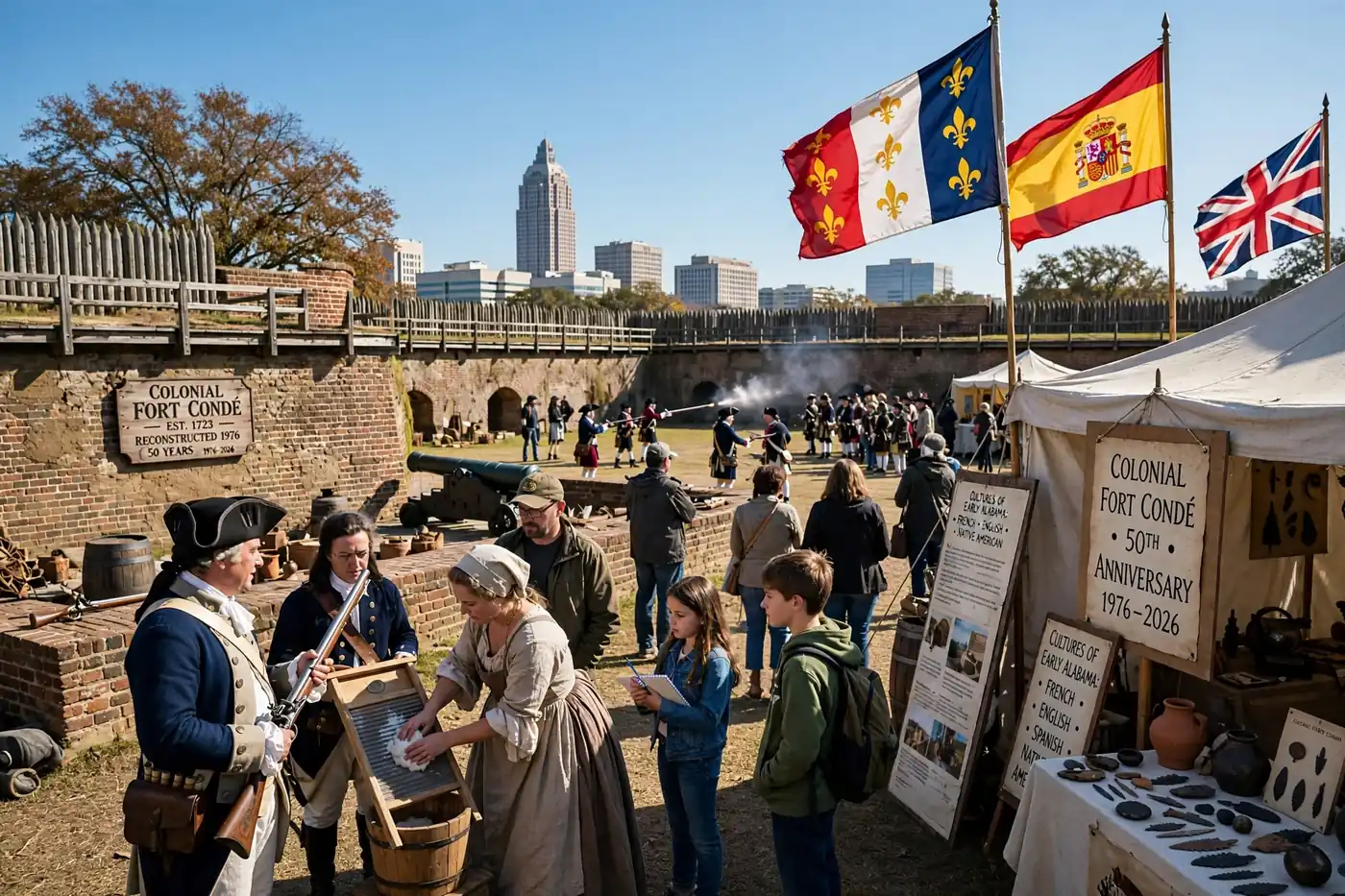
MOBILE, Ala. — Musket fire, military drills and a glimpse at how colonial residents did their laundry will fill downtown Mobile next month as the Fort Condé Living History Festival celebrates a milestone anniversary. The free festival, set for Saturday, Nov. 14, from 10 a.m. to 3:30 p.m. at Colonial Fort Condé, marks 50 years since the 1976 reconstruction of the 18th-century fort that once guarded the city.
Organizers are calling the 2026 edition the fort’s biggest celebration yet. Historical groups from throughout the region will gather at the fort to demonstrate colonial military life and everyday skills from the 1700s, while exhibits and activities will explore the English, French, Spanish and Native American communities that shaped early Alabama.
Stepping back into colonial Mobile
The festival is designed to bring history off the page and into the present. Throughout the day, visitors can watch demonstrations, military displays and hands-on presentations focused on the details of daily life in colonial Mobile.
Organizers invite visitors to come with questions. How did people do their laundry in the 1700s? Did colonial residents use money? What did personal hygiene look like before modern plumbing? Costumed interpreters will be on hand to show how the city’s colonial forebears went about their lives.
Highlights planned for the day include:
- Musket firing demonstrations showing how soldiers of the era loaded and fired their weapons
- Military drills by historical groups recreating colonial garrison life
- Demonstrations of 18th-century skills and activities tied to everyday work and home life
- Presentations on the cultures of early Alabama, including English, French, Spanish and Native American communities
- Exhibits of artifacts and recovered archaeological pieces from Mobile’s colonial past
Visitors can also climb atop the reconstructed fort walls for views of the Mobile skyline, a vantage point that contrasts the modern downtown with the city’s colonial beginnings.
A fort with many flags
Mobile is one of the oldest cities on the Gulf Coast. French colonists founded the settlement in 1702 at a site upriver known today as Old Mobile, then moved it to its present location on the west side of Mobile Bay in 1711. The original Fort Condé was built beginning in 1723, replacing an earlier wooden fortification with a brick and earthwork stronghold that anchored French Louisiana’s presence on the Gulf.
As control of the region changed hands, so did the fort’s name. Under the various colonial powers that held Mobile, it was known by names including Fort Louis, Fort Charlotte and Fuerta Carlota. Great Britain took possession of Mobile in 1763 after the French and Indian War, and Spanish forces under Bernardo de Gálvez captured the city in 1780 during the American Revolution. The United States took control of Mobile in 1813, and the old fort was dismantled in the years that followed as the growing city spread over the site.
That layered history is part of what the festival aims to convey. Each group that controlled the fort left its mark on Mobile’s culture, architecture, food and traditions, many of which still shape the city today.
Rediscovered under a tunnel, rebuilt for the bicentennial
For more than a century, the fort existed mostly in records and memory. That changed in 1966, when construction of the George C. Wallace Tunnel, which carries Interstate 10 beneath the Mobile River, uncovered remnants of the original fort. Those remains can still be seen today in nearby Mardi Gras Park, facing Church Street.
A decade later, Mobile opened a replica of the fort in 1976 as part of the nation’s bicentennial celebration. About one-third of the fort was reconstructed, built at four-fifths scale. Since then, the reconstructed Fort Condé has served as a downtown landmark, a museum space and a gathering place for living history programs.
The 50th anniversary of that reconstruction arrives in the same year the United States marks its 250th birthday, giving this year’s festival a special connection to the bicentennial project that brought the fort back to life.
Admission and weather plans
Admission to the Living History Festival at Colonial Fort Condé is free. Admission to the nearby History Museum of Mobile is separate for visitors who also want to tour its exhibits, which cover the city’s story from its earliest days to the present.
The festival will go on regardless of the weather. In the event of inclement weather, organizers will move the program indoors.
Festival at a glance
- What: Living History Festival at Colonial Fort Condé, celebrating the 50th anniversary of the fort’s reconstruction
- When: Saturday, Nov. 14, 10 a.m. to 3:30 p.m.
- Where: Colonial Fort Condé, downtown Mobile
- Cost: Free; History Museum of Mobile admission is separate
- Weather: Moves indoors in case of inclement weather
- Highlights: Musket firing, military drills, 18th-century skills, cultural presentations, artifacts and views from the fort walls
Making a day of it downtown
The festival falls on a busy Saturday in downtown Mobile. Arti Gras 2026, an art show featuring 44 artists, is also scheduled for Nov. 14 in the city’s DeTonti Square neighborhood, giving visitors a chance to pair colonial history with contemporary art on the same day.
Families planning to attend may want to arrive early, especially those who hope to catch the musket demonstrations and drills. Comfortable walking shoes are a good idea for exploring the grounds and climbing to the top of the fort walls, and a short walk to Mardi Gras Park lets visitors see the remnants of the original fort for themselves.
For students, history buffs and anyone curious about how people lived in Mobile nearly 300 years ago, the festival offers a free, hands-on way to explore the city’s colonial roots in the place where much of that history happened.