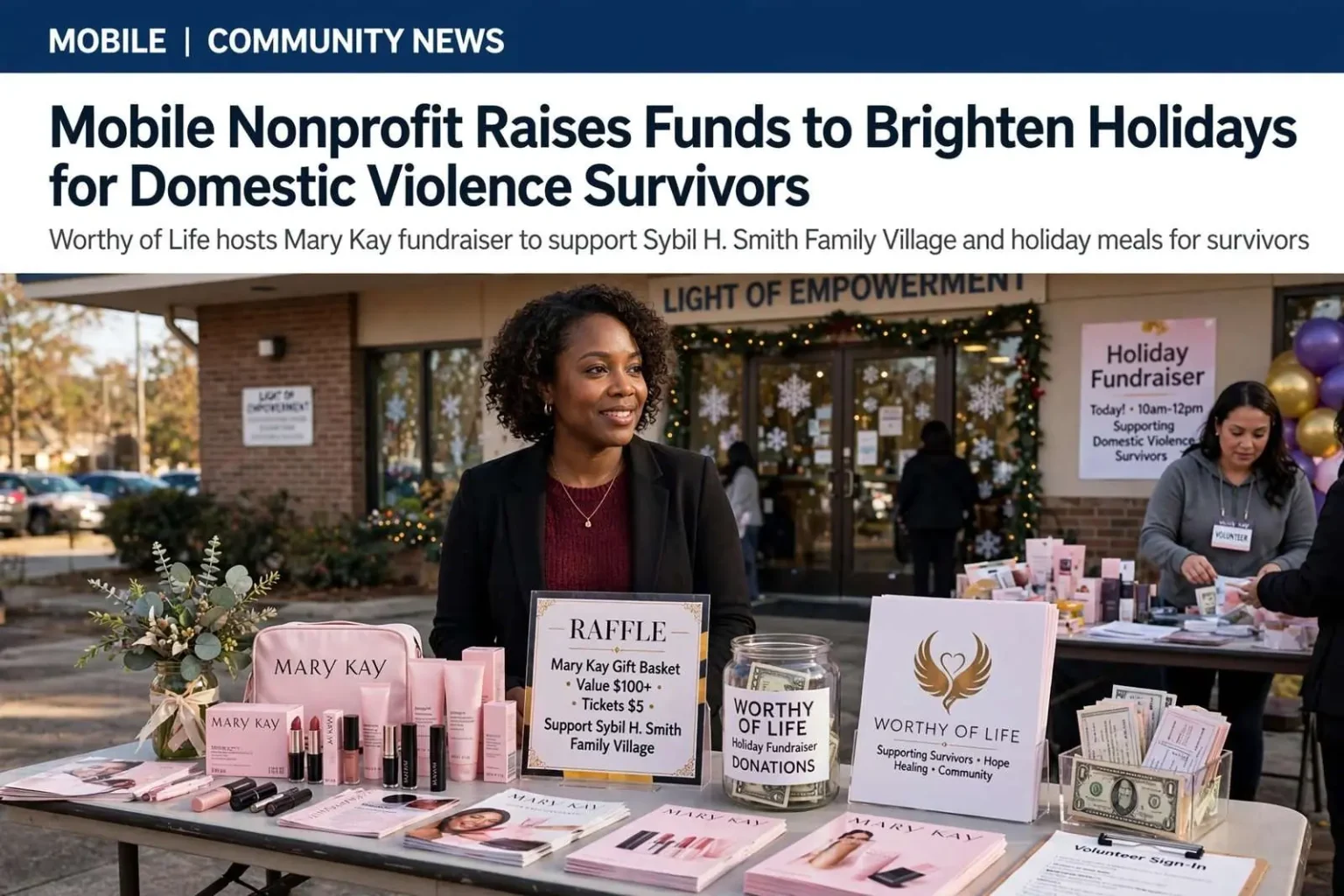
Volunteers organizing a charity fundraiser table with donated itemsA Mobile nonprofit held a fundraiser to help provide holiday meals for women and children at a local shelter.

A Mobile-based nonprofit is working to make the upcoming holiday season a little brighter for women and children rebuilding their lives after escaping domestic abuse, organizing a weekend fundraiser aimed at supporting a local transitional shelter.

Cassandra Rodgers, who leads the nonprofit Worthy of Life, planned a Saturday fundraiser at Light of Empowerment on South Beltline Service Road, where volunteers spent two hours selling Mary Kay cosmetics to raise money for the cause. For every qualifying order of $25 or more, Worthy of Life receives a portion of the proceeds, and the group also sold raffle tickets for a Mary Kay gift basket valued at more than $100 to boost the total.

Rodgers said her goal was to raise at least $500 to help feed women staying at the Sybil H. Smith Family Village, a transitional housing program for homeless women and their children operated by the Dumas Wesley Community Center. The shelter provides a safe place for families to stabilize their lives, and Rodgers wanted the holiday meal effort to cover either Thanksgiving or Christmas, depending on how details worked out with center staff.

For Rodgers, the cause is personal. She has spoken publicly about a family member who once lived at the same type of shelter and was later killed by an estranged partner, a loss that has shaped her commitment to supporting other women trying to escape dangerous relationships. She has said she understands firsthand what it means for a parent and child to depend on a shelter for safety, and that experience continues to drive her nonprofit’s work in the Mobile community.

Worthy of Life accepts donations year-round through any Hancock Bank branch or by mail at the group’s Daphne post office box, giving supporters multiple ways to contribute beyond the weekend fundraiser. Rodgers has framed the organization’s mission simply: to let survivors and grieving family members alike know that support exists and that the community cares about their wellbeing.

Beyond the fundraiser itself, Worthy of Life also organizes a regular support group for people who have lost loved ones to violence, offering a space for processing grief and connecting with others who have experienced similar loss. The group’s most recent gathering was scheduled for later in the month at Light of Empowerment, continuing a series of meetings the nonprofit holds to support both survivors and families affected by domestic violence.

The fundraiser adds to a growing network of grassroots efforts across the Mobile area aimed at supporting shelters and transitional housing programs, particularly as the holiday season places additional strain on nonprofits trying to stretch limited budgets to cover extra meals, gifts and services for the families they serve.

See also  Mobile Fire-Rescue Honors Firefighter of the Month, Launches Smoke Alarm Blitz in Willow Brook Run

Mobile is the county seat of Mobile County in southwest Alabama and the state’s only saltwater port. Situated where the Mobile River meets Mobile Bay near the northern Gulf of Mexico, the city has long served as a commercial and cultural gateway between Alabama and the wider Gulf Coast. Founded in 1702 as Fort Louis de la Louisiane and ruled in turn by France, Britain, and Spain before joining the United States in 1813, Mobile carries a layered heritage distinct from the rest of the state.

Today Mobile anchors a metropolitan area spanning Mobile County and neighboring Baldwin County, and it remains a center for shipping, aerospace, healthcare, and higher education in the region. Its downtown and waterfront have seen sustained revitalization, while historic neighborhoods preserve architecture from its colonial and antebellum past. The city’s identity is shaped as much by its working port and industrial base as by its festivals and food culture, making it a frequent focal point for news about growth and change in southern Alabama.

Charitable and nonprofit organizations form a vital safety net across South Alabama, addressing needs from hunger and homelessness to disaster relief and holiday assistance. Groups such as The Salvation Army operate local corps that provide shelter, food, and seasonal programs funded largely by community donations.

The generosity of Gulf Coast residents, often mobilized after hurricanes and economic hardship, underscores how tightly knit many of these communities are. Local philanthropy also relies on volunteers and corporate partners, and the progress of fundraising efforts is a recurring subject of regional news because it reflects the community’s capacity to care for its most vulnerable members.

Holiday campaigns in particular reveal the scale of need and the reach of volunteer networks. The rhythm of annual giving, from food drives to toy distributions, is woven into the regional calendar and into the coverage that keeps residents informed about how to help and where support is most needed.

The economy of the Mobile region is diversified across shipping and logistics, aerospace and shipbuilding, healthcare, tourism, and manufacturing. The Port of Mobile is one of the nation’s busiest seaports and a cornerstone of the local and state economy.

See also  'Son of a Son of a Sailor Experience' Set to Open at Mobile's Maritime Museum in September

Major employers in aviation and defense contribute to a skilled workforce, while economic-development organizations aim to attract investment and jobs through incentives and infrastructure improvements. Small businesses, from restaurants to professional services, form the backbone of neighborhood commerce.

The health of the regional economy is a frequent subject of public discussion and reporting. Workforce development, recruitment of industry, and the fortunes of local retailers all feed into a broader picture of how the Gulf Coast competes and adapts in a changing national economy.

Probate courts in Alabama handle matters distinct from the trial courts that hear criminal and civil cases, including wills, estates, guardianships, and involuntary commitments for mental-health treatment. In Mobile County the probate judge is an elected official with broad administrative and judicial duties.

Cases involving involuntary psychiatric commitment require the court to balance an individual’s liberty interests against concerns for their safety and the safety of others, a sensitive legal threshold that has drawn scrutiny in many jurisdictions. The procedures governing such hearings, including who must appear and testify, are set by state law and local rule.

Disputes over those procedures often surface tensions between healthcare providers, the court, and advocates for patients. Because the stakes involve both liberty and wellbeing, courts and clinicians alike face pressure to honor the law while ensuring that people in crisis receive timely and appropriate care.

Local government in the Mobile area operates through a combination of mayor-council or commission structures at the municipal level and a county commission in Mobile County, with elected officials handling budgets, public safety, infrastructure, and zoning. Baldwin County has its own commission and a collection of incorporated municipalities.

Decisions made in council chambers and commission meetings affect roads, school funding, economic development, and quality of life, which is why coverage of local government is a staple of regional journalism. The interplay between city, county, and state authorities often determines how effectively the area can address shared challenges.

Because many services residents rely on are delivered at the local level, the choices of elected officials have direct, everyday consequences. Budget priorities, in particular, reveal a community’s values and shape the trajectory of growth and public welfare for years to come.

Baldwin County sits directly east of Mobile County across Mobile Bay and is the largest county in Alabama by land area. It encompasses the Eastern Shore communities of Daphne, Fairhope, Spanish Fort, and Foley and stretches south to the beaches of Gulf Shores and Orange Beach along the Gulf of Mexico.

See also  Mobile Mayor Sandy Stimpson Reflects on Turbulent First Year in Office

Long among the fastest-growing counties in the state, Baldwin blends suburban development near the bay with tourism-driven coastal economies. Its proximity to Mobile and its position on the Eastern Shore make it a recurring subject of regional news covering growth, infrastructure, schools, and the balance between development and coastal preservation.

Mobile Bay is a shallow estuary in southern Alabama where freshwater from the Mobile, Tensaw, and other rivers mixes with saltwater from the Gulf of Mexico. It is among the largest estuarine systems in the United States and supports commercial and recreational fishing, shipping through the Port of Mobile, and wetlands that buffer the coastline from storms.

The bay’s Eastern Shore, in Baldwin County, includes Daphne, Fairhope, and Spanish Fort, while the Western Shore lies in Mobile County. Its ecology and economy have guided settlement for centuries, and the bay figures in regional debates over development, navigation, and conservation. Events on either shore are routinely covered as part of the interconnected life of the Mobile metro area.

The Gulf of Mexico borders Alabama’s southern edge and defines much of the state’s coastal identity. Alabama’s Gulf coastline, centered on Dauphin Island, Gulf Shores, and Orange Beach, supports a tourism industry built around beaches, charter fishing, and marine recreation, while offshore waters host shipping lanes and energy interests.

The Gulf’s warm, shallow shelf and exposure to hurricanes make weather and disaster preparedness recurring concerns for communities from Mobile to Baldwin County. The marine environment also underpins commercial seafood harvests that have sustained Gulf Coast families for generations, tying the region’s economy and culture closely to the water.

Alabama is a state in the southeastern United States bordered by Tennessee, Georgia, Florida, the Gulf of Mexico, and Mississippi. Often called the Heart of Dixie, it spans Appalachian foothills in the north and flat coastal plains in the south. Its largest cities include Birmingham, Montgomery, Huntsville, and Mobile.