
Bar Panel Disbars Former Judge Herman Thomas, Calling Paddlings ‘Sexually Motivated Assaults’
A five-member Alabama State Bar disciplinary panel found former Mobile County Circuit Judge Herman Thomas untruthful and barred him from practicing law, crediting the inmates a jury had not.
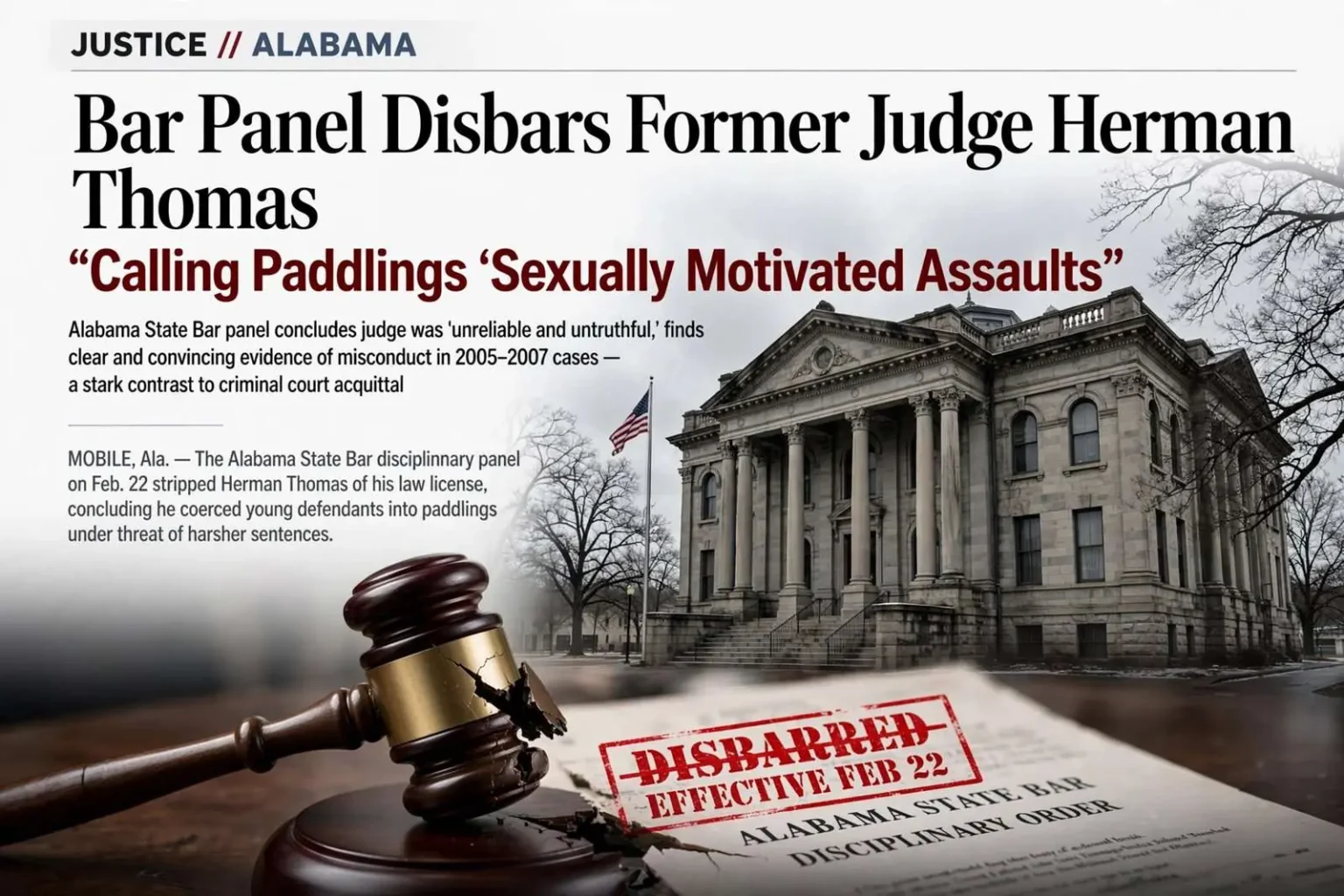
A five-member Alabama State Bar disciplinary panel has stripped former Mobile County Circuit Judge Herman Thomas of his license to practice law, concluding that the young inmates who accused him of paddling their bare backsides were telling the truth and that Thomas himself was “both unreliable and untruthful” when he testified in his own defense. The panel’s report and order, which became public as Thomas appealed his disbarment to the Alabama Supreme Court, arrives at a conclusion strikingly different from the one reached in a Mobile criminal courtroom, where Thomas walked away without a single conviction.
A different verdict, a different standard
Thomas served on the bench in Mobile County for more than 15 years before surrendering his robe in 2007 rather than face trial before the Court of the Judiciary. At the peak of the criminal case against him, he faced more than 100 charges tied to allegations that he summoned defendants on his docket to a room at the Mobile County Courthouse, ordered them to lower their pants and struck them with a paddle. Prosecutors argued the young men were kept within the judge’s reach by lenient sentences and long probations. Thomas was cleared of every charge, either by jury verdict or by ruling from specially appointed Judge Claud Nielson of Demopolis. The bar proceeding was a separate matter with a separate standard of proof, and the panel that heard it reached the opposite result.
The disciplinary board — hearing officer Billy Bedsole, along with James R. Pratt III, Phillip W. McCallum, Christy Crow and non-lawyer member Leon Garrett — met in a closed hearing in the ceremonial courtroom at the Mobile County Courthouse on Feb. 22. It found the evidence “clear and convincing” that Thomas had spanked and paddled criminal defendants appearing before him, and that the conduct had nothing to do with mentoring or discipline. “It is clear to this board that these young men were coerced into complying with Thomas under threat of harsher sentences,” the order states.
Background on the criminal case
The criminal prosecution of Herman Thomas was one of the most closely watched judicial misconduct cases in Alabama history. Thomas, a Democrat first elected to the circuit bench in 1990, had developed a reputation for unconventional sentencing — ordering defendants to attend church, to write essays, to perform community service in lieu of jail time. But the allegations that surfaced in 2005 went far beyond unorthodox sentencing. Former defendants, most of them young Black men in their late teens and early twenties, came forward with accounts of being taken to a small room off the courtroom, ordered to drop their pants, and struck repeatedly with a wooden paddle that Thomas kept in his chambers.
The Mobile County District Attorney’s office brought more than 100 charges, including assault, sexual abuse, and official oppression. The trial, held in 2007 before Judge Claud Nielson — a retired circuit judge appointed to hear the case after all Mobile County judges recused themselves — ended with Thomas’s acquittal on all counts. Nielson ruled that the statute of limitations had expired on many charges and that the testimony of the former defendants was not credible beyond a reasonable doubt. The jury deliberated for less than two hours on the remaining charges.
The bar proceeding
The bar proceeding was a separate matter with a separate standard of proof, and the panel that heard it reached the opposite result. The disciplinary board — hearing officer Billy Bedsole, along with James R. Pratt III, Phillip W. McCallum, Christy Crow and non-lawyer member Leon Garrett — met in a closed hearing in the ceremonial courtroom at the Mobile County Courthouse on Feb. 22. It found the evidence “clear and convincing” that Thomas had spanked and paddled criminal defendants appearing before him, and that the conduct had nothing to do with mentoring or discipline. “It is clear to this board that these young men were coerced into complying with Thomas under threat of harsher sentences,” the order states.
The standard of proof in bar disciplinary proceedings is “clear and convincing evidence,” a lower threshold than the “beyond a reasonable doubt” standard required in criminal court. The panel also operated under different evidentiary rules, allowing consideration of hearsay and prior consistent statements that would have been excluded in a criminal trial. Most critically, the panel was not bound by the statute of limitations that had doomed many of the criminal charges — the Alabama State Bar’s rules permit discipline for conduct regardless of when it occurred, provided the evidence is sufficient.
Six former defendants testified before the panel. Their accounts were consistent in detail: the paddle was a wooden board, approximately 18 inches long, 4 inches wide, and half an inch thick, with a handle wrapped in athletic tape. Thomas would order the young man to bend over a desk or chair. The number of strikes varied from three to twelve. Thomas sometimes made comments about the young man’s body or suggested the paddling was a form of “tough love” that would keep him out of prison. Several witnesses said Thomas offered them a choice: the paddle or additional jail time. All chose the paddle.
Thomas’s defense and the panel’s rejection
Thomas testified in his own defense, denying the allegations and characterizing the paddling as a discretionary sentencing alternative that he believed was within his judicial authority. He cited historical precedent for corporal punishment in Alabama courts and argued that the young men had consented to the paddling as an alternative to incarceration. He acknowledged keeping a paddle in his chambers but said it was a gift from a former defendant and that he used it rarely.
The panel found Thomas “both unreliable and untruthful.” The order notes that Thomas’s testimony contradicted his own prior statements to the Court of the Judiciary, where he had acknowledged paddling defendants but characterized it as a rare and benevolent practice. The panel also credited testimony from court staff who said the paddle was kept in a drawer in Thomas’s chambers and that Thomas referred to it openly. A former bailiff testified that he had seen Thomas retrieve the paddle before calling certain defendants to the back room.
Sexually motivated assaults
The panel’s report and order, which became public as Thomas appealed his disbarment to the Alabama Supreme Court, arrives at a conclusion strikingly different from the one reached in a Mobile criminal courtroom, where Thomas walked away without a single conviction. The panel concluded that the paddlings were “sexually motivated assaults” rather than legitimate judicial discipline. This finding was based on the testimony of the former defendants, the circumstances of the paddlings — the private setting, the removal of pants, the physical contact with buttocks — and Thomas’s own statements, which the panel found revealed a sexual intent.
“It is clear to this board that these young men were coerced into complying with Thomas under threat of harsher sentences,” the order states. “The power differential between a circuit judge and a criminal defendant awaiting sentencing is absolute. There is no meaningful consent in that context.” The panel also noted that all of the known victims were young Black men, raising questions about racial dynamics in the exercise of judicial power. Thomas is white. Mobile County’s population is approximately 35 percent Black, but the defendants who appeared before Thomas on the charges most likely to result in paddling — nonviolent drug offenses, probation violations — were disproportionately Black.
Appeal and legacy
Thomas appealed the disbarment to the Alabama Supreme Court, arguing that the panel exceeded its authority, that the clear-and-convincing standard was insufficient for such a severe sanction, and that the panel’s finding of sexual motivation was unsupported by the evidence. The Supreme Court heard oral arguments in October and is expected to rule before the end of the term. If the disbarment is upheld, Thomas will be permanently ineligible to practice law in Alabama. He is 68 years old.
The case has reverberated through Alabama’s legal community. The Alabama State Bar has since amended its rules to require mandatory reporting of judicial misconduct by attorneys who become aware of it, closing a gap that allowed Thomas’s conduct to continue for years without formal complaint from the lawyers who practiced before him. The Court of the Judiciary has adopted new guidelines for evaluating allegations of non-traditional sentencing practices. And the Mobile County Courthouse, where Thomas presided for 17 years, has removed the ceremonial courtroom where the bar panel met — it was renovated in 2019 and now serves as a jury assembly room.
For the former defendants who testified, the panel’s finding represents a form of validation that the criminal trial did not provide. Several have spoken publicly in the years since, describing the lasting psychological impact of the paddlings and the difficulty of being believed when the perpetrator was a judge. Their testimony before the bar panel, given under oath and subject to cross-examination, created a record that the panel found credible and compelling. Whether the Alabama Supreme Court affirms or reverses, that record remains — a testament to the difference between legal guilt and professional truth.


