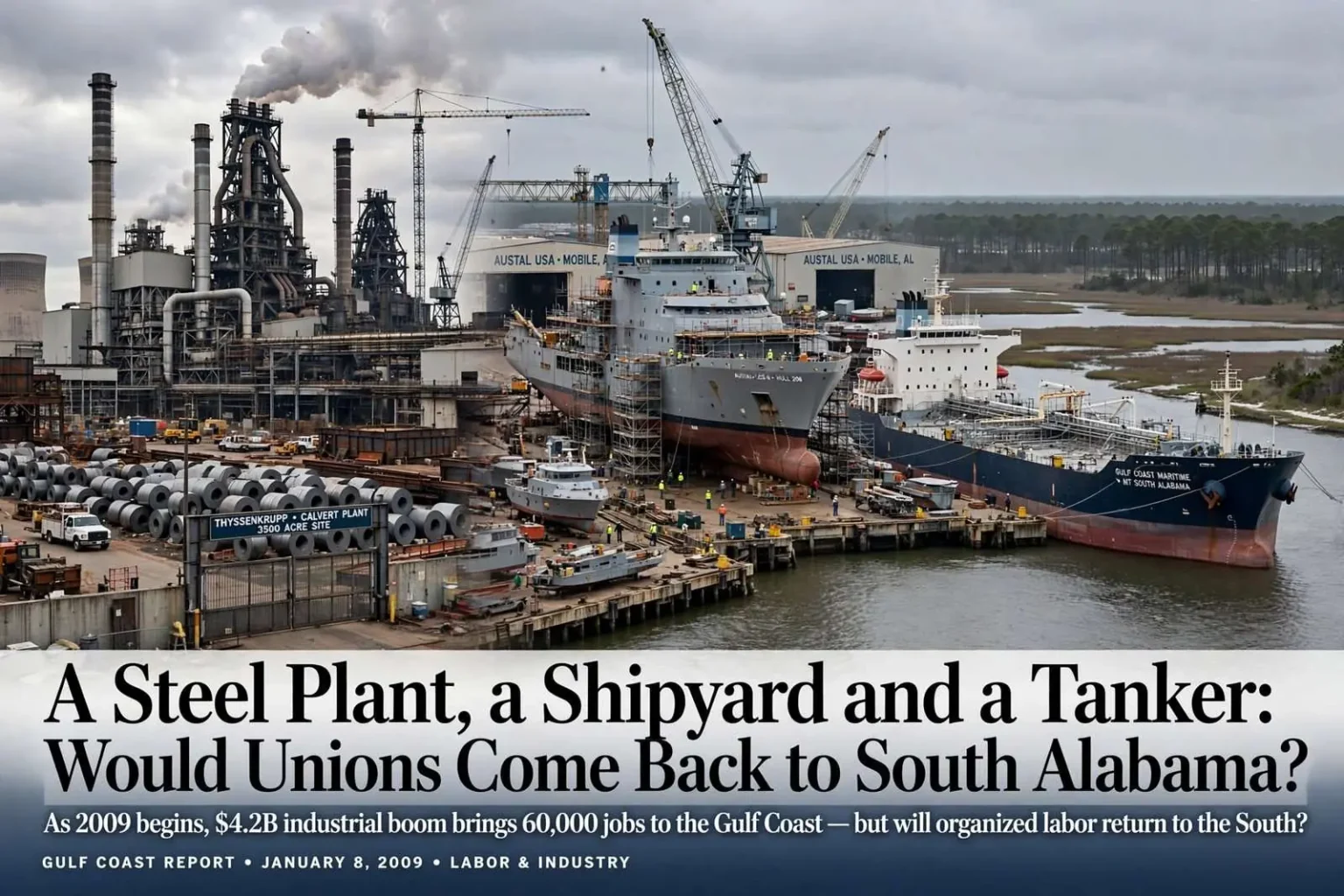
A Steel Plant, a Shipyard and a Tanker: Would Unions Come Back to South Alabama?
With ThyssenKrupp rising near Calvert, Austal expanding downtown and aircraft work possible at Brookley, a veteran labor lawyer was asked whether organized labor would ride the boom back into Mobile. His answer: don't count on it.
Hurricanes put a damper on Labor Day celebrations along the Gulf Coast in the fall of 2008. The years before that had rained on organized labor’s parade across the South more generally. Yet as 2009 opened, the ground in south Alabama looked, at least on paper, unusually fertile for union organizers.
Consider what was being built. The ThyssenKrupp steel and stainless complex near Calvert was a $4.2 billion project projected to require 29,000 construction jobs, employ 2,700 people permanently and generate some 50,000 related jobs. Aircraft manufacturing at the Brookley industrial complex was a live possibility, and perhaps a likelihood. The Austal shipyard on the downtown waterfront was running at full throttle. Thousands of industrial jobs were arriving in a region that had once been among the most heavily unionized in the South.
Would the unions arrive with them? The management lawyer’s answer: Veteran labor relations attorney Frank McRight, who typically represents management, was skeptical. McRight is a familiar name in Alabama politics. Twenty-five years earlier, as the Democratic nominee, he lost a hard-fought contest to Sonny Callahan for the First District seat in the U.S. House being vacated by Jack Edwards. He later ran, as a Republican, for the U.S. Senate seat won in 1996 by Jeff Sessions.
Labor’s Historical Role in Alabama
He began, notably, with a defense of the institution he spends his professional life opposing. “The reality is organized labor played a vital role in the development of our country,” he said. In the 1930s, workers in production jobs “really didn’t have a lot of money to live on,” and collective bargaining gave them leverage that put money into the economy — “probably one of the factors that got us out of the Depression.”
What changed, in his telling, was the law. Congress enacted wage protections, protections against discriminatory practices and rules on unsafe working conditions. “The success in getting remedial statutes in place at the same time diminished the need for the union as a protective vehicle,” McRight said.
Alabama’s industrial history tells a more complicated story. The state’s first major union footholds came in the coal mines of the Birmingham district and the steel mills that followed, where the United Mine Workers and the Steelworkers built density in the early 20th century. Mobile’s waterfront unions — longshoremen, shipyard workers, teamsters — made the port one of the most organized in the Gulf by the 1940s. Paper mills in the Pine Belt, textile mills in the Tennessee Valley, and the Redstone Arsenal workforce added layers of union presence through the 1960s.
But the trajectory shifted after the 1970s. Foreign competition, automation, and a political realignment that made Alabama a right-to-work state in 1953 — and reinforced that stance in subsequent decades — eroded private-sector density. By 2008, Alabama’s union membership rate hovered around 10 percent, well below the national average.
The ThyssenKrupp Project and Its Promise
The ThyssenKrupp announcement in 2007 had been hailed as the largest single industrial investment in Alabama history. The site, a 3,500-acre tract in northern Mobile County near the Washington County line, was chosen for its rail access, proximity to the Port of Mobile, and available industrial water supply. Groundbreaking ceremonies drew Governor Bob Riley, German executives, and a bipartisan congressional delegation.
For union organizers, the calculus was straightforward: a workforce of 2,700 permanent steelworkers, many of them skilled trades, represented a rare greenfield organizing opportunity in a right-to-work state. The United Steelworkers, which had represented workers at ThyssenKrupp facilities in Germany and elsewhere, had expressed interest in the Calvert project from its announcement.
The construction phase alone — 29,000 jobs over several years — would bring building trades unions a significant foothold. The Alabama AFL-CIO and its affiliated building trades councils had been preparing organizing campaigns for months, seeing the project as a potential turning point for labor in the region.
Brookley and Austal: Additional Industrial Anchors
Beyond ThyssenKrupp, the Brookley Aeroplex — the former Brookley Air Force Base redeveloped as an industrial and aviation complex — was courting major aircraft manufacturing tenants. EADS North America, the U.S. subsidiary of the European aerospace giant, was in final negotiations to assemble Air Force tanker aircraft at Brookley, a contract worth billions and thousands of jobs. Though the tanker contract ultimately went to Boeing, the prospect in early 2009 seemed real.
Austal USA, the American subsidiary of the Australian shipbuilder, had already established a major presence on Mobile’s waterfront. The company’s littoral combat ship and joint high-speed vessel programs for the U.S. Navy employed over 3,000 workers at peak, with plans for further expansion. Austal’s workforce included welders, electricians, pipefitters, and engineers — trades with strong union traditions in other regions.
Together, these three projects — ThyssenKrupp, the potential Brookley aviation work, and Austal’s expansion — represented a concentration of heavy industrial employment not seen in south Alabama since the World War II shipbuilding boom. The Mobile Area Chamber of Commerce estimated the combined direct and indirect employment impact at over 60,000 jobs within a decade.
Right-to-Work Realities and Organizing Challenges
Alabama’s right-to-work law, enshrined in the state constitution since a 1953 amendment, prohibits union membership as a condition of employment. This means that even if a union wins a representation election and negotiates a collective bargaining agreement, workers covered by the contract cannot be required to join the union or pay dues.
The practical effect, organizers say, is a “free rider” problem: workers receive the wages, benefits, and protections negotiated by the union without contributing to the cost of representation. This dynamic makes sustaining a union financially difficult, especially in a state where cultural and political attitudes toward organized labor range from indifferent to hostile.
McRight, drawing on decades of representing employers in union campaigns, argued that the economic rationale for unionization had fundamentally shifted. “The modern workplace is regulated in ways that were unimaginable in the 1930s,” he said. “OSHA, the Fair Labor Standards Act, Title VII, the ADA, FMLA — these statutes provide the protections that unions once had to fight for at the bargaining table.”
But labor advocates countered that statutory floors are not collective bargaining ceilings. The Alabama AFL-CIO pointed to wage gaps between union and non-union workers in the same industries, access to employer-sponsored health care and defined-benefit pensions, and the grievance and arbitration process as protections no statute fully replicates.
The Political Landscape and Union Prospects
Alabama’s political leadership has been consistently anti-union for decades. Governors from Fob James to Bob Riley to Kay Ivey have opposed card-check legislation, supported right-to-work, and framed union avoidance as a competitive advantage in industrial recruitment. The state’s congressional delegation has voted reliably against the Employee Free Choice Act and similar measures.
Yet 2009 brought a Democratic president and Democratic majorities in Congress — a alignment that labor nationally hoped would produce the Employee Free Choice Act, which would have eased the path to union recognition through card-check authorization rather than mandatory secret-ballot elections. The bill passed the House but stalled in the Senate.
In Mobile, the political calculus was mixed. Mayor Sam Jones, the city’s first African American mayor, had labor support in his election. But the Mobile County Commission and the Baldwin County Commission — both Republican-controlled — were less sympathetic. The region’s state legislative delegation was split, with urban Mobile legislators more labor-friendly than their suburban and rural counterparts.
What Happened: The Post-2009 Reality
History took a different turn than either optimists or skeptics predicted in early 2009. The ThyssenKrupp plant, after years of cost overruns and technical problems with its stainless steel production, was sold in 2014 to a joint venture of ArcelorMittal and Nippon Steel for $1.55 billion — a fraction of its $4.2 billion cost. The new owners, AM/NS Calvert, retained the workforce but the organizing momentum had dissipated.
The Air Force tanker contract went to Boeing in 2011, ending the Brookley aviation manufacturing prospect. EADS, later renamed Airbus, did eventually establish an A320 final assembly line at Brookley in 2015, but on a smaller scale and with a workforce that has not unionized.
Austal USA continued to grow, winning additional Navy contracts and expanding its workforce to over 4,000 by 2020. The company has maintained a non-union workforce, emphasizing direct communication, competitive wages, and an employee stock ownership plan as alternatives to collective bargaining.
The Great Recession, which deepened through 2009, also reshaped the organizing landscape. Construction unemployment soared, and the building trades’ organizing focus shifted from offensive campaigns to defensive efforts protecting existing market share. The Employee Free Choice Act never became law.
Labor’s Current Footprint in South Alabama
Today, union density in the Mobile metropolitan area remains below the national average, concentrated in the public sector — teachers, firefighters, police — and in a handful of legacy private-sector strongholds: the International Paper mill in Mobile, the Olin chlor-alkali plant in McIntosh, and a few building trades locals that maintain hiring hall arrangements with specialty contractors.
The Alabama State Dock workers, represented by the International Longshoremen’s Association, remain the most visible union presence on the waterfront, though containerization and automation have reduced their numbers from historic highs.
Economic development officials continue to cite Alabama’s right-to-work status and low unionization rate as selling points for new investment. The state’s automotive cluster — Mercedes-Benz in Vance, Honda in Lincoln, Hyundai in Montgomery, Mazda Toyota in Huntsville — has been built entirely on non-union platforms, a fact frequently highlighted in recruitment materials.
Yet the question that hung over south Alabama in 2009 — whether a new wave of industrial investment would bring union organization with it — remains relevant. As the region positions for the next industrial cycle, driven by aerospace, shipbuilding, and the energy transition, the underlying dynamics have not fundamentally changed: capital seeks flexibility, workers seek security, and the law, the culture, and the politics of Alabama still tilt toward the former.