Mobile’s Austin Davis, St. Luke’s Salutatorian, Begins Plebe Summer at the Naval Academy
Austin Davis of Mobile, salutatorian at St. Luke's Episcopal School, joined the U.S. Naval Academy's Class of 2018 for the grueling seven weeks of Plebe Summer after turning down other service appointments.
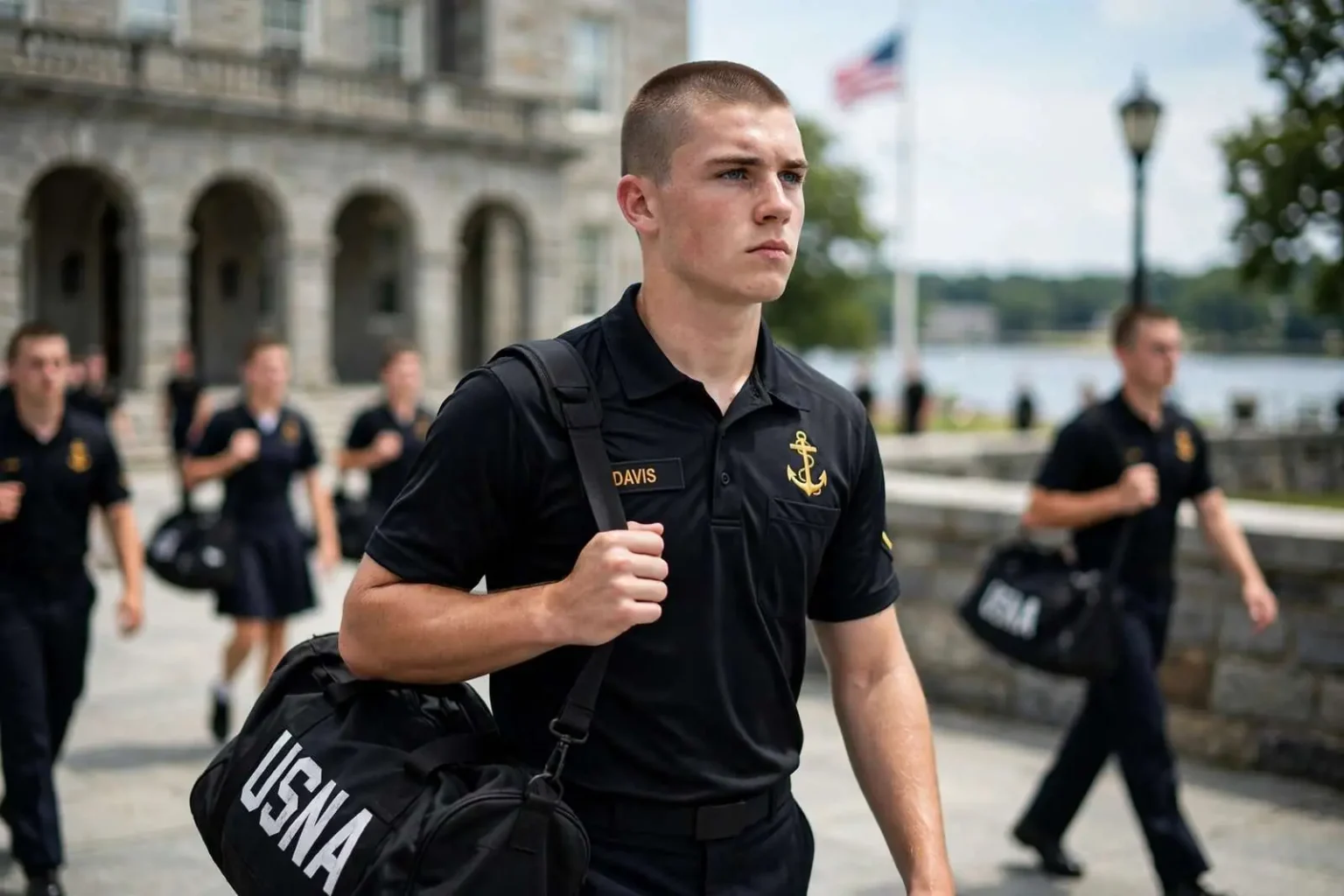
As the nation celebrated its 238th birthday, the U.S. Naval Academy’s Class of 2018 began Plebe Summer, a grueling seven weeks of training for roughly 1,200 incoming freshmen preparing to serve their country. Among them was Austin Davis of Mobile, salutatorian of the Class of 2014 at St. Luke’s Episcopal School — a two-sport athlete and class president who had spent four years positioning himself for exactly this moment.
The arithmetic of admission alone set him apart. More than 18,000 students had applied to the academy that year, an acceptance rate of less than 7 percent, making Annapolis one of the most selective institutions in American higher education. Every appointment required the full stack: competitive academics, proven athletics, demonstrated leadership, congressional or service-secretary nomination, physical qualification and medical clearance. Davis cleared all of it. He said he believed it was his duty as a citizen to defend the rights he had been given — a plainly stated conviction that the midshipmen around him would hear, in one form or another, from nearly every member of a class that arrived knowing the odds it had beaten.
A resume built on leadership
Davis had set his sights on a military career early and assembled an impressive record at St. Luke’s, the small Episcopal school in west Mobile known for turning out disciplined, well-rounded graduates. He graduated with a 4.38 grade point average, served as president of the senior class, earned a long list of honors and awards, played on the Wildcats’ state-champion baseball teams and its football team, and logged nearly 200 hours of community service. None of the pieces was decorative; each mapped directly onto what service academy admissions boards score.
His applications yielded a striking set of offers. In addition to his appointment to the Naval Academy, Davis received appointments to the U.S. Coast Guard Academy and to West Point, the U.S. Military Academy, along with a full, four-year NROTC scholarship to The Citadel. That is the full menu of paths into America’s uniformed officer corps offered to a single teenager from Mobile.
When applying to a service academy, Davis said, an applicant takes every opportunity available, and he did not think his multiple appointments were especially unusual. He treated them as parallel applications to the same ambition rather than separate honors to be counted. Others disagreed. Cmdr. Brian Campbell, the Naval Academy’s Blue and Gold officer and admissions liaison for the region, called Davis’s appointments exceptional precisely because most applicants do not pursue admission to each academy — the process is demanding enough that most candidates focus on one service or another rather than running the gauntlet four times over.
A natural leader
Campbell described Davis as a natural leader with great academics and athletics, the sort of trifecta the academy sought in candidates who were leaders in their communities and schools and who wished to serve their country. It was rare, Campbell added, to find a top scholar who also possessed such leadership potential, and he said the faculty at St. Luke’s raved about him. For a Blue and Gold officer — the volunteer interviewers who screen academy hopefuls for their home regions — such an endorsement from a candidate’s own teachers is the strongest signal an application can carry.
Davis credited teachers and coaches at St. Luke’s for helping him get there. He named English teacher Chris Keary-Taylor, dean of academics Suzy Banks, college counselor Ellen Blackwell and director of the middle and upper schools Patsy Horn — the administrators who had shaped his coursework, written his recommendations and steered him through the academy application maze, which is longer and more bureaucratic than a typical college admission and involves congressional nomination offices, physical testing and medical review.
He also cited coaches including football coach Eddie Guth, who had moved on to another school but still called every Saturday morning to check in, and baseball coaches Tim Becker, Tyler Minto and Josh Eddington. Davis played cornerback and defensive back in football and was the catcher on a baseball team that won back-to-back state championships in 2013 and 2014 — the catcher being the position coaches describe as the field general, the player who sees the whole diamond and manages pitchers through tight games. Championship baseball in Alabama’s classified playoffs is a punishing gauntlet of area rounds and elimination games, and St. Luke’s had done it twice running.
Those Saturdays of conditioning and the habits of team discipline were about to be repurposed. Academy classes fill with team captains and Eagle Scouts for a reason: Plebe Summer is designed to compress four years of high school leadership into seven weeks of accountability, and the youngsters who survive it are the ones already accustomed to doing hard things on schedule.
Seven demanding weeks ahead
His athletic conditioning promised to serve him well during Plebe Summer. Over the seven weeks, recruits would run more than 100 miles, complete more than 3,000 push-ups and sit-ups, and consume more than 4,000 calories a day, according to one published account. The regimen also included swimming, martial arts, rock climbing and obstacle courses, along with coursework in seamanship, navigation and sailing — the academic spine that turns an athlete into a future naval officer rather than merely a fit one.
Induction Day delivers the famous shock: the haircuts, the uniforms, the shouted corrections of the detailers — upperclassmen assigned to train the new class — and the sudden conversion of honor students into plebes who march to meals and memorize menus. What follows is a structured grind in which each week adds a privilege and a responsibility, from learning to salute to handling small boats on the Severn River. By August, the survivors take their oath-honored place in the Brigade and begin the academic year; by then, the phrase “Plebe Summer” has become shorthand for the hardest thing most of them have ever done.
Davis had a preview of the demands after attending the academy’s five-day summer program the previous year and a Candidate Visit Weekend in January — both designed to show prospective midshipmen the Academy as it actually is, before they commit four years of their lives and, potentially, a career of naval service to it. Many candidates come away from those visits more determined; others redirect to civilian colleges. Davis came away enrolled.
Plebe Summer, he knew, would be a no-internet, no-television experience, with recruits allowed only a handful of phone calls. For a member of the class of 2014 — the most connected generation in history to that point — the communication blackout was as much a test as the physical training. Families track the weeks by those brief calls and the occasional form letter, marking off the milestones: the first call from Bancroft Hall, the mid-summer break when classes visit, the final week when the new fourth class is formally received into the Brigade.
A family’s send-off
His parents, Scott and Melinda Davis, admitted to some worry about their only child’s chosen path, but said they were extremely proud of him. The uniformed services ask more of families than most colleges do — four years of academy discipline, then a commissioning and a service obligation that can send a new officer anywhere the fleet or the fleet Marine Force goes. Mobile families know that geography well; the port city has sent sons and daughters into the Navy for generations, and the academy’s alumni network in the area remains active in recruiting and mentoring candidates like Davis.
His mother said she felt good about the decision because she knew it was what he wanted, and that there was no part of him that did not understand what he was getting into. The visits had seen to that. Austin, she said, had been grown up for a very long time — the observation of a parent watching a son walk into an institution built precisely to test whether that maturity holds.
The academy’s route into Annapolis runs through Mobile more often than many residents realize. South Alabama has long produced competitive candidates for the service academies, aided by active congressional nomination offices, JROTC programs in area high schools and the region’s deep naval tradition along the Gulf Coast. Local Blue and Gold officers interview applicants each fall, and successful candidates often return to speak at school assemblies, feeding the next cycle of hopefuls from Mobile and Baldwin counties into the process Davis had just completed.
By the time the Class of 2018 marched in its first parade, the salutatorian from St. Luke’s had traded his Wildcats’ championships for the white works and the long gray line, one of roughly 1,200 plebes out of 18,000 applicants, running the first miles of the 100 that summer would demand. For Mobile, it was the kind of local story school assemblies are built on: a homegrown student who decided early what he wanted to serve, did the work without shortcuts, and left in July for Annapolis with his city’s good wishes and his own duty in mind.