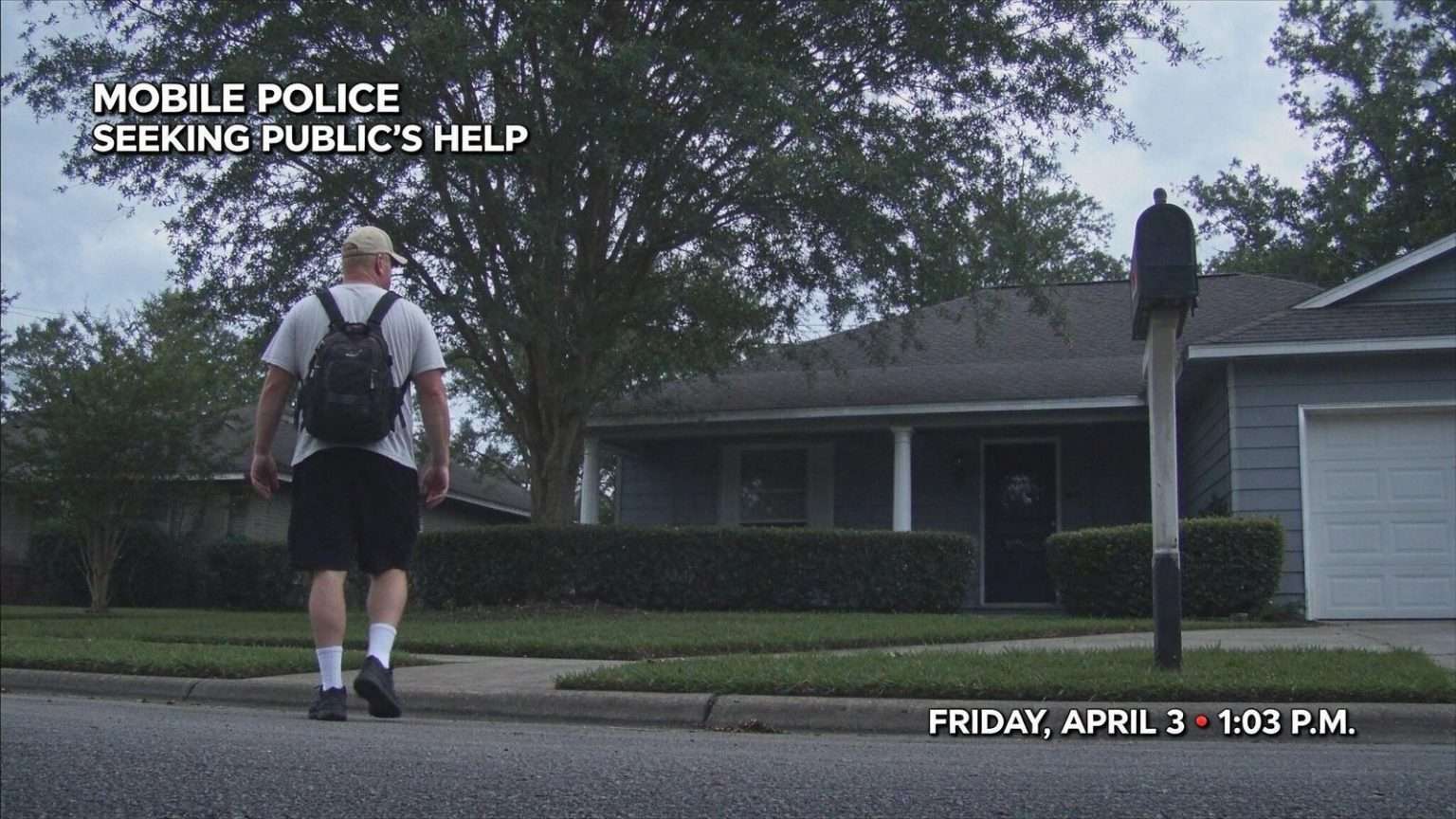
The Mobile Police Department is asking for the public’s help identifying a man seen on video near the scene of a residential burglary earlier this month. Investigators say the burglary took place in the 3800 block of Claridge Road, and the man in question was recorded in the area on Friday, April 3, at approximately 1:03 p.m. Police describe the individual as a white male wearing a white or light-colored hat, a light-colored short-sleeve T-shirt, a black or dark-colored backpack, black shorts extending to knee-length, and black or dark-colored shoes.
What Investigators Are Looking For
The surveillance footage captured the man in the area of the burglary scene shortly after 1 p.m. on a Friday afternoon, a window when many residents are at work and neighborhoods are quiet. Investigators released the description in hopes that someone will recognize the clothing combination — a light hat, light short-sleeve shirt, dark backpack, knee-length dark shorts and dark shoes — or recall seeing a matching individual in the area that day. A backpack in particular can be significant in residential burglary investigations, since it gives a suspect a way to carry jewelry, electronics, cash and small valuables away from a home on foot.
Anyone who recognizes the man is asked to contact the Mobile Police Department at 251-208-7211. Tipsters may remain anonymous. Anonymous tips are a staple of property crime investigations across Mobile, where witnesses may know a suspect but be reluctant to come forward formally. Callers to the department’s tip line can provide information without giving their names, and details from those calls routinely help detectives fill gaps that video evidence alone cannot close.
The 3800 block of Claridge Road sits in a residential section of west Mobile, an area of established neighborhoods characterized by single-family homes, mature trees and the kind of mid-century housing stock that lines the streets off Airport Boulevard and University Boulevard. Residential streets in this part of the city see steady daytime activity from school traffic and deliveries, which increases the chances that someone noticed something out of the ordinary that afternoon. The neighborhood’s location between the Spring Hill corridor and the busy commercial strips along Airport Boulevard places it among the city’s most settled residential districts.
How Surveillance Video Shapes Modern Investigations
Residential burglaries remain a persistent concern in neighborhoods throughout Mobile, and police routinely rely on surveillance footage and tips from residents to identify suspects when other leads are limited. Doorbell cameras, home security systems and commercial surveillance have become widespread across the city in recent years, changing the landscape of property crime investigation. Where detectives once depended on fingerprints, witness recollection and luck, a typical case now often begins with a hard drive full of video from the victim’s home and the neighbors on either side.
That shift has made the public’s role in solving these cases more important, not less. Cameras capture images, but identifying the person in the frame usually requires a human being who recognizes the walk, the clothing or the face. Police departments across the country have adapted by releasing short clips and still images through social media, television partners and community groups, turning thousands of residents into an extended investigative network. Mobile’s department uses precisely this approach, and the request in the Claridge Road case follows the standard playbook: a clear description, a specific date and time, and a tip line for people who know more than they may realize.
Timing details matter in these appeals. The 1:03 p.m. timestamp gives residents a specific window to reconstruct: where they were driving, whether they saw anyone walking in the neighborhood, whether a delivery driver or mail carrier passed someone matching the description. In burglary cases, the difference between a solved and unsolved case is often a single neighbor’s recollection of a stranger on the street. Early afternoon on a Friday also means school zones and busier arteries nearby would have been handling midday traffic, so the man’s movements likely crossed paths with dozens of drivers and pedestrians whose memories may still be intact.
Detectives investigating property crimes typically pursue several avenues in parallel: canvassing the neighborhood door to door, checking whether nearby businesses captured additional angles, comparing the suspect’s description against open cases in the same precinct, and running the video through any available databases. Public tips feed every one of those lanes, which is why the department pairs each video release with a phone number and an explicit promise that anonymity is welcome.
Burglary in Mobile: The Broader Picture
Residential burglary laws in Alabama cover entering or unlawfully remaining in a dwelling with intent to commit a crime, and the offense carries serious penalties that escalate when the home is occupied or when a suspect is armed. Burglary in the first degree, involving an occupied dwelling, is a class A felony under state law, while burglary of an unoccupied home falls to lower degrees with correspondingly shorter sentencing ranges. For victims, the losses go beyond the stolen property — the sense of violation that follows a home burglary lingers, and neighborhoods often respond with renewed attention to block watch programs, security lighting and camera registration efforts.
The department’s request for public assistance is part of a broader, ongoing effort to solve property crimes across the city with the help of residents who may have seen something out of the ordinary. Mobile police have long encouraged residents to report suspicious activity in real time rather than after the fact, noting that a call about a stranger lingering in the neighborhood can prevent a burglary in progress. Community policing initiatives in Mobile’s precincts emphasize exactly this partnership, with officers attending neighborhood association meetings and sharing crime prevention guidance directly with residents.
Crime prevention specialists recommend a standard set of protections for homeowners: deadbolt locks on all exterior doors, lighting on timers when houses are empty during work hours, trimmed shrubbery that does not screen windows and doors from the street, and neighbors who know each other’s schedules well enough to spot when something is wrong. A home that looks occupied — cars in the drive, a radio playing, packages collected by a neighbor — remains far less attractive to a burglar than one that sits dark and quiet through a weekday afternoon. Police also urge homeowners to record serial numbers and photograph valuables, since recoverable property with documentation stands a far better chance of returning to its owner if investigators make an arrest.
What Residents Can Do
For those who live in or near the 3800 block of Claridge Road, the most useful step is to review any security footage from Friday, April 3, in the early afternoon. Many home camera systems retain recordings for days or weeks, and even footage that seems unremarkable — a car passing, a person crossing an intersection a block away — can corroborate or extend the timeline detectives are building. Residents should also check whether visitors, delivery drivers or service workers were in the area around 1 p.m. and might have seen the man in the released description.
Anyone with information is encouraged to call 251-208-7211, the department’s tip line for this and other investigations. Callers who prefer anonymity can do so, and investigators stress that even partial information — a first name, a familiar face from the neighborhood, a direction of travel after the man left the area — can be the thread that unravels the case. The department’s message to the public in cases like this is consistent: the people who live on the street know it better than anyone, and their eyes are the resource no camera can replace.
The investigation into the Claridge Road burglary remains active, and police have not released details about what was taken or whether the suspect has been linked to other break-ins in the area. Residents of west Mobile’s neighborhoods can expect continued attention to the case as detectives work the video evidence and the tips that come in. Burglars who work a neighborhood rarely stop at one house, so an arrest in this case could clear multiple incidents across the district — one more reason investigators place such weight on the public’s response to the footage.
The department’s appeal serves as a reminder to every neighborhood in the city that the cameras on the porches and the people behind them are now the first line of defense in solving property crime. A single clear frame at 1:03 p.m. on a Friday afternoon has already given detectives a face, a build and a wardrobe; what it needs now is a name, and that name almost certainly lives somewhere within the memory of a Mobile resident who has yet to make the call.
Neighbors considering a camera of their own should note that positioning matters as much as resolution: units aimed at sidewalks, driveways and the street capture the passing detail that identifies a stranger, while units aimed only at a front door record the encounter after it is too late. The department’s investigators can use timestamps from multiple homes to build a movement map through a neighborhood, turning scattered private recordings into a single continuous account of a suspect’s path.