Record Pump Prices Squeeze Mobile Drivers as Alabama Average Nears $4.30
Regular gas hit a record high in Mobile as Alabama's average neared $4.30 a gallon, and drivers on fixed incomes say the cost is reshaping their budgets.
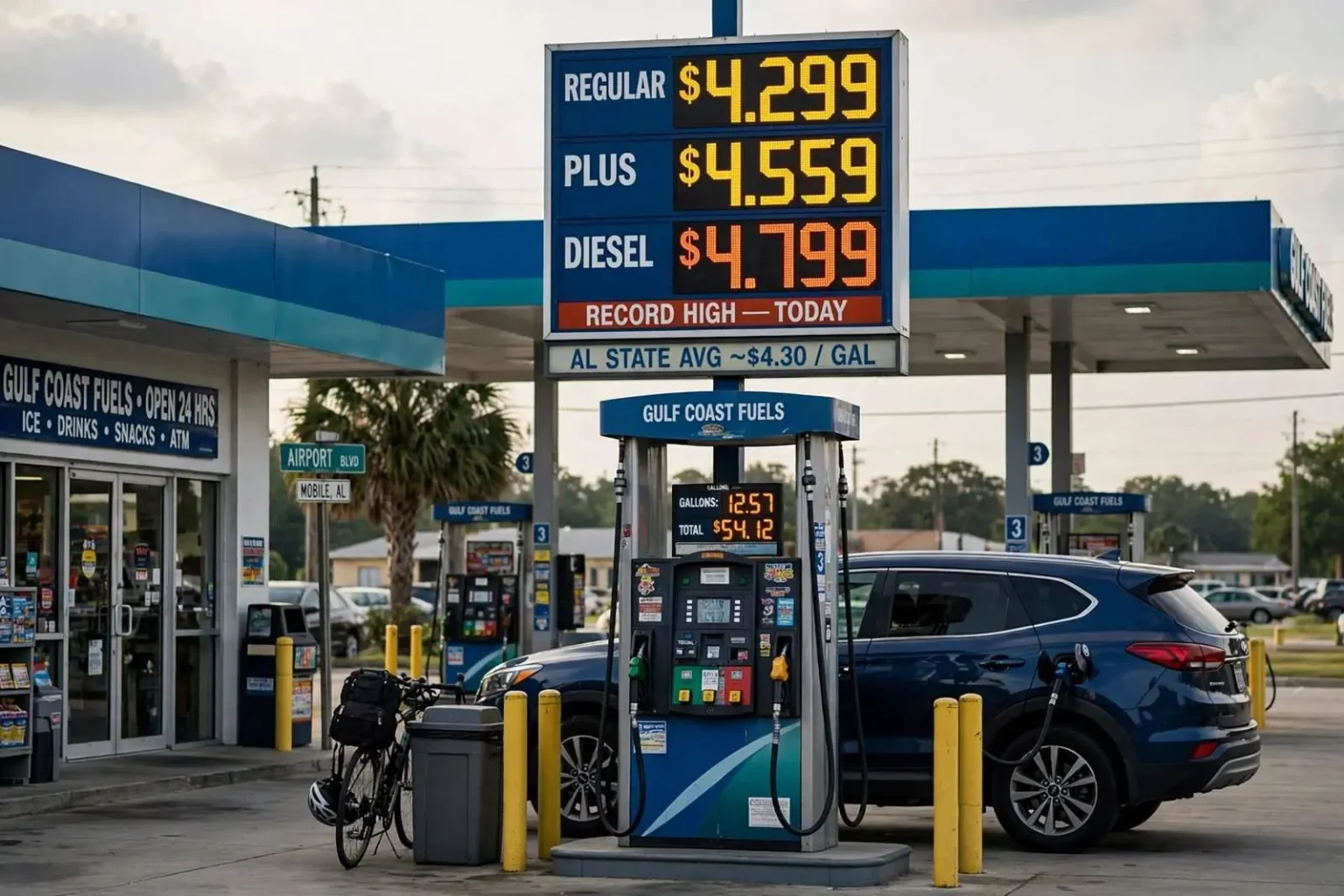
Drivers across Mobile are rethinking how often they turn the key as fuel costs climb to levels the city has never seen before. Regular gasoline in Mobile set a record high late last week, and forecasters expect little relief before the end of summer.
AAA pegged Alabama’s statewide average at roughly $4.30 a gallon, a figure the motor club says is close to two dollars higher than the same period a year earlier. Analysts tracking the market expect the national average to keep drifting upward as summer travel demand builds.
The statewide average masks variation at the pump. Prices along the Gulf Coast typically run slightly below the state average because of proximity to refineries and port terminals, while interior counties pay more for transport — but at these levels, even the cheapest stations in the Mobile area are asking prices residents have never seen on a local sign.
Household Budgets Absorb The Hit
For people who drive to work every day, the increase has already changed the math on a routine fill-up. Mobile resident Marshall Presnall said a tank that cost him about $40 a few months ago now runs closer to $54.
“I work pretty much not paycheck to paycheck, but I’m not rich,” Presnall said. “So it is taking a toll on my pockets.”
The gap between $40 and $54 adds up quickly for a commuter. A driver who fills up weekly is spending more than $700 a year extra at that rate — money that comes out of the same budget as groceries, rent and utilities, all of which have also been rising.
Retirees living on a set monthly amount have less room to adjust. Dervon Womble of Mobile said his income does not rise alongside the price board at the corner station.
“I’m retired and I’m on a fixed income, so with the gas prices going up my income doesn’t go up,” Womble said. “But I still have my bills and a family to take care of.”
Fixed-income households face the squeeze from both directions: fuel costs feed into food prices through shipping, and into utility bills, so the same retirees absorbing $4.30 gasoline are also paying more for everything the delivery trucks carried.
Some Drivers Look For Alternatives
Dominic Lewis, another Mobile resident, said the numbers have pushed him to consider leaving his vehicle parked more often and returning to a bicycle he once relied on for short trips.
That kind of substitution is what transportation analysts watch for when prices spike. Every errand shifted from car to bike, every combined trip that eliminates a separate drive, shaves a few dollars off a household’s monthly fuel bill — and enough households making those shifts eventually shows up in demand statistics.
Research circulating this spring projects the typical American household will spend in the neighborhood of $4,800 on gasoline this year, roughly double the prior year’s outlay, with some analysts warning the national average could test $6 a gallon during peak summer driving season.
A $6 national average would push Alabama prices well past where they stand now, deepening the squeeze on commuters and fixed-income households alike. Forecasters caution that hurricane season adds its own uncertainty for Gulf Coast drivers, since refinery and port disruptions in the region send ripples through national supply.
Why Prices Climbed
Drivers interviewed in Mobile offered differing explanations for the run-up. Presnall said he attributes much of the increase to the war in Europe rather than domestic policy, and said he hopes prices ease later in the year.
The war’s disruption of global oil markets has been the dominant driver of crude prices, with sanctions and shipping disruptions tightening supply just as post-pandemic demand returned. For consumers, the effect lands with a lag: crude prices move first, then wholesale gasoline, and finally the street price at the corner station.
Domestic refinery capacity has added its own pressure. The United States has closed several refineries in recent years, leaving the remaining plants running near maximum output through peak season. When a Gulf Coast refinery hiccups, wholesale prices across the Southeast move within hours, because the region’s supply chains run through the same corridor Mobile’s fuel comes from.
What Mobile Drivers Are Doing About It
Along with trading down to smaller vehicles and combining errands, Mobile drivers are comparison-shopping more aggressively. Fuel apps and station signs along heavily traveled corridors like Airport Boulevard, Government Street and the I-65 interchanges show spreads of 20 cents or more per gallon between stations within a short drive of each other — a gap that matters more at these price levels than it did when a gallon cost half as much.
Employers are fielding the question too. Commuting costs affect worker retention, particularly for hourly positions, and some businesses across the region have responded with adjusted schedules that let employees compress their workweeks and cut driving days.
Public transit offers only partial relief in Mobile. The Wave Transit system serves key corridors of the city, but coverage gaps mean most households that own a car cannot realistically give it up. For drivers like Lewis, the bicycle remains the practical alternative for short trips that fall within the city’s older, denser neighborhoods.
The price surge also reshapes summer travel plans. Tourism officials along the Gulf Coast watch fuel prices closely because drive-in visitors — the vast majority of the region’s beach traffic — make destination decisions based on the cost of the trip. A family driving from Birmingham or Atlanta to the coast at record prices faces a fuel bill that can rival a night’s lodging.
The Road Ahead
Forecasters expect the tight market to hold through the end of summer, with relief — if it comes — arriving as vacation travel tapers in the fall. Much depends on factors outside Alabama’s control: the course of the war in Europe, decisions by oil-producing nations, and whether hurricane season spares the Gulf’s refining and port infrastructure.
For now, motorists along the upper Gulf Coast are left doing what Presnall described as trying to stretch a dollar a little further each week.
The habits formed during a price spike tend to outlast it, transportation researchers note. Households that discovered they can bike to the drugstore or cut one driving day a week often keep the practice when prices retreat, which is why fuel economists treat spikes as permanent reshapers of driving behavior rather than temporary annoyances.
For Mobile’s drivers, though, the calculation for the rest of the summer is simpler: the sign at the corner station is the highest anyone in the city has ever seen, and nothing on the horizon suggests it will come down before the season ends. Whether the next fill-up costs $54 or more, the tanks still need filling — and the bills, as Womble said, still have to be paid.
The Geography of the Pain
Fuel costs hit Mobile differently than they hit cities with robust transit or walkable cores. The metro area grew outward along automobile corridors — Tillman’s Corner, West Mobile, the Eastern Shore commuter routes — so most households have no practical way to reach work, school and groceries without driving daily.
That dependency means the pump price functions almost like a tax on living here, and it is paid by workers whose wages have not moved at the same speed. Delivery drivers, construction crews, home health aides and others whose jobs are on the road absorb the cost directly in their work vehicles, then again at home.
Businesses that run fleets — landscapers, plumbers, freight carriers — have been passing fuel surcharges through to customers, a quiet second wave of the increase that reaches households that barely drive themselves. The pattern economists describe is straightforward: energy inflation spreads through an economy for months after the initial spike, showing up in invoices long after the signs at the stations stopped rising.
How This Spike Compares
Alabama’s previous record prices came during the 2008 run-up, when crude briefly topped levels that make today’s averages look familiar, and again during the supply shocks of recent years. What distinguishes the current spike is the pace — a climb of nearly two dollars in a year leaves households no time to adjust purchases, vehicles or housing choices.
Older Mobile residents describe a different benchmark. Longtime commuters remember when a $20 bill more than filled the tank of a mid-size sedan; a $54 fill-up compresses decades of price memory into a single trip to the pump, and the sticker shock is part of what is pushing drivers like Lewis back toward two wheels.
The state’s average of roughly $4.30 also sits within a regional band that stretches across the Southeast, where prices have moved in near-lockstep because the same Gulf Coast refineries and pipelines supply the market. Relief for Mobile, when it comes, will arrive at roughly the same time it arrives in Atlanta, New Orleans and Birmingham.
Stretching a Dollar
For households planning around the rest of the summer, the practical advice circulating from AAA and consumer groups has been familiar: keep tires inflated, consolidate errands, lighten loads, and shop the price spread between stations. Each measure saves a modest amount, but at record prices the modest amounts accumulate into real budget room.
The deeper adjustments — trading vehicles, moving closer to work, shifting to transit or cycling — take months and are already underway in scattered cases across the city. Lewis’s consideration of his old bicycle is the earliest and most visible form of what transportation planners expect to see more of if the high prices hold into fall.
Until the market turns, Mobile’s drivers are managing the only way they can: one fill-up at a time, hoping the sign at the station has not climbed again by the time the needle reaches empty.