Mobile Police Overhaul Promotion System, Elevate Nearly 30 Officers
Mobile police promoted nearly 30 officers under a new merit-based system designed to reduce reliance on college degrees and reward experience.
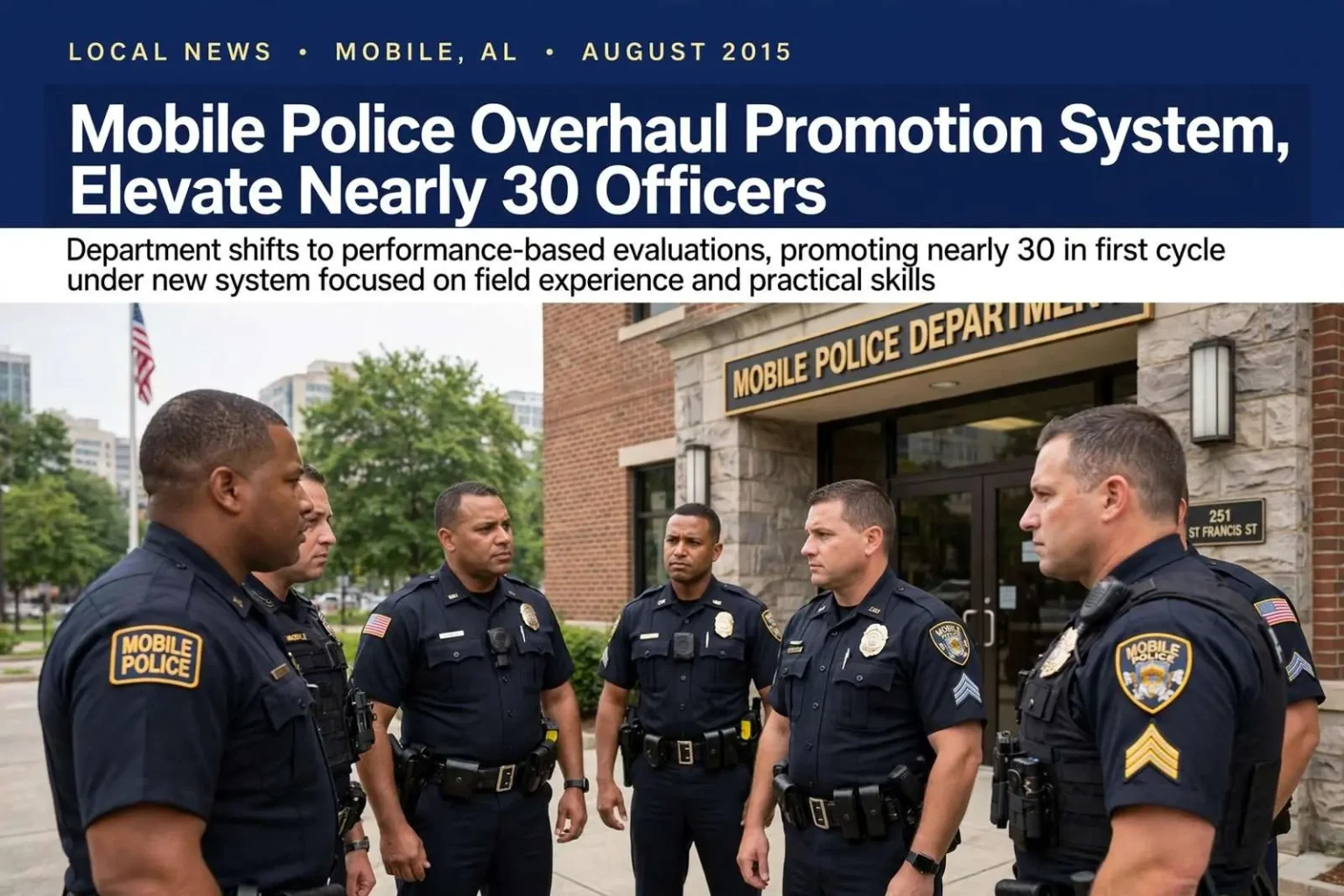
The Mobile Police Department promoted nearly 30 sworn officers this summer under a newly overhauled evaluation process that shifts weight away from academic credentials and toward hands-on performance and experience. The promotions touched every level of the department’s chain of command and marked the first full cycle under a system Police Chief James Barber framed as a correction to years of frustration inside the ranks.
Why the old system was scrapped
Under the department’s previous promotion system, holding a college degree provided a scoring bonus on top of an officer’s test results, even when experience on the street told a different story. The design assumed that formal education correlated with readiness to lead — an assumption common in American policing for decades, but one that rank-and-file officers in Mobile had long complained penalized veterans who learned the job in the field rather than in a classroom.
“Historically we’ve had a difficult time getting qualified people into positions,” Barber said of the old approach. His assessment was blunt: when promotion scores could hinge on whether an officer held a degree rather than whether that officer could actually perform the duties of the next rank, the department ended up promoting credentials and hoping the leadership followed.
The new process requires officers seeking advancement to complete a three-part evaluation: a 100-question exam covering law and department procedure, along with practical simulations of the tasks expected at the next rank up. The written component keeps the academic floor in place — officers must still know the law and department policy cold — but the simulations put the decisive weight on demonstrated capability: running a call scene as a corporal would, managing a shift problem as a sergeant would, handling the administrative and supervisory work the higher rank actually performs.
Supporters within the department say the format gives a clearer picture of whether an officer is ready to lead. In practical terms, the change means an officer’s bid for promotion is decided less by what he or she has studied and more by what he or she can show under observation — a shift that mirrors moves other departments nationally have made as they reassess how supervisory talent is identified.
A case study from the ranks
Among those promoted was a Mobile native with 23 years in law enforcement, 13 of them with MPD, who moved up to corporal and began new duties in the department’s planning and research unit. He also works as one of the department’s self-defense instructors, a role that places him in front of recruits and veteran officers alike — teaching, evaluating and demonstrating under the same kind of performance standards the new promotion system emphasizes.
He said the previous system had effectively penalized experienced officers without degrees, since a lower test score paired with a degree could outrank a stronger score without one. The arithmetic was simple and, to veterans, demoralizing: two officers could sit for the same exam, the stronger performer could score higher, and the degree-holder could still finish ahead on the final list. Under the new structure, the exam score and the simulation performance carry the evaluation.
“The city of Mobile deserves a well-trained, well-disciplined police force,” he said, adding that he supports the direction Chief Barber has set for the department. That sentiment — from an officer whose career spanned the old system and lived through its consequences — captures the mood among many in the ranks who saw the overhaul as overdue rather than controversial.
A reshuffling across every rank
The round of promotions touched every rank in the chain of command, from captains moving up to major down to patrol officers stepping into corporal roles. Sergeants advanced to lieutenant, corporals moved up to sergeant, and officers across multiple units earned corporal stripes, reflecting a broad reshuffling of MPD’s leadership structure heading into the second half of 2015.
The breadth matters operationally. Promotions at the corporal and sergeant levels change who runs calls and supervises streets day to day; promotions at the lieutenant and major levels change who manages districts and commands. A single cycle that moves officers at every rung ripples through the department’s assignments for years, as each promotion below creates a vacancy above that itself must be filled — the reason departments describe promotion cycles as pipelines rather than one-time events.
The corporal rank deserves particular attention because it is where the department’s supervisory culture is set. Corporals are the first rank that carries formal responsibility for other officers — training new hires, reviewing reports, making the on-scene decisions that define how MPD polices its neighborhoods. If the new evaluation system produces corporals who demonstrated readiness in simulations rather than simply outscoring peers on a written test, the effect compounds as those corporals rise.
The national context
The change comes amid a broader national conversation about how police departments identify and prepare officers for supervisory roles. Departments across the country have spent years wrestling with the same questions Mobile confronted: whether written examinations measure leadership, whether degrees predict supervisory performance, and how to test the judgment that policing at scale actually requires. Assessment centers and scenario-based evaluations — the model MPD’s simulations resemble — have been the most widely adopted answer, and departments that adopted them have generally reported better alignment between promotion decisions and real-world performance.
Mobile’s overhaul also arrives at a moment when recruiting and retention concerns press on departments nationally. Officers weigh promotion prospects heavily when deciding whether to stay in a department, and a system seen as fair — one that rewards demonstrated capability — is itself a retention tool. The officers promoted this summer will carry that message back to their shifts, for better or worse, depending on how the system is perceived to have performed.
What comes next
Department officials say the revised promotion criteria will remain in place for future evaluation cycles, with the goal of building a more consistent pipeline of leadership from within the ranks rather than relying heavily on formal education alone. The emphasis on internal development reflects a longstanding preference among professional departments: homegrown supervisors who know the city, the neighborhoods and the department’s own history, advanced because they proved ready.
MPD did not indicate whether further adjustments to the testing format are planned, but officials said they will monitor how the new system performs in upcoming promotion cycles. The metrics that matter are straightforward — how promoted officers perform in their new roles, how the exams and simulations hold up under review, and whether the department’s leadership pipeline keeps pace with retirements and attrition in the years ahead. This summer’s promotions were the first test; the results, as the department itself acknowledged, will be judged one cycle at a time.
Inside the new evaluation
The 100-question exam anchors the process in knowledge every supervisor must possess: state criminal law, departmental policy, use-of-force standards and the procedural rules that govern how MPD operates. The written test functions as a gate — officers who cannot pass it do not advance to the practical stage — but the simulations that follow are where candidates are separated. Scenarios are drawn from the duties of the rank being sought, so a corporal candidate is evaluated on leading a call, directing officers on scene and documenting the outcome, while candidates for higher ranks face administrative and command-level problems.
The simulation format rewards something a written test cannot capture: composure. Supervisors in policing make their decisions in noisy, uncertain situations, often with incomplete information and with subordinates waiting on direction. Watching a candidate work through a scenario — assigning tasks, communicating clearly, recognizing when a situation exceeds their authority — gives evaluators a live look at the qualities the old system could only infer from test scores and transcripts.
The structure also levels the field between officers with different backgrounds. A veteran with two decades on patrol enters the simulation on equal footing with a degree-holding colleague, because the evaluation measures what each can do rather than what each has completed. That does not disadvantage education — officers who studied criminal justice still hold an edge on the written exam — it simply stops education from functioning as an automatic bonus independent of performance.
The planning and research assignment
For the newly promoted corporal moving into the planning and research unit, the assignment represents a different kind of supervision than the street. The unit handles the department’s behind-the-scenes work — policy analysis, accreditation documentation, grant projects and the studies that inform how MPD deploys its resources — and it draws on officers with enough field experience to know how policy written at a desk will actually play out on a shift. An officer with 23 years in law enforcement, and years teaching defensive tactics besides, brings exactly that perspective to the role.
The dual role he holds — supervisor in training and self-defense instructor — reflects a broader reality in mid-sized departments, where specialized skills are spread across the ranks rather than concentrated in dedicated training divisions. Instructors like him train recruits at the academy and recertify veteran officers, and the credibility that comes with teaching the material is part of what made his promotion under a performance-based system a natural fit.
What Mobile residents should know
For city residents, the promotion overhaul is mostly invisible but broadly consequential. The corporal who responds to a disturbance call, the sergeant who manages the scene and the lieutenant who commands a district are all products of whichever evaluation system the department was using when they advanced. A system designed to put the most capable officers into those roles shows up, over time, in how calls are handled, how complaints are resolved and how the department performs in the moments that define public trust.
The nearly 30 officers promoted this summer are now working their new assignments across the city’s precincts and units, and the department’s leadership pipeline — refreshed at every rank in a single cycle — begins its next rotation from this new baseline. Whether the revised system becomes Mobile’s long-term answer will be determined in future cycles, but for the officers who advanced under it, and for the veterans who watched the old one hold them back, this summer’s promotions marked a reset the department had been waiting years to see.