A Bag of Bloodstained Money, a Fifth Amendment Claim, and a Bid to Undo a Mobile Manslaughter Verdict
Defense attorney Christine Hernandez asked a Mobile County judge to set aside Harold Lee Miller's manslaughter conviction, citing unmarked evidence, missing surveillance footage and Prichard police officers who have since been charged with crimes.
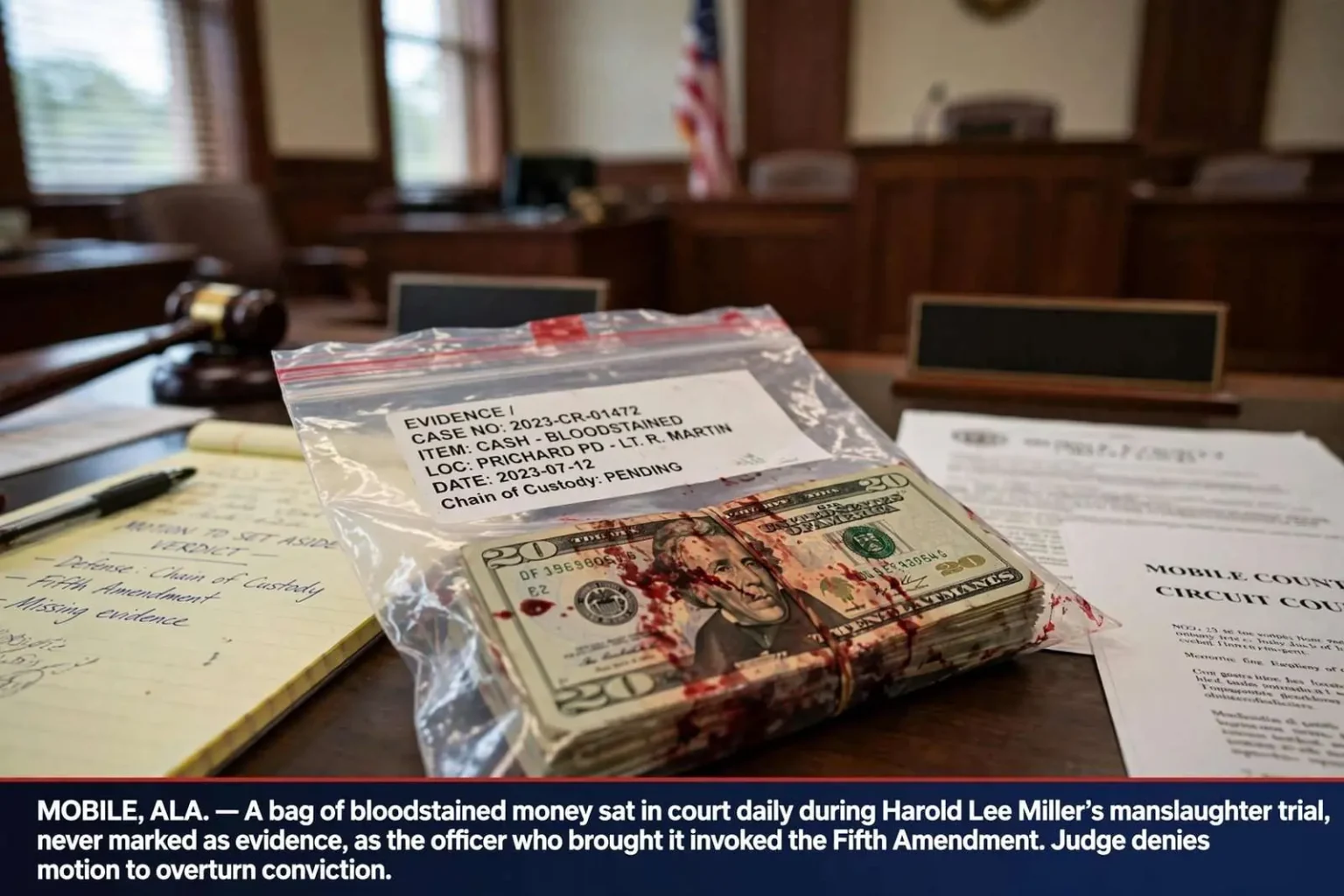
MOBILE, Ala. — A bag of money stained red sat in a Mobile County courtroom every day of Harold Lee Miller’s manslaughter trial. It was never marked as evidence. No one explained it to the jury. And when the defense finally tried to ask the Prichard police lieutenant who brought it what it was, he invoked his Fifth Amendment right against self-incrimination.
That moment sits at the center of a motion argued before Mobile County Circuit Judge Jay York on Wednesday, in which defense attorney Christine Hernandez asked that her client’s conviction be set aside — in substantial part because of the conduct of Prichard police officers who have since been charged with crimes of their own.
York sentenced Miller last month to 14 years and two months in prison for the shooting death of Jacquel Graham inside the Lotus Gentlemen’s Club in 2023.
“There is some serious question about the evidence in this case missing and Harold Miller not receiving a fair trial,” Hernandez told the judge.
The Money
Hernandez said Lt. Robert Martin brought the red-stained bag of money — presumably stained with blood — to court every day of the trial. It was never marked as evidence, and Martin never explained it in front of the jury.
The Mobile County District Attorney’s Office has said the money belonged to the victim and that police took custody of it at the hospital. Prosecutors said it was not relevant to the case.
Hernandez took issue with that explanation, and her objection was procedural as much as substantive.
“Anything that is taken from a crime scene is supposed to be marked into evidence,” she said. “Second, where was it taken? Was it taken from the person? Was it taken from around the person?”
The point underlying those questions is chain of custody — the documented record of who handled a piece of physical evidence, when, and where it was held. Chain of custody is not a formality. It is the mechanism by which a court can be satisfied that an item presented at trial is what a witness says it is and has not been altered. An item that circulates outside that system cannot be tested by either side.
An Officer Takes the Fifth Mid-Trial
When Hernandez attempted to question Martin about the money and about other matters related to the investigation, he invoked his Fifth Amendment privilege against self-incrimination.
“I’ve not had an officer take the Fifth in the middle of a trial,” she said during Wednesday’s hearing.
The remark reflects how unusual the situation is. The Fifth Amendment privilege belongs to every person, including law enforcement officers, and it may be asserted by anyone whose testimony could tend to incriminate them. But an investigating officer asserting it about his own investigation, while that investigation’s outcome is being tried, creates a problem with no clean solution. The defense cannot compel answers. The jury cannot be told to draw conclusions from the silence in the way it might in a civil case. And the record simply lacks the explanation.
Who Pulled the Video
Hernandez pointed to discrepancies in the testimony Martin did give. She said he testified that he pulled surveillance video from the club, even though the club owner testified that Detective Jason Hadaway did so.
Hadaway was later convicted of perjury in a separate, unrelated case.
The conflict matters because of what the video does and does not show. Hernandez said the surveillance footage captures the shooting and shows then-Chief Walter Knight and Officer Emanuel Naman Dotch II entering the club afterward. Both officers have since been charged with crimes unrelated to this investigation.
She said the video cuts off before showing how the victim’s body was moved or what happened inside the club after the shooting. When she began asking Martin about that, he invoked the Fifth.
The Missing Gun
The gap in the footage connects directly to the defense Miller ran at trial.
“Our position has been, and the testimony was, that Jacquel Graham was armed,” Hernandez said. “Where’s the gun? Where’s the video footage that shows when Jacquel Graham’s shoes were being removed? Where’s the video footage that shows when Jacquel Graham was moved from the floor to the couch?”
In a self-defense case, whether the person who died was armed is frequently the single most consequential factual question. Alabama law permits the use of deadly physical force when a person reasonably believes another is using or about to use unlawful deadly physical force against them. A weapon in the decedent’s possession supports that belief; the absence of one undercuts it.
The defense position is not simply that a gun existed and was not recovered. It is that the record of what happened in the minutes after the shooting — a period during which the scene was under police control — is incomplete in ways the defense cannot investigate, because the officers who could explain it either are not answering or have credibility problems of their own.
The State’s Answer
Mobile County Assistant District Attorney Louis Walker argued that the video is not relevant because the identity of the shooter was never in question. Miller did not deny firing; he argued self-defense.
Walker did not dispute the broader problem with the department.
“Clearly, there are serious issues there (with the Prichard Police Department),” he said. “We’re not disputing that.”
That concession is notable. The state’s position is not that the Prichard Police Department’s conduct is above question, but that the specific deficiencies alleged did not bear on the specific issue the jury had to decide.
The Second Argument: An Inconsistent Verdict
Separately from the police conduct, Hernandez argued that the verdict itself is legally inconsistent. Manslaughter, she said, relates to conduct that is not intentional, and that does not fit with self-defense.
“It undermines the affirmative defense of self-defense,” she said.
The argument reflects a genuine tension in the law. Self-defense is an intentional act — a person who claims it is asserting that they meant to use force and were legally justified in doing so. Reckless manslaughter, by contrast, involves consciously disregarding a substantial and unjustifiable risk rather than acting with intent to kill. A verdict that rejects both intentional murder and complete justification can be difficult to reconcile with either theory as presented.
Walker countered that the jury “did not agree with either the state or the defense,” since Miller claimed self-defense and prosecutors alleged intentional murder. He said the defense theory was “rejected by the jury, which is their prerogative.”
Courts have generally been reluctant to disturb verdicts on inconsistency grounds, reasoning that juries are entitled to accept some evidence and reject other evidence, and that a compromise verdict falling between the parties’ competing theories is within their authority.
The Wider Context in Prichard
The officers named in Hernandez’s argument are not incidental figures. Walter Knight was the chief of the Prichard Police Department and is now at the center of his own legal dispute with the city, having filed a civil suit contending he never resigned following his July arrest on charges that he used public time and city police equipment while working private funeral processions.
Detective Jason Hadaway has been convicted of perjury in an unrelated case. Officer Emanuel Naman Dotch II has been charged with crimes unrelated to this investigation. Lt. Robert Martin invoked his Fifth Amendment privilege rather than answer questions about the investigation he conducted.
Prichard has spent the past several months rebuilding its police department, with the city contracting a search firm for a new chief, raising officer pay and negotiating with the Mobile County Sheriff’s Office to maintain coverage in the interim.
What Wednesday’s hearing illustrates is a consequence of that upheaval that extends beyond the department’s own personnel files. Criminal convictions rest on investigations. When the investigators become defendants, cases they built are exposed to challenge — not necessarily because the underlying facts were wrong, but because the record cannot be defended by the people who made it.
What Comes Next
York did not immediately rule on the motion. If it is denied, Miller’s conviction and 14-year, two-month sentence stand, subject to any appeal. If it is granted, the conviction would be set aside, and the district attorney’s office would face a decision about whether to retry the case — a decision complicated by the same evidentiary problems argued Wednesday.
South Alabama News will report the judge’s ruling when it is issued.
Update: The Judge Denies the Motion
A judge has rejected Harold Miller’s bid to set aside his manslaughter conviction.
Attorneys for Miller argued that the jury’s verdict was “legally inconsistent.” Defense attorney Christine Hernandez also raised concerns about the Prichard Police Department’s handling of the case.
Hernandez pointed to a bag of blood-stained money that the lead detective brought to court each day during the trial but never turned over to the district attorney’s office. She also cited criminal charges filed against the police chief and several responding officers involved in the case.
The judge denied the motion to overturn the verdict.
Miller was previously sentenced to 14 years and two months in prison for the 2023 fatal shooting of Jacquel Graham at the Lotus Gentlemen’s Club.
What a Denial Means Procedurally
A post-trial motion to set aside a verdict asks the trial judge to undo the jury’s finding. The standard is demanding: a judge is not asked to weigh the evidence as a juror would, but to determine whether the verdict can stand as a matter of law.
An argument that a verdict is “legally inconsistent” generally contends that the jury’s findings cannot logically coexist — that convicting on one count while acquitting on another, or finding one set of facts while rejecting another, produces a result the law cannot sustain. Courts have historically been reluctant to disturb verdicts on inconsistency grounds, in part because juries are permitted a degree of leniency that does not have to be internally consistent.
Denial of the motion leaves the conviction and sentence in place. The ordinary next avenue for a defendant in that position is appeal to a higher court, where the issues raised at trial and in post-trial motions can be reviewed.