An Alarm at Benson’s Appliance Center Led Foley Police to a Second Break-In Across the Street
Foley police arrested 33-year-old Mendrell Dewayne-Marion Porter inside Benson's Appliance Center after a 12:30 a.m. alarm, then found a second forced entry at the Foley Service Center across the street. He faces eight charges spanning four incidents.
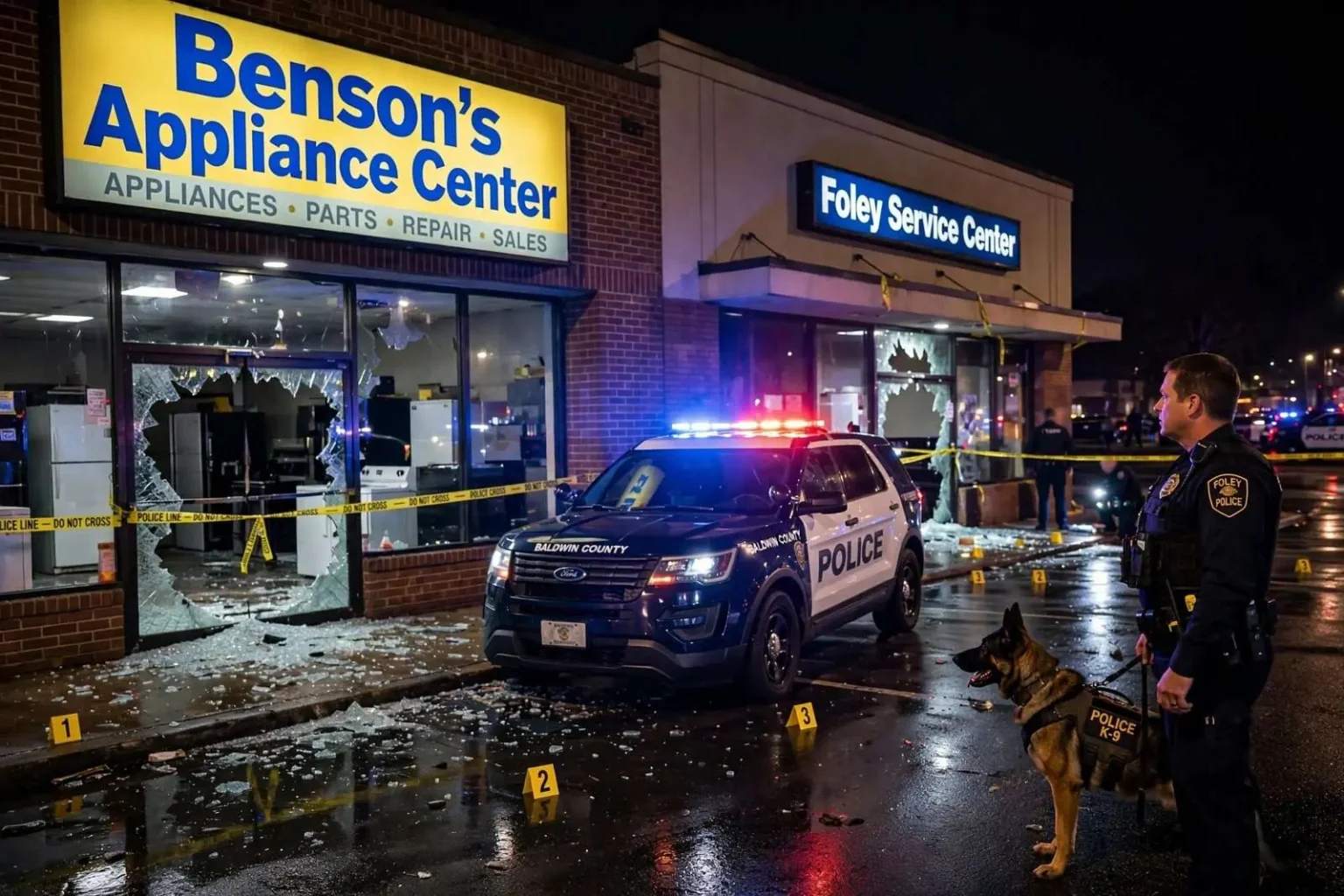
FOLEY, Ala. — A security alarm at an appliance store just after midnight led Foley police to a man inside the closed business, and then across the street to a second break-in the officers found only because they kept looking. By the end of the night, a 33-year-old Foley man faced eight charges spanning four separate incidents.
According to the Foley Police Department, officers responded to an activated security alarm at Benson’s Appliance Center at approximately 12:30 a.m. on Sept. 9. When they arrived, they found signs of forced entry and confirmed that someone was inside the closed business.
Officers established a perimeter with assistance from the department’s K-9 unit and took Mendrell Dewayne-Marion Porter of Foley into custody without incident or injury.
A Second Scene Across the Street
What happened next is the part of the account most worth noting. Rather than treating the arrest as the end of the call, officers canvassed the immediate area for additional property damage. Across the street, they discovered a second forced entry at the Foley Service Center.
Foley Police Department detectives and crime scene technicians responded to process both scenes.
That canvass is standard practice in commercial burglary response, and it exists for a practical reason: businesses that are closed overnight often do not discover a break-in until staff arrive the following morning, sometimes many hours later. By then, evidence has degraded and any trail has gone cold. Locating a second scene while officers are still on the block, with technicians available and a suspect already in custody, changes what investigators can establish.
The Interview
During a subsequent interview with detectives, Porter confessed to committing both burglaries that evening, as well as an additional commercial burglary and a vehicle break-in earlier in the month, according to the department.
Porter was transported to the Baldwin County Correction Center and charged with:
- Burglary, third degree (three counts)
- Unlawful breaking and entering of a vehicle
- Criminal mischief, second degree
- Criminal mischief, third degree
- Theft of property, fourth degree
- Tampering with physical evidence
A charge is an accusation. Porter is presumed innocent unless and until proven guilty in a court of law, and a statement made to investigators is subject to challenge in court like any other piece of evidence.
Reading the Charge Sheet
The list of charges is longer than the number of buildings involved, and the structure of it says something about how Alabama grades property crime.
Third-degree burglary applies when a person knowingly enters or remains unlawfully in a building with intent to commit a crime inside. It is a Class C felony in Alabama, carrying a sentencing range of one year and one day to 10 years. It is the grade used for most commercial break-ins where no one is present and no weapon is involved. Three counts correspond to three separate buildings.
Unlawful breaking and entering of a vehicle is a separate offense from burglary in Alabama, covering entry into a vehicle with intent to commit a felony or theft. It is also a Class C felony.
Criminal mischief charges cover damage to property, and the degree turns on the dollar value of the damage. Second-degree criminal mischief is a Class A misdemeanor covering damage above a statutory threshold; third-degree covers lesser amounts. In break-in cases, these charges typically attach to the damage caused by the forced entry itself — a broken door frame, a shattered window, a damaged lock — which is frequently more expensive to repair than the value of anything taken.
Fourth-degree theft of property is the lowest grade of theft in Alabama, applying to property below a set value threshold.
Tampering with physical evidence is a distinct and more serious allegation in character. It applies when a person, believing an official proceeding is pending or about to be instituted, alters, destroys, conceals or removes physical evidence with intent to impair its availability. It is a Class D felony. The department has not described what conduct that charge refers to.
The Cost Businesses Actually Absorb
The charge structure points to something small-business owners understand well and that gets lost in headline coverage of burglary: the theft is rarely the expensive part.
A commercial break-in typically leaves a business with a damaged point of entry, a security system to reset, a scene that cannot be disturbed until technicians finish, and hours of lost operating time the following day. Insurance deductibles often exceed the value of the merchandise taken. For a small independent business, the practical loss from a night like this one is measured in repair invoices and closed hours rather than in inventory.
That is one reason law enforcement agencies push commercial alarm registration and monitoring as hard as they do. The alarm at Benson’s Appliance Center is what produced a response while someone was still inside.
The Department’s Message to Business Owners
The Foley Police Department used its release on the arrest to make a point about that relationship directly.
“The Foley Police Department deeply values its strong partnerships with local businesses,” the release said. “We extend our sincere gratitude to business owners who proactively secure their properties and collaborate with our officers, enabling us to respond quickly and effectively to these types of incidents.”
The practical measures that tend to matter in cases like this one are unglamorous: monitored alarm systems rather than sirens alone, exterior lighting that eliminates dark approaches to doors and windows, camera coverage positioned to capture faces at entry points rather than only wide views of a parking lot, and reinforced door frames and strike plates, which are the actual failure point in most forced entries.
Equally useful, and frequently overlooked: keeping an accurate inventory with serial numbers, and maintaining current contact information with the police department so that a business owner can be reached at 1 a.m. rather than at 9 a.m.
The K-9 Unit’s Role
The department credited its K-9 unit with assisting in establishing the perimeter that led to the arrest without incident or injury.
In a building search where a suspect is believed to be inside, a perimeter is the priority before entry, and a police dog changes the calculation for everyone involved. The announcement of a K-9 presence frequently produces a surrender that would not otherwise occur, and the resolution described here — a suspect taken into custody without injury to officers or to him — is the outcome those units are meant to produce.
Foley’s Commercial Corridor
Foley has grown substantially over the past two decades, from a small Baldwin County agricultural town into one of the region’s retail hubs, anchored by outlet shopping, tourism traffic moving toward Gulf Shores and Orange Beach, and a steadily expanding year-round population.
That growth has produced a broad commercial base of independent businesses along the older corridors alongside the newer national retail. Businesses of that type — standalone buildings, closed overnight, often without an on-site presence after hours — are the ones that show up most often in commercial burglary reports in any growing city.
What Comes Next
Porter was booked into the Baldwin County Correction Center. As with any felony case in Baldwin County, the matter will proceed through district court, where a preliminary hearing determines whether sufficient evidence exists to bind the case over to a grand jury for possible indictment.
The Foley Police Department has not said whether the additional commercial burglary and vehicle break-in described in the interview have been matched to specific reported incidents, or whether further charges are anticipated.
South Alabama News will update this report as the case moves forward.