Missing Video, $6,400 in Cash and a Fifth Amendment Claim: Defense Seeks New Trial in Prichard Nightclub Killing
Attorney Christine Hernandez says a Prichard police lieutenant carried $6,400 in unlogged cash to court during the trial and invoked the Fifth Amendment on the stand. A hearing is set for Sept. 10.
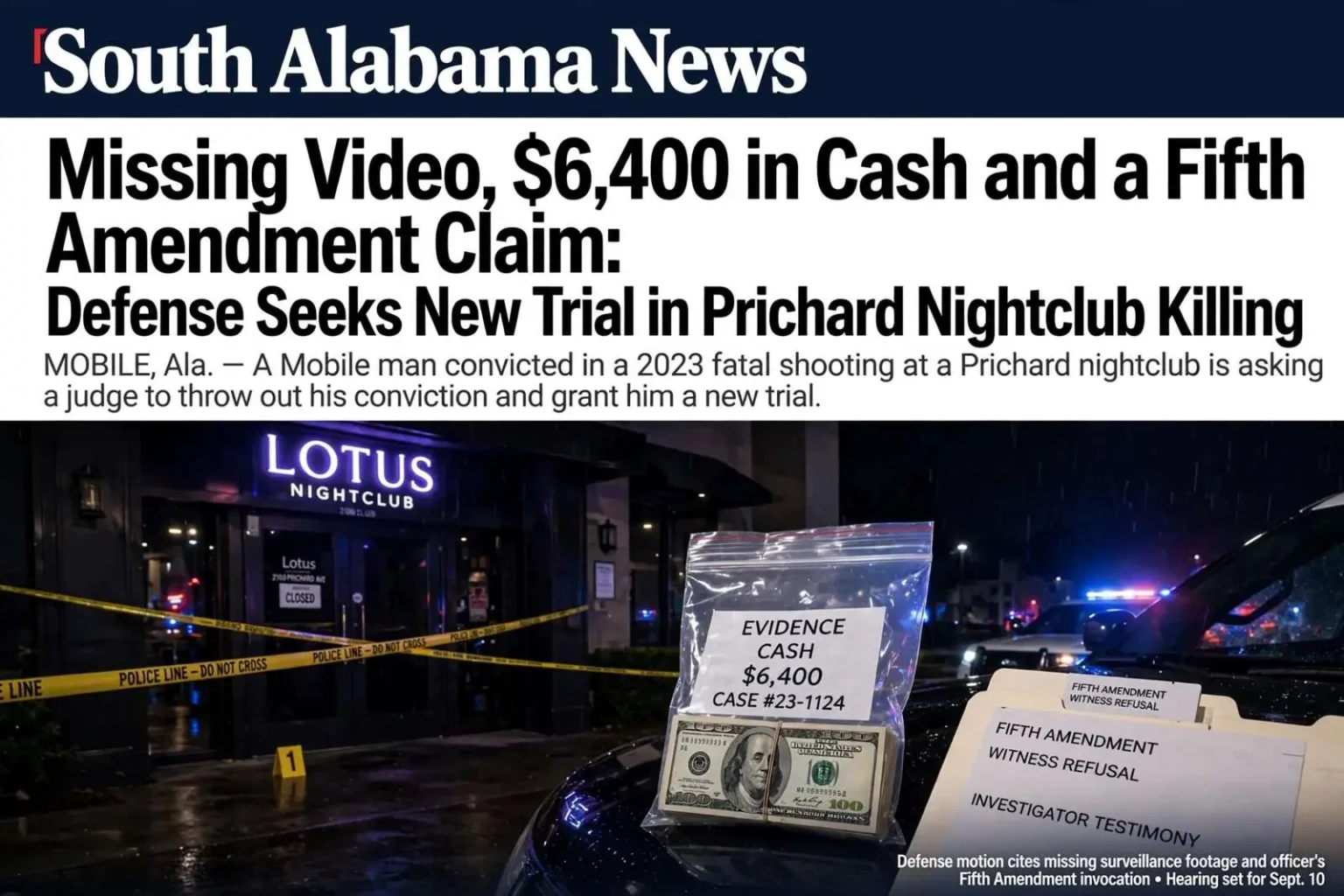
MOBILE, Ala. — A Mobile man convicted in a 2023 fatal shooting at a Prichard nightclub is asking a judge to throw out his conviction and grant him a new trial.
Harold Miller was sentenced to prison last month for the death of JaQuell Graham, who was shot inside Lotus nightclub. Miller’s attorney, Christine Hernandez, points to what she describes as major problems with the evidence — including missing surveillance footage, $6,400 in cash carried by a police lieutenant during the trial, and that lieutenant’s decision to invoke his Fifth Amendment right against self-incrimination.
“There’s missing video. There’s missing money. There’s missing weapons. There’s a lot that’s missing in this case,” Hernandez said.
What the Video Shows — and What It Doesn’t
Surveillance video captured the shooting inside Lotus. The footage shows then-Prichard Police Chief Walter Knight and former officer Emanuel Dotch, who were already at the club, responding to the chaos.
Dotch retrieved a rifle from his SUV. Knight walked toward the club’s entrance with a handgun in one hand and a cell phone in the other, and appeared to look at the phone as he approached the door.
Both Knight and Dotch have since been charged in separate cases connected to alleged widespread corruption within the Prichard Police Department.
Hernandez says the video evidence collected by investigators is incomplete. According to her, there is no footage showing what happened inside the club after police officers entered.
That gap leaves unanswered questions she says are material: how Graham’s body moved from the floor to a couch, where witnesses said paramedics treated him, and how his shoes were removed.
“That’s where the questioning was when Martin took the Fifth,” Hernandez said. “What was the conversation? What was happening inside the club that we don’t have video of?”
A Detective Invokes the Fifth
During Miller’s trial, the state’s own witness — Prichard Police Lieutenant Robert Martin — invoked his Fifth Amendment right against self-incrimination.
“That’s the first time I’ve had a detective get on the stand to take the Fifth,” Hernandez said.
The situation is genuinely unusual. A Fifth Amendment invocation by a prosecution witness signals that the witness believes truthful answers could expose him to criminal liability, and when that witness is the investigating officer, it raises questions about the investigation itself that the jury cannot resolve — because the questions go unanswered.
The $6,400
Hernandez is also raising questions about $6,400 in cash she says Martin brought to court during the trial, taking the money with him to and from the courthouse each day.
According to Hernandez, Martin said the money had been in Graham’s pocket, and she says some of the bills appeared to have blood on them.
The motion states there was no log showing where the money was collected, no photographs documenting its recovery, and no indication it was submitted to the Alabama Department of Forensic Sciences for testing.
“That’s very odd, because if money is in a case, it’s generally noted in the file,” Hernandez said.
Why Chain of Custody Matters
The specific failures Hernandez describes go to chain of custody — the documented record of who handled a piece of evidence, when, and where it was kept.
Standard practice for recovered currency in a homicide case is straightforward: photograph it in place, log it into evidence, record its recovery location, and store it in a controlled facility. Currency with apparent biological material on it would ordinarily be a candidate for forensic testing.
Cash that is instead carried back and forth to a courthouse each day by an individual officer, without a log or photographs, has no verifiable chain of custody at all. That absence affects not only the money itself but the credibility of the broader evidence collection in the case.
A Federal Connection
Hernandez says she later spoke with a federal investigator who told her the issue involving the money is being examined as part of the ongoing federal investigation into Prichard police officers.
That investigation forms the backdrop to the entire motion. Knight and Dotch, both visible in the surveillance video, have been charged in separate cases tied to alleged corruption in the department. Miller’s filing effectively asks whether a conviction can stand on an investigation conducted by a department under federal scrutiny.
The State’s Position and What Comes Next
The state has opposed Miller’s request for a new trial.
A hearing on the motion is scheduled for Sept. 10. The judge’s decision will turn on whether the alleged evidentiary problems were material enough to have affected the outcome of the trial — the standard that governs post-conviction motions of this kind.
South Alabama News will report the outcome of the Sept. 10 hearing.