State Withdraws Aniah’s Law Bid to Jail Homeland Security Agent Kent Blacklidge
The Alabama Attorney General's Office withdrew its request for an Aniah's Law hearing to hold HSI agent Kent Blacklidge without bond after the defense subpoenaed the juvenile alleged victim to testify. Judge Clark Stankoski canceled the hearing.
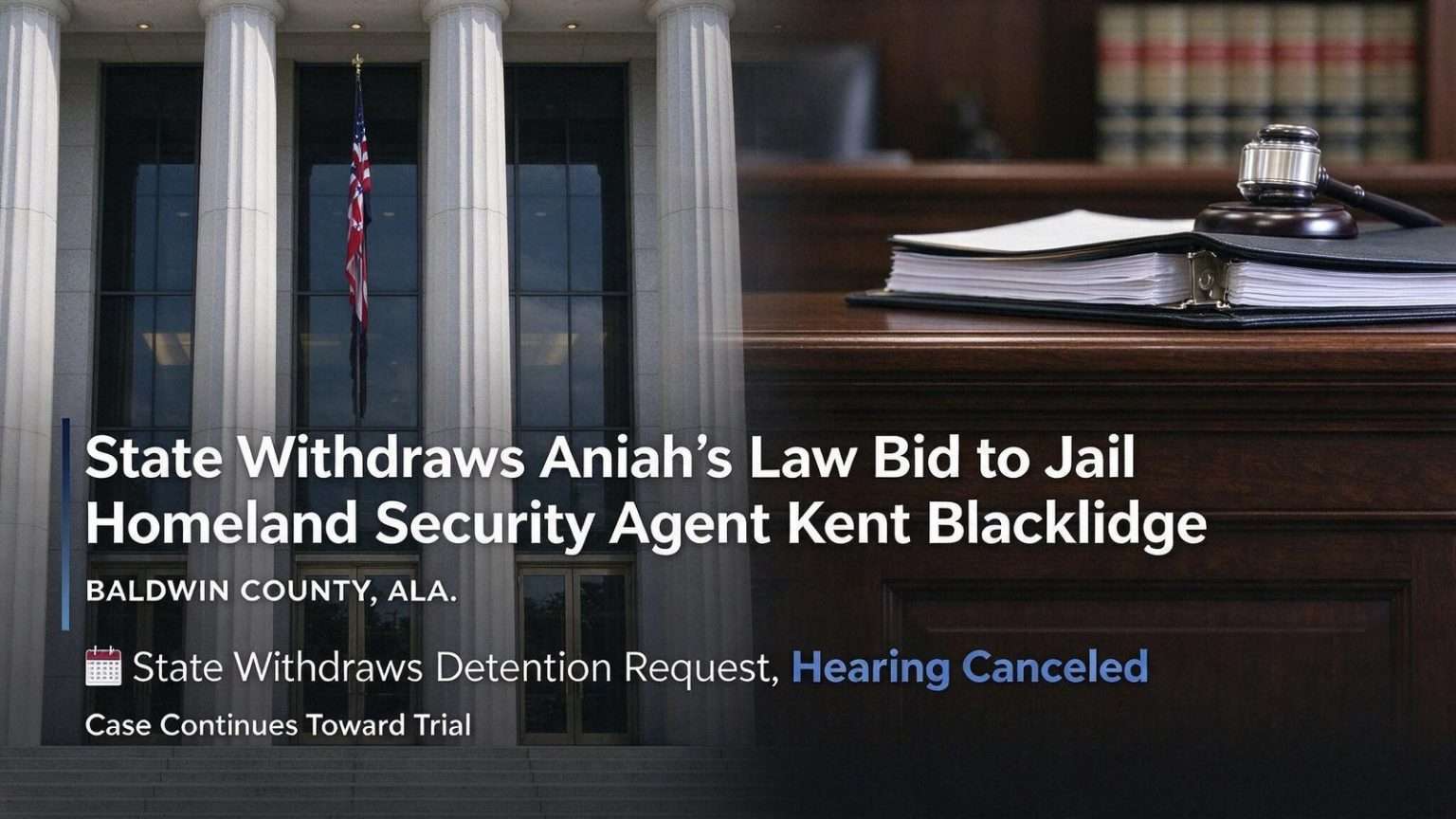
BALDWIN COUNTY, Ala. — The Alabama Attorney General’s Office has withdrawn its request to hold Homeland Security Investigations special agent Kent Blacklidge without bond, and a judge has canceled the Aniah’s Law pretrial detention hearing that had been set for Tuesday, Sept. 29.
Update: State Withdraws Detention Request, Hearing Canceled
In a filing made Sunday, Sept. 27, prosecutors told the court that Blacklidge had subpoenaed the juvenile alleged victim to testify at the detention hearing. The state said it did not want the minor, who it says has experienced significant trauma, to be forced to testify in a proceeding outside of a trial, and it asked to withdraw its motion.
Circuit Judge J. Clark Stankoski granted the request, canceling the hearing that could have determined whether Blacklidge would be returned to jail while his case moves forward.
With the motion withdrawn, the bond previously set in the case and its conditions — including GPS-monitored house arrest and no contact with minors or with the alleged victim — remain in place. The withdrawal does not affect the charges, and the case continues toward trial in Baldwin County Circuit Court.
Blacklidge, whose work as an HSI special agent included child-exploitation cases, is charged with first- and second-degree rape, first- and second-degree sodomy, two counts each of first- and second-degree sexual abuse, and incest. Spanish Fort police opened the investigation after receiving a report in January of child sexual abuse involving a juvenile female. The identity of the alleged victim has not been released and will not be reported here.
Background: The State’s Original Motion
Earlier this month, the Alabama Attorney General’s Office asked the court to return Blacklidge to jail and hold him without bond until trial, filing a motion for a hearing under Aniah’s Law.
Kent Blacklidge was released from the Baldwin County Jail on a $560,000 bond. A grand jury indicted him on rape, sodomy, sex abuse and incest charges following an investigation led by Spanish Fort police that began in January of this year.
According to the Attorney General’s motion, “the crimes occurred habitually over the course of a year.”
Blacklidge turned himself in over the weekend. He has been on administrative leave from Homeland Security Investigations since the investigation began in January.
The charges are allegations. Blacklidge is presumed innocent unless and until proven guilty in a court of law.
What Aniah’s Law Does
Aniah’s Law is a constitutional amendment approved by Alabama voters in November 2022 and implemented by legislation the following year. It changed something structural about how bail works in the state.
Before the amendment, the Alabama Constitution guaranteed that all persons charged with a criminal offense were bailable by sufficient sureties, with a single exception for capital offenses where the proof was evident or the presumption great. The practical effect was that a judge facing a defendant charged with almost any offense — however serious — had to set some bond amount. The judge could set it high, but could not deny it outright.
Aniah’s Law expanded the list of offenses for which a judge may deny bail entirely. The enumerated offenses include murder, kidnapping in the first degree, rape in the first degree, sodomy in the first degree, sexual torture, domestic violence in the first degree, human trafficking in the first degree, burglary in the first degree, arson in the first degree, robbery in the first degree, terrorism and aggravated child abuse.
First-degree rape and first-degree sodomy are on that list, which is the basis of the state’s motion here.
The Law’s Origin
The amendment is named for Aniah Blanchard, a 19-year-old Southern Union State Community College student who was abducted from an Auburn convenience store in October 2019 and later found dead in Macon County. The man charged in her death had been released on bond in an earlier case involving serious violent charges at the time she disappeared.
That sequence — a defendant with pending violent charges out on bond when a new offense occurred — drove the campaign for the amendment. Her family advocated for it publicly through the legislative process and the 2022 ballot campaign, and voters approved it by a wide margin.
The Procedure the Law Requires
Denying bail under Aniah’s Law is not automatic, and the mere fact that a defendant is charged with a listed offense does not by itself keep them in custody. The law establishes a process.
The prosecution must file a motion seeking pretrial detention. The court must then hold a hearing at which the state bears the burden of proving, by clear and convincing evidence, that no condition or combination of conditions of release will reasonably ensure the defendant’s appearance in court, protect the safety of the community or any person, or prevent obstruction of justice or intimidation of witnesses.
That is a demanding standard, and it is deliberately so. Clear and convincing evidence is a higher bar than the preponderance standard used in most civil matters, though lower than beyond a reasonable doubt. The defendant is entitled to be present, to be represented by counsel, and to present evidence.
The Defense Response: ‘A Second Bite at the Apple’
Blacklidge’s attorney, Patrick Prendergast, immediately asked the court to deny the state’s request, telling the court that the state was “now asking for a second bite at the apple.”
Prendergast noted that a District Court judge had already determined Blacklidge was “neither a flight risk nor a danger to the community.”
“A determination has already been made on these issues and sufficient bond conditions put in place,” Prendergast wrote in his motion.
Those conditions include GPS house arrest and no contact with minors or with the alleged victim.
The defense argument rests on a procedural point rather than on the merits of the charges: that a court has already conducted the analysis the state is now asking a court to conduct again, reached a conclusion, and imposed conditions accordingly. The state’s implicit position is that the conditions imposed are insufficient given the nature and duration of the conduct alleged in the indictment.
Resolving that disagreement is what the requested hearing is for.
The $560,000 Figure
The bond set in the case totals $560,000, an aggregate across multiple counts rather than a single figure attached to one charge. Alabama uses a recommended bail schedule that assigns ranges by offense class, and courts commonly stack amounts across counts in multi-count indictments.
A defendant typically secures release by posting a percentage through a bonding company, by posting the full amount in cash or property, or by a combination. The headline figure therefore does not represent money paid.
What accompanied the release in this case — GPS monitoring and house arrest — is a form of supervision courts increasingly impose in serious cases as an alternative to detention. Electronic monitoring establishes a record of a defendant’s location and alerts supervising authorities to violations of movement restrictions. It does not physically prevent movement, which is the core of the state’s concern in seeking detention instead.
A Federal Agent in a State Court
One aspect of this case that distinguishes it from an ordinary prosecution is the defendant’s employment. Homeland Security Investigations is the principal investigative arm of U.S. Immigration and Customs Enforcement, and its special agents conduct federal criminal investigations across a broad portfolio including human trafficking, child exploitation, financial crime and transnational smuggling.
The charges here were brought by Alabama authorities in state court. The investigation was led by the Spanish Fort Police Department, a municipal agency in Baldwin County, and the prosecution is being handled by the Alabama Attorney General’s Office rather than by a district attorney — an arrangement the attorney general’s office uses in cases where a conflict, resource demand or particular sensitivity makes state-level prosecution appropriate.
Blacklidge has been on administrative leave from HSI since January. Administrative leave in a federal agency during a criminal investigation is a personnel action, not a disciplinary finding, and it does not indicate any conclusion about the underlying allegations.
What Has Not Been Released
Investigators have not said publicly where the alleged crimes occurred, and have not said whether they believe there may be additional victims. The identity of the alleged victim has not been released and will not be reported here.
The incest count in the indictment indicates a familial relationship as alleged by the state. Consistent with standard practice in cases involving alleged child victims, this report omits details that could serve to identify the person involved.
What Happens Next
Because the state withdrew its motion before the Sept. 29 hearing, no ruling on pretrial detention was made. Blacklidge remains free on bond under the conditions a District Court judge previously set.
The detention question is separate from the question of guilt, which will be resolved only through the ordinary course of a criminal trial or a resolution short of one. Blacklidge is presumed innocent unless and until proven guilty.
South Alabama News will continue to follow the case.
According to online court records, Blacklidge is scheduled to be arraigned on Oct. 21 in Baldwin County Circuit Court, with Presiding Circuit Judge Clark Stankoski set to preside over the case. He will also appear in court for a pretrial hearing in October as the case moves forward.
Spanish Fort Mayor Brad Bass said in a Facebook post that he thanks the Spanish Fort Police Department for its work on the investigation into Blacklidge.
Before turning himself in, Blacklidge had previously led a class for Baldwin County teachers in August on how to identify situations where students might be engaging with a child predator, according to previous reports.