Mobile County Grand Jury Indicts Two Drivers for Manslaughter in Separate Fatal Crashes
Christopher Douglas Smith and Sally Ann Lambert were each indicted on reckless manslaughter charges by the August 2026 Mobile County grand jury in unrelated fatal crashes. Bail for each was set at $30,000.

MOBILE, Ala. — Two people have been indicted on manslaughter charges by a Mobile County grand jury in connection with separate fatal traffic crashes, according to court filings from the August 2026 grand jury session. Both cases allege reckless driving that resulted in a death, and both carry bail set at $30,000.
The indictments arrive from crashes nearly two years apart, involving different roads, different circumstances and different victims. What links them is the charge prosecutors chose and the theory behind it: that the driver’s conduct went beyond ordinary negligence and rose to recklessness under Alabama law.
Christopher Douglas Smith
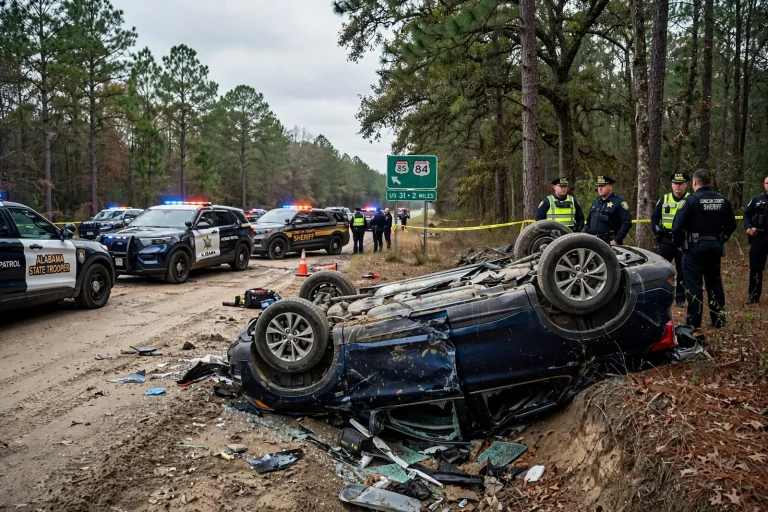
Christopher Douglas Smith was charged with reckless manslaughter following a Jan. 4, 2025, single-vehicle crash that killed his passenger, Michael Ficke.
Prosecutors allege Smith was speeding, failing to stay in his lane, and driving under the influence of alcohol, cocaine, amphetamines and cannabinoids when his vehicle struck a tree.
The combination alleged in the indictment — four categories of intoxicant, along with speed and lane departure — is the kind of accumulation prosecutors point to when arguing that a driver’s conduct was not merely careless. Each element on its own might support a lesser charge. Charged together, they form the basis of a recklessness allegation.
Sally Ann Lambert
In a separate indictment, Sally Ann Lambert was indicted on one count of reckless manslaughter in connection with an Oct. 4, 2025, crash that killed driver Ronald Marvin Greenlee.
Court documents state that Lambert was driving under the influence of alcohol, was driving on the wrong side of the road, and was holding or using her cell phone when her vehicle collided with Greenlee’s car.
The cell phone allegation is a comparatively recent feature of Alabama vehicular cases. The state’s hands-free law, which took effect in 2023 after a phase-in period, prohibits drivers from physically holding or supporting a wireless telecommunication device while operating a vehicle. In prosecutions like this one, a phone allegation does more than add a traffic infraction; it supports the argument that the driver’s attention was voluntarily diverted from the road.
What Reckless Manslaughter Means Under Alabama Law
Manslaughter in Alabama covers two distinct situations. The first is a killing committed under a sudden heat of passion caused by provocation, which would otherwise be murder. The second — the one charged in both of these cases — is recklessly causing the death of another person.
Recklessness has a specific statutory meaning. A person acts recklessly when they are aware of and consciously disregard a substantial and unjustifiable risk, and when that disregard constitutes a gross deviation from the standard of care a reasonable person would observe. The key word is “consciously.” Recklessness requires awareness of the risk, which distinguishes it from criminal negligence, where a person simply fails to perceive a risk they should have perceived.
Alabama law contains a provision that matters a great deal in impaired-driving prosecutions: a person who creates a risk while voluntarily intoxicated, and who is unaware of that risk solely because of the intoxication, acts recklessly with respect to it. In other words, a driver cannot argue that being too impaired to appreciate the danger means they were not reckless. Voluntary intoxication supplies the awareness the statute requires.
Manslaughter is a Class B felony in Alabama, carrying a sentencing range of two to 20 years on conviction.
Why Not Murder, and Why Not Homicide by Vehicle
Alabama prosecutors handling a fatal crash have several charging options, and the choice among them communicates how they read the driver’s conduct.
At the more serious end sits reckless murder, which applies when a person, under circumstances manifesting extreme indifference to human life, recklessly engages in conduct creating a grave risk of death and thereby causes a death. That charge requires more than recklessness; it requires conduct so extreme that it approaches an indifference to whether anyone lives. Mobile County juries have seen that charge tested in recent vehicular cases, and it is a demanding standard to meet.
At the less serious end sits homicide by vehicle, a misdemeanor offense that applies when a death results from a violation of traffic laws. It carries substantially lower exposure.
Manslaughter occupies the middle ground, and it is the charge Alabama prosecutors most commonly bring in fatal impaired-driving cases. The indictments in both of these matters indicate that the grand jury found probable cause for that middle position: conduct that grossly deviated from reasonable care, but that prosecutors are not framing as extreme indifference to human life.
What an Indictment Is — and Is Not
Both cases were returned by the August 2026 session of the Mobile County grand jury. A grand jury reviews evidence presented by prosecutors and decides whether probable cause exists to formally charge a person with a crime. The proceedings are secret, the defense does not present a case, and the standard is far below what a trial requires.
An indictment is therefore an accusation, not a finding of guilt. Both Smith and Lambert are presumed innocent unless and until proven guilty beyond a reasonable doubt in a court of law. The allegations described in the charging documents are the state’s allegations; they have not been tested through cross-examination, and the defense has not yet responded to them publicly.
Bail for each driver has been set at $30,000. Bail amounts in Alabama are set with reference to a recommended schedule that varies by offense class, and a Class B felony sits in a range consistent with the figure set here. Bail is not a penalty; it is a mechanism intended to secure a defendant’s appearance at future proceedings.
The Passenger Problem
The Smith case includes a feature that recurs in Alabama impaired-driving prosecutions and that families of victims often find difficult: the person who died was a passenger in the defendant’s own vehicle.
Michael Ficke was riding in the car that struck the tree. In cases of that shape, there is no second vehicle, no other driver, and frequently no witness beyond the occupants of the car. The prosecution rests almost entirely on physical evidence — crash reconstruction from skid marks and vehicle damage, toxicology results, and data recovered from the vehicle’s event data recorder, which in most modern cars logs speed, braking and throttle position in the seconds before an impact.
Those cases are also, in a plain human sense, among the hardest. The driver and the person who died were often traveling together by choice, and the surviving driver frequently knew the victim well. That reality does not change the legal analysis, but it shapes how these prosecutions unfold and how they are ultimately resolved.
The Broader Picture on Alabama Roads
Impaired driving remains a persistent factor in fatal crashes across Alabama, and the Mobile County area sees its share. The Alabama Law Enforcement Agency and the state’s highway safety office have run sustained enforcement and public-awareness campaigns around impaired driving for years, concentrated around holiday periods when impaired-driving fatalities historically spike.
The addition of phone use to the list of allegations in the Lambert indictment reflects a newer enforcement priority. Distracted driving statutes have moved from secondary to primary enforcement in many states, Alabama included, and in serious-injury and fatal cases, phone records are now a routine investigative subpoena rather than an unusual one.
What Comes Next
Both cases will proceed in Mobile County Circuit Court. Following indictment, defendants are arraigned, enter pleas, and move into a pretrial phase in which discovery is exchanged and motions are litigated. Toxicology, crash reconstruction and the admissibility of vehicle data are commonly contested in cases of this type.
South Alabama News will follow both cases as they move through the court system.