
Charges Bound Over to Grand Jury Against Man Accused in Mobile Christmas Day Assault
Todd Overstreet's 13 Mobile County charges — including sexual abuse, sodomy and burglary — were bound over to a grand jury after his capture.
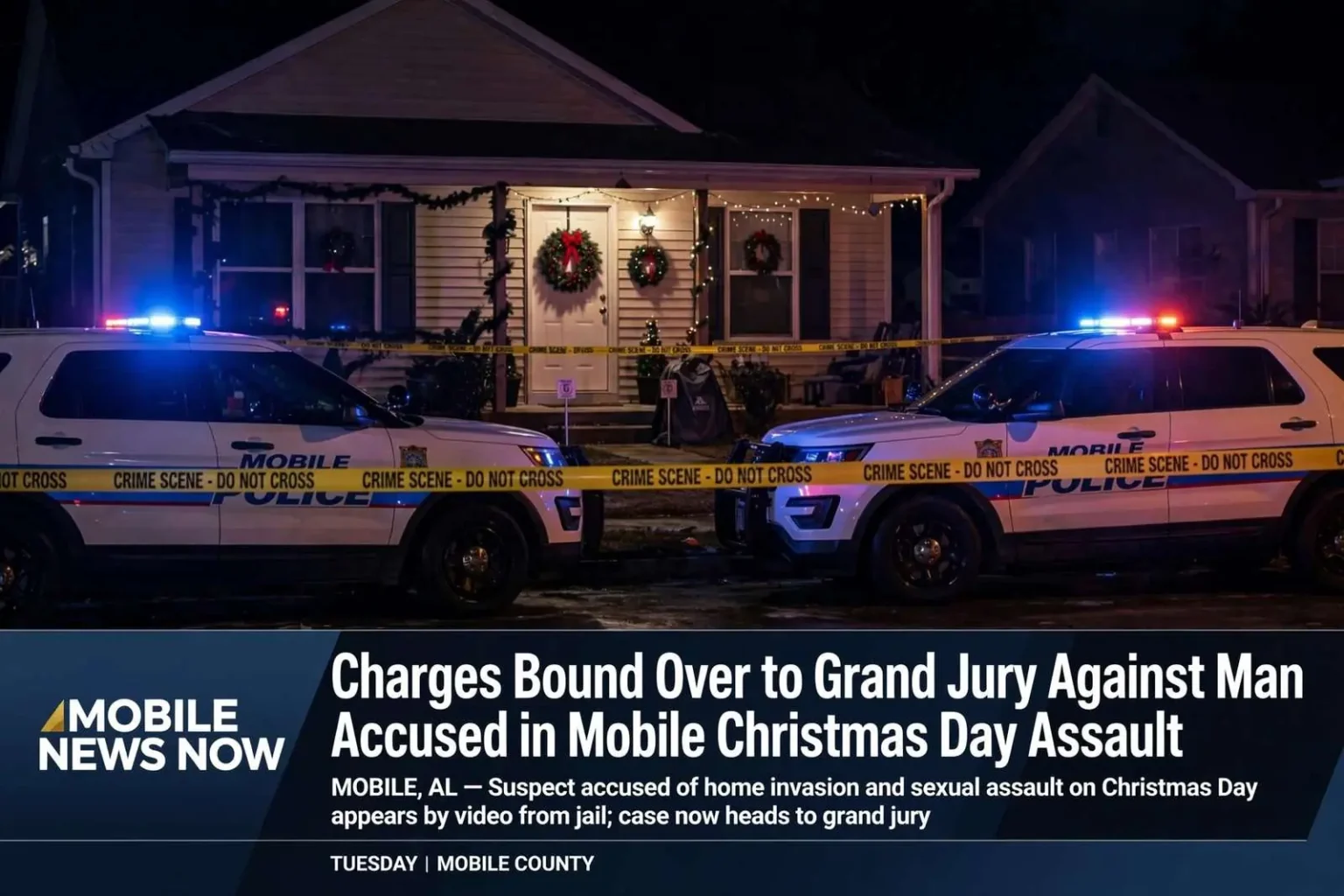
MOBILE, Ala. — A man accused of hiding inside a stranger’s Mobile home on Christmas Day and sexually assaulting the woman who lived there appeared in court by video from jail Tuesday, and all charges in the case were bound over to a grand jury, according to court documents. The brief proceeding marks a routine but significant step in the criminal justice process: a preliminary hearing in which a judge decides whether the state has shown enough evidence to send the case forward to the grand jury that will consider an indictment.
Todd Overstreet faces 13 charges in Mobile County, including sexual abuse, sodomy, and burglary. The charge list reflects the scope of what prosecutors allege happened inside the home during the holiday attack, and the number of counts gives a measure of the conduct described in court documents. Police say he broke into the woman’s home on Christmas Day and attacked her; authorities said he was a stranger to the victim. The allegation — that a home invasion and assault were committed against someone the suspect had never met — is among the most unsettling kinds of crime a community can confront, precisely because it offers no explanation of motive or connection.
Three weeks on the run
Overstreet then spent nearly three weeks on the run, at one point topping Mobile’s most wanted list, before officers took him into custody following an extensive manhunt. The search involved coordination among area law enforcement agencies and drew on tips from the public as investigators worked to track a man whose alleged crimes had made him one of the most sought suspects in the city. Fugitive investigations of this kind typically combine surveillance, interviews with anyone who may have had contact with the suspect, and public appeals asking residents to report sightings rather than approach him.
Being named to the most wanted list carries practical consequences for a fugitive. His photograph circulated widely, and every patrol officer in the area knew his face and name. The three-week span between the Christmas Day attack and the arrest tested both the persistence of investigators and the patience of a community watching for updates. When the arrest finally came, it closed one chapter of the case and opened another: the process of moving from capture to prosecution.
The case now heads to a Mobile County grand jury, which will determine whether to indict. Grand juries in Alabama meet in secret, hear evidence presented by prosecutors, and decide whether probable cause exists to formally charge a defendant and send the case to circuit court for trial. The standard is lower than the proof required for conviction, but the step matters: an indictment formally initiates felony prosecution, while a refusal — a “no bill” — can end the case. Given the number and seriousness of the charges bound over here, prosecutors will present the evidence supporting all 13 counts for the grand jury’s review.
How the process works from here
The Tuesday appearance by video from jail is now standard practice in Mobile County and across Alabama, adopted widely for security and efficiency. Defendants appear before a judge on a screen from the jail, hear the charges and the findings of the preliminary hearing, and receive rulings without the risks and costs of transporting inmates to the courthouse. For defendants facing charges of this seriousness, the hearings are short — the legal questions at this stage concern evidence and procedure, not guilt.
Should the grand jury return indictments, the case moves to circuit court, where the defense and prosecution begin preparing for trial in earnest. That phase typically includes motion practice over the admissibility of evidence, DNA and forensic testing where applicable, and pretrial hearings that can stretch for months. Defendants facing multiple serious felony counts often see their cases take a year or more to reach resolution, whether by plea agreement or jury verdict. Throughout, the defendant remains presumed innocent, and the burden stays on the state to prove every element of every charge beyond a reasonable doubt.
The charges described here are allegations, and Overstreet has not been tried on them. That distinction matters in a case that drew public attention from the start — both because of the nature of the alleged attack and because of the manhunt that followed it. News coverage of arrests necessarily reports what police and prosecutors say has happened, but the American legal system deliberately inserts steps between accusation and punishment, and each of those steps exists to protect both defendants and the integrity of verdicts.
The broader context: holiday crimes and stranger attacks
Crimes committed on holidays carry a particular weight in the public imagination. Christmas Day attacks strike at a time when families are gathered, when victims are least expecting danger, and when the contrast between celebration and violence feels sharpest. Law enforcement officials note that serious crimes do occur on holidays — sometimes at elevated rates, as alcohol, family stress and empty neighborhoods converge — and that emergency services continue to operate at full readiness even as much of the city sleeps in.
Stranger-on-stranger sexual assaults, meanwhile, are the rarity that generates the most fear. Statistics consistently show that most sexual assaults are committed by someone known to the victim, which makes the alleged scenario in this case — an intruder with no connection to the household — unusual and alarming. Home security advocates use cases like this to remind residents of practical steps: locking doors and windows even during daytime hours, installing exterior lighting and cameras, and reporting suspicious people or activity to police immediately rather than after the fact.
For the victim, the legal process that continues in the months ahead offers both a path to accountability and an extended ordeal. Advocates for survivors of sexual violence note that the criminal justice system, whatever its strengths, requires victims to relive the events repeatedly — in interviews, hearings and potentially a trial. Support services in Mobile County, including victim advocates attached to the district attorney’s office and community-based crisis centers, exist to help survivors navigate that process while their case moves toward the grand jury and, possibly, a courtroom.
Inside the manhunt
The nearly three weeks between the Christmas Day attack and the arrest were consumed by a fugitive investigation that drew on resources from across the city. Mobile police investigators worked the case alongside patrol officers and, typically in situations of this kind, with support from federal partner agencies that bring additional tools to the search — databases that flag everything from transit passes to prescription pickups, and surveillance networks that can confirm a sighting in minutes. Most wanted lists, like the one Overstreet topped, are not ceremonial; they direct patrol attention, and officers checking routine calls know to be alert for the named suspects.
Public tips almost always play a role in cases that end this way. Investigators appeal for help through the news media and social channels, and even fragments of information — a possible sighting in a particular neighborhood, a person matching the description at a convenience store, a friend or relative who might be sheltering the fugitive — give detectives places to look. Fugitives on the run face a shrinking world: every acquaintance becomes a potential contact point for police, and the longer the search continues, the fewer places remain to hide. The extensive manhunt that ended with Overstreet in custody reflected that grind — days of interviews, surveillance and follow-ups until the break came and officers moved in.
The arrest also settled a period of anxiety for residents of the neighborhood where the attack occurred. Until a suspect is captured, police presence stays elevated, doors stay locked and rumors spread faster than facts. When word came that the man atop the most wanted list had been caught, the community could begin to breathe again — though for the woman police say was attacked in her own home, the sense of safety will take far longer to rebuild.
What the grand jury will weigh
When Mobile County prosecutors present this case to the grand jury, they will walk jurors through the evidence behind each of the 13 counts. That evidence typically includes the victim’s account, physical and forensic evidence collected at the scene, and any statements or identification linking the defendant to the home. Burglary charges in Alabama turn on entering or remaining unlawfully in a dwelling with intent to commit a crime inside — an element that the alleged circumstances of the Christmas Day attack squarely address if the evidence supports it. Sexual abuse and sodomy charges each carry their own elements, and the number of counts suggests prosecutors intend to present the full range of alleged conduct rather than consolidating it.
The grand jury itself is a safeguard with deep roots in Alabama law. Unlike a trial jury, it does not decide guilt; it decides only whether charges should go forward. Jurors hear only the state’s side at this stage, and defense attorneys are not present, but the threshold — probable cause — filters out weak cases before defendants face the expense and exposure of a full trial. Once indicted, a case lands on the circuit court docket, where judges manage everything from bail questions to trial dates, and where plea negotiations, if any, occur under the eye of the court.
However the case resolves, the allegations have already left their mark on the community’s sense of security — a reminder issued on the most unlikely of days that danger can arrive without warning, at any door in the city. The legal system now carries the responsibility the manhunt set in motion: testing the evidence, protecting the rights of both the accused and the accuser, and reaching a verdict the community can trust.


