Mobile Woman Indicted on Two Murder Counts in February Crash That Killed Two Passengers
A Mobile County grand jury has indicted Shurmeeka Renita Hall on two counts of murder and one count of first-degree assault in a February crash that killed two passengers. An indictment is an accusation, and Hall is presumed innocent.
MOBILE — A Mobile woman has been indicted on two counts of murder and one count of first-degree assault in connection with a February crash that killed two passengers and seriously injured a third person.
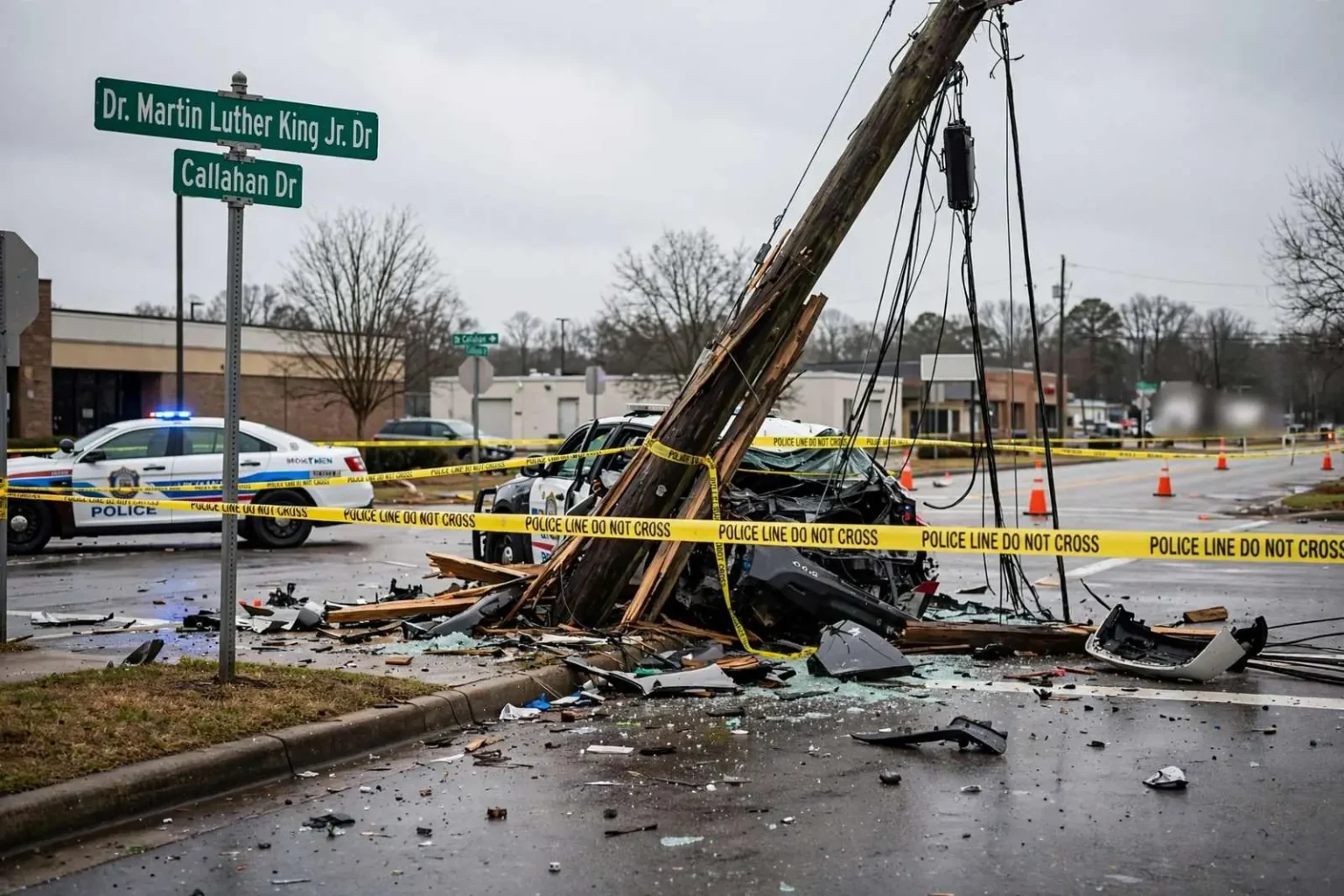
A Mobile County grand jury returned the indictment against Shurmeeka Renita Hall stemming from the Feb. 8 crash near Callahan Drive and Dr. Martin Luther King Jr. Drive. She was booked into Mobile Metro Jail on Thursday on warrants tied to the indictment.
An indictment is an accusation. Hall has not been convicted, and she is presumed innocent unless and until the state proves the charges beyond a reasonable doubt.
What Police Reported in February
Mobile police said at the time that a vehicle traveling on Dr. Martin Luther King Jr. Drive left the roadway, struck a power pole and ejected two rear-seat passengers. Both were pronounced dead at the scene.
The indictment identifies the two people who died as Henry Johnson and David Parker. It identifies Joseph Todd Bowden as the person seriously injured.
Ejection is among the most lethal outcomes in any crash. When a vehicle strikes a fixed object such as a utility pole, the vehicle stops abruptly while unrestrained occupants continue moving at the vehicle’s pre-impact speed. A fixed narrow object also concentrates crash forces into a small area of the vehicle rather than distributing them across a crumple zone, which is why pole strikes tend to produce severe intrusion and severe injuries at speeds that a broader impact might be survivable.
What the Indictment Alleges
According to the indictment, Hall allegedly recklessly engaged in conduct showing extreme indifference to human life by driving at speeds above the posted limit, failing to maintain the correct lane of travel and/or driving under the influence of alcohol. Prosecutors allege Hall’s vehicle struck another vehicle and/or a stationary object, causing the deaths and Bowden’s injuries.
The “and/or” phrasing is standard drafting rather than vagueness. An indictment is required to give a defendant notice of the accusation, and prosecutors frequently plead alternative theories of the same conduct so the state is not locked into proving one specific mechanism when the evidence may support several. A jury would ultimately be instructed on which theories the evidence supports.
Why a Traffic Death Can Be Charged as Murder
Most fatal crashes in Alabama that result in charges are prosecuted as criminally negligent homicide, manslaughter, or homicide by vehicle. Murder is the most serious charge available and requires substantially more than carelessness.
Alabama’s murder statute includes a provision, sometimes described as reckless or depraved-heart murder, that applies when a person recklessly engages in conduct creating a grave risk of death to another person and thereby causes a death — under circumstances manifesting extreme indifference to human life. That is the theory the language in this indictment tracks.
The distinction between that offense and manslaughter is one of degree, and it is often the central fight in these cases. Reckless manslaughter requires that the defendant consciously disregarded a substantial and unjustifiable risk. Reckless murder requires that the conduct went further — that it created a grave risk of death and reflected an extreme indifference to human life generally, not merely a bad decision that turned out badly.
Prosecutors typically build toward the higher charge by stacking aggravating factors: alleged impairment, alleged excessive speed, alleged failure to stay in a lane, and the presence of passengers who depended on the driver. Defense arguments in such cases usually focus on whether the conduct rises to that heightened level or belongs in the manslaughter category, and on the reliability of the evidence supporting each factor.
First-degree assault, the third count, generally involves causing serious physical injury — and Alabama’s statute includes a provision covering serious physical injury caused by recklessly engaging in conduct that creates a grave risk of death under circumstances manifesting extreme indifference to human life. In practice, it is the injury counterpart to the murder counts, applied to the surviving victim.
What an Indictment Is — and Is Not
A grand jury is a panel of citizens convened to review evidence in secret and decide whether formal felony charges are warranted. Only the prosecution presents evidence. There is no defense attorney in the room, no judge presiding over the presentation, and no requirement that the person under investigation testify or even be told the panel is meeting.
The standard is probable cause, not proof beyond a reasonable doubt. If a majority of the required number of grand jurors agrees the standard is met, the panel returns a true bill — the indictment. If not, it returns a no bill and the charges do not proceed at that time.
The indictment’s legal function is to move a felony case into circuit court and to put the defendant on notice of what the state intends to prove. Because a case originating with a grand jury indictment produces an arrest warrant, defendants are frequently taken into custody on indictment warrants weeks or months after the underlying event — as happened here, roughly seven months after the February crash.
That interval is typical in a fatal crash prosecution. Crash reconstruction, download and analysis of vehicle event data, toxicology testing through the state forensic sciences system, autopsy findings and witness interviews all have to be completed before a case is presented to a grand jury.
Bond and How It Is Set
Bond is set at $300,000 on each murder count and $100,000 on the assault charge.
Bail in Alabama is governed by a schedule that establishes recommended ranges by offense class, with judges retaining discretion to depart upward or downward based on the circumstances. Courts weigh the seriousness of the offense, the weight of the evidence, the defendant’s ties to the community, employment and family circumstances, prior record, any history of failing to appear, and the risk posed to the community.
Bond is not a fine or a penalty. It is security intended to ensure a defendant returns to court. A defendant who cannot post the full amount in cash typically works through a licensed bail bond company, paying a nonrefundable premium — commonly a percentage of the face amount — with the company assuming responsibility for the balance if the defendant fails to appear. Courts routinely attach conditions to release, which can include surrendering a driver’s license, restrictions on driving, electronic monitoring, or no-contact orders.
Because bond is set separately on each count here, the amounts are cumulative, and the total for release is the sum across all three charges.
What Comes Next
The case now proceeds in Mobile County Circuit Court. The next step is arraignment, at which Hall will be formally advised of the charges and enter a plea. Alabama practice ordinarily treats a defendant who does not appear or does not plead as having entered a not guilty plea, and the case moves into discovery.
Discovery in a case built on crash reconstruction is document- and expert-heavy: the state’s reconstruction report, event data recorder downloads, scene photographs and measurements, toxicology and autopsy reports, body camera footage, and any surveillance video from nearby businesses. Defense counsel commonly retains an independent reconstruction expert and files pretrial motions challenging the collection or analysis of blood evidence, the qualifications of state experts, or the admissibility of particular findings.
Most cases resolve before trial, either by plea to the charged offense or to a lesser included offense such as manslaughter, or by dismissal. A case that goes to trial requires the state to prove each element of each count to a unanimous jury.
Hall remains presumed innocent, and the allegations in the indictment are accusations that have not been tested in court.