Bond Set at $450,000 for Mobile Neurosurgeon Charged With 10 Child Pornography Counts
A Mobile neurosurgeon arrested after searches of his Fairhope home and Mobile medical office faces five counts of possessing and five counts of producing child pornography. Bond was set at $450,000, and he is presumed innocent.
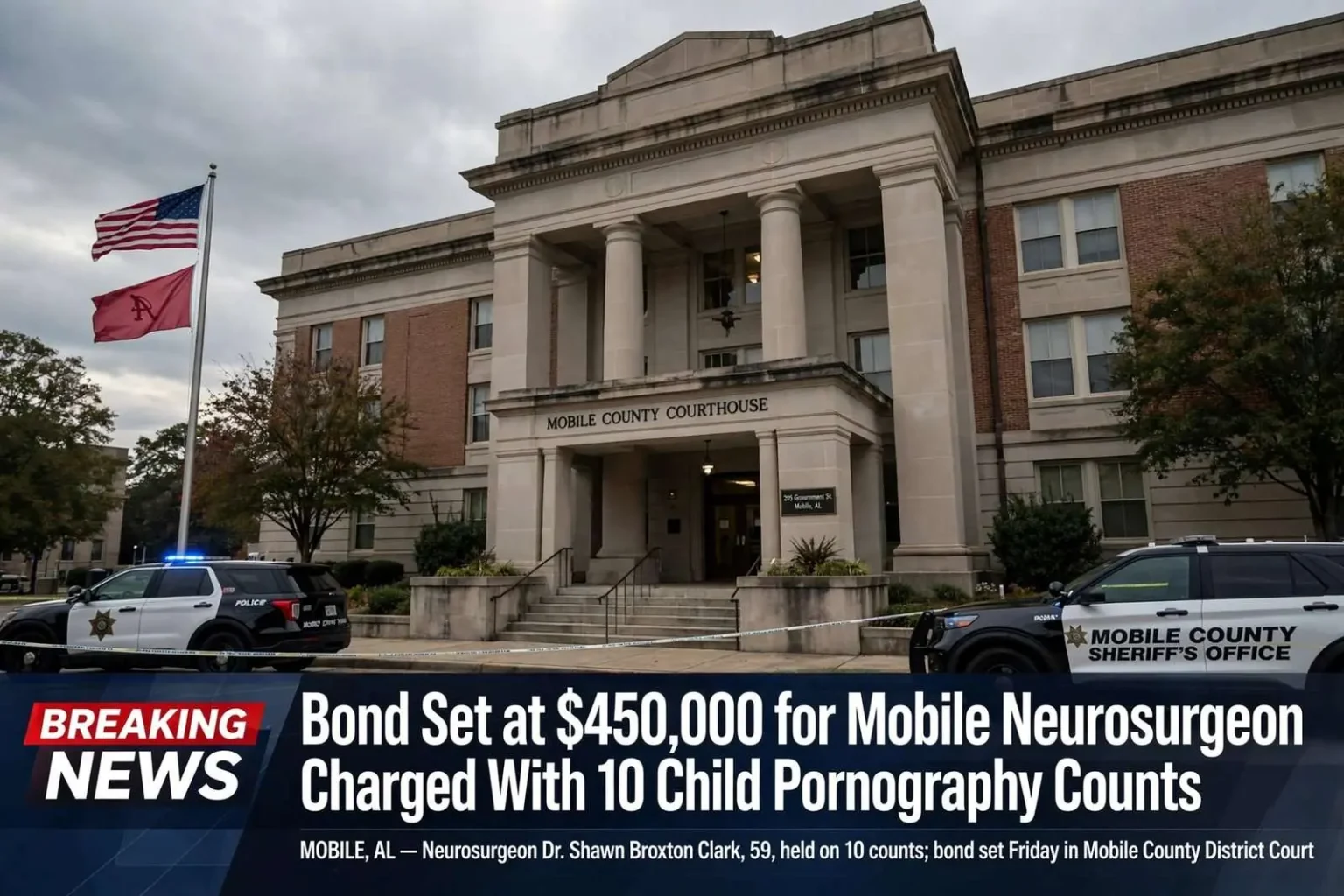
MOBILE — A Mobile neurosurgeon arrested on 10 child pornography charges had bond set at $450,000 at a hearing in Mobile County District Court, a day after sheriff’s deputies searched his Baldwin County home and his Mobile medical practice.
Dr. Shawn Broxton Clark, 59, was arrested Thursday and charged with five counts of possessing child pornography and five counts of producing it, according to the Mobile County Sheriff’s Office. He appeared in court Friday morning for the bond hearing.
The charges are accusations. Clark has not been convicted, and he is presumed innocent unless and until the state proves the charges beyond a reasonable doubt.
The Searches in Fairhope and Mobile
Deputies executed two search warrants Thursday — one at Clark’s residence in Fairhope and one at his medical practice office, Clarke’s Neurosurgery and Spine, in Mobile. Clark was arrested and taken to Mobile County Metro Jail.
During the searches, officers took “items of evidentiary value,” the Sheriff’s Office said. The agency did not itemize what was seized.
The warrants stemmed from a months-long investigation involving both the Sheriff’s Office and the Federal Bureau of Investigation, beginning in March when deputies were tipped off about a specific IP address linked to a location in Fairhope. Investigators say the material at issue was connected to his home in Baldwin County and to the medical office in Mobile, and that the victims were girls around the age of 13.
Criminal complaints detailing more of the charges had not yet appeared in online court records as of Thursday afternoon.
What a Cyber Tip Is and How It Travels
Investigations of this type typically begin with a report to the CyberTipline operated by the National Center for Missing & Exploited Children. Federal law requires electronic service providers — social platforms, email services, cloud storage companies — to report apparent child sexual abuse material to the center when they become aware of it.
The reports usually arrive with technical identifiers attached: an account name, timestamps and the IP address used at the time of the activity. The center reviews and forwards those reports to the appropriate law enforcement agency, which in Alabama is often a task force operating under the federal Internet Crimes Against Children program, a network of state and local task forces coordinated with federal partners.
From there the work is subpoenas and warrants. An IP address is not a name; it is an address assigned by an internet service provider, and identifying the subscriber behind it requires legal process served on that provider. Investigators then have to connect a subscriber account to a particular person and a particular device, which is why the interval between an initial tip and an arrest is commonly measured in months rather than days — here, from March to September.
Search warrants for digital evidence must describe with particularity what is to be seized. In practice that produces the phrase used by the Sheriff’s Office: computers, phones, external drives, cameras and storage media are collected as “items of evidentiary value” and later imaged and examined in a forensic laboratory, a process that can take weeks or months and frequently produces additional charges.
The Charges and the Distinction Between Them
Clark faces five counts of possession and five counts of production. Under Alabama law those are meaningfully different offenses carrying different exposure.
Possession of obscene matter depicting a person under 17 involved in an obscene act is a felony under Alabama’s child pornography statutes. Production — the creation of that material — is treated far more seriously, because it requires that a child was actually abused to make the material rather than that existing material was downloaded or stored.
The bond amounts set Friday reflect that gap directly: $30,000 for each possession count and $60,000 for each production count, twice as much per count.
Convictions under these statutes in Alabama carry sex offender registration and notification requirements that persist long after any sentence is served, along with residency and employment restrictions.
How Bond Is Set
Bond in Alabama is guided by a schedule in the state’s rules of criminal procedure that sets recommended ranges by offense class. Judges can depart from those ranges based on the circumstances of the case, and they weigh a familiar set of factors: the seriousness of the offense, the weight of the evidence, the defendant’s ties to the community, employment, family circumstances, prior criminal record, any history of failing to appear, and the danger the defendant would pose to the community if released.
Bond is not a punishment and it is not a measure of guilt. Its constitutional function is to secure a defendant’s appearance at future proceedings and, where authorized, to protect the community. Because bond was set per count here, the amounts are cumulative — $150,000 across the five possession counts and $300,000 across the five production counts, totaling $450,000.
A defendant who cannot post the full amount in cash generally works through a licensed bail bond company, which charges a nonrefundable premium and assumes responsibility for the face amount if the defendant fails to appear.
Conditions of Release
If Clark posts bond, the court imposed a set of conditions on his release. He will be placed on house arrest, wear an ankle monitor, forfeit his passport, have no contact with minors, and face limited use of electronic devices.
Each of those conditions maps to a specific risk a judge is required to weigh. Passport surrender and home confinement with electronic monitoring address flight risk, which courts scrutinize more closely where a defendant has professional mobility and financial resources. No-contact provisions and restrictions on device and internet use address the risk of further offenses and of contact with potential victims or witnesses.
Conditions of that kind are enforceable. Violating them can result in bond being revoked and the defendant being held pending trial, and it can produce additional charges independent of the underlying case.
Why Federal Charges Could Follow
The FBI said Clark could face federal charges in addition to the state charges.
That is not double jeopardy. Under the dual sovereignty doctrine, the state of Alabama and the federal government are separate sovereigns, and each may prosecute conduct that violates its own laws. In practice, state and federal prosecutors coordinate and usually decide which forum will carry a case, but the constitutional bar on being tried twice for the same offense does not apply across that line.
Federal child exploitation statutes are frequently the more severe option. Federal production offenses carry substantial mandatory minimum sentences, federal sentences are served without parole, and the federal system reaches material that traveled in interstate commerce — a threshold that internet-based conduct routinely satisfies. Cases developed jointly with the FBI, as this one was, are the ones most likely to end up charged federally.
What Happens Next
The state case will proceed through Mobile County District Court, where a preliminary hearing can be held to test whether probable cause exists, before any felony case moves to circuit court by grand jury indictment. Forensic examination of the seized devices is likely to continue for some time, and prosecutors have said charging documents were still being filed.
Separate from the criminal case, allegations of this nature against a licensed physician fall within the jurisdiction of state medical regulators. The Alabama Board of Medical Examiners and the Medical Licensure Commission of Alabama have authority to investigate and to suspend or restrict a license, and they can act on an interim basis before a criminal case is resolved, applying a different standard and a different process than a criminal court.
The Sheriff’s Office has not said whether it believes any patients were involved, and no such allegation appears in the information released so far. Clark remains presumed innocent, and the charges against him are accusations that have not been tested in court.