Mary G. Montgomery AHSAA Lawsuit Moves to Federal Court, Adds Second Student
An attorney has dropped a state suit and filed a federal lawsuit on behalf of two Mary G. Montgomery students ruled ineligible by the AHSAA, adding free speech and equal protection claims against the recruiting rule.
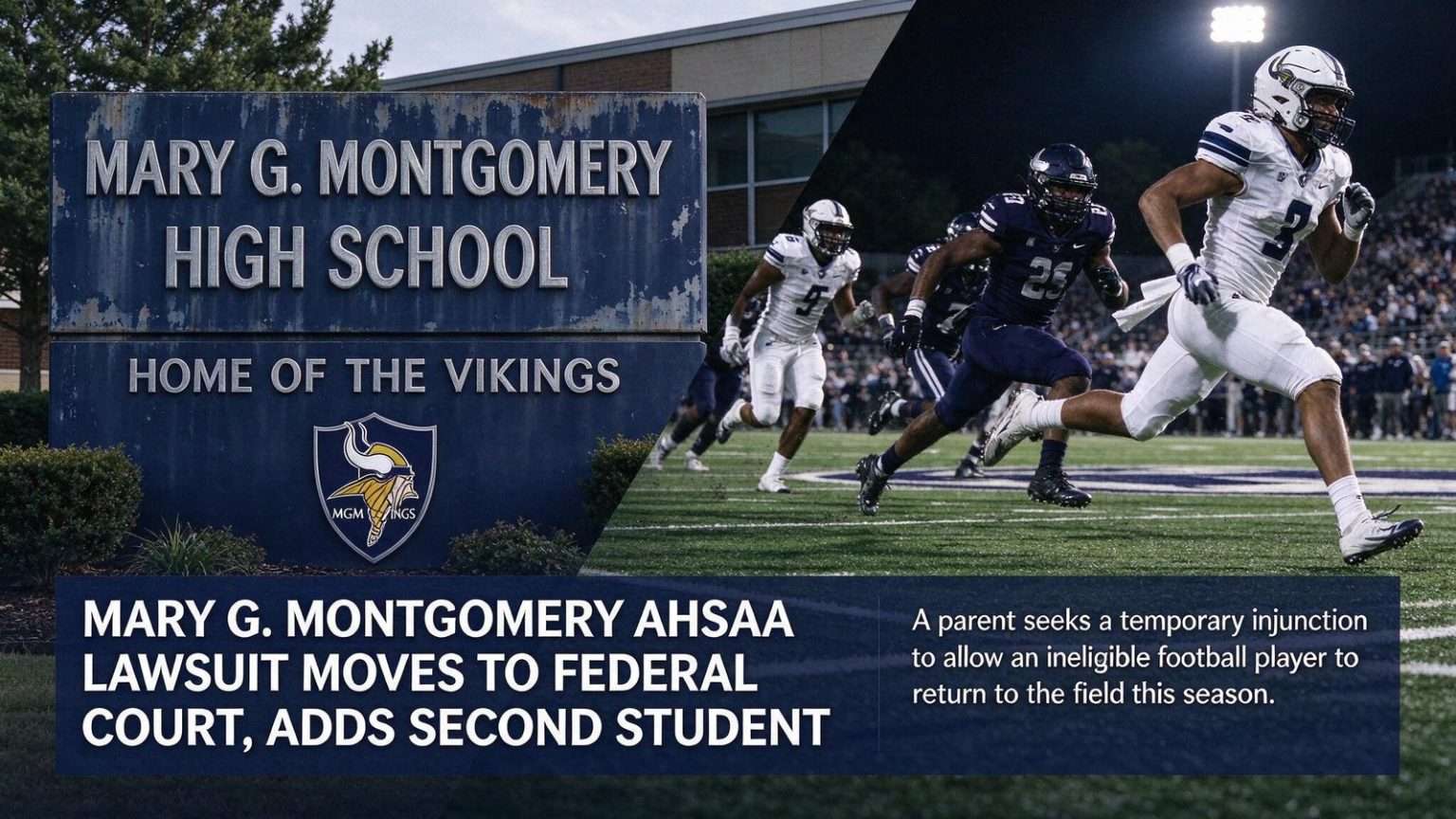
MOBILE — A parent has gone to court seeking an order that would let a Mary G. Montgomery High School football player who was ruled ineligible in May return to the field this season.
Tameka Dale, acting on behalf of her son, filed a request for a temporary injunction against the Alabama High School Athletic Association and its executive director, Heath Harmon. The filing was made in Montgomery County Circuit Court this week.
The student is a minor and is identified in the case only as “T.D.” The filing asks that he be allowed to play again and that the school not face further penalties for playing him.
Harmon, through AHSAA director of communications Scott Griffin, said the association does not comment on ongoing legal matters.
What a Temporary Injunction Asks For
The request is for emergency relief, and the difference between that and an ordinary lawsuit matters to how quickly — and on what basis — a judge can act.
A temporary restraining order is the most immediate form of court intervention. It is short-lived by design, meant only to hold a situation in place until the court can hold a hearing. A preliminary or temporary injunction is the next step: it follows notice to the other side and a hearing, and it can last until the case is resolved on the merits.
To obtain that relief in Alabama, a party generally has to make a four-part showing: that without an injunction it would suffer irreparable injury; that there is no adequate remedy at law — meaning money damages would not fix the problem; that it has a reasonable likelihood of succeeding on the merits of the case; and that the hardship the injunction would impose on the other side is not unreasonably disproportionate to the benefit gained.
The irreparable-injury element is why athletic eligibility cases so often arrive as injunction requests. A season that has already been played cannot be given back, and a court that waits to decide the underlying legal question until after the final game has effectively decided it against the player regardless of who was right. Courts issuing injunctions may also require the party seeking one to post security to cover damages if the injunction is later found to have been wrongly granted.
Importantly, an injunction is not a ruling that the plaintiff wins. It is a judgment that the balance of harms and the strength of the claim justify preserving a position while the case proceeds.
The Penalties That Made T.D. Ineligible
In May, the AHSAA announced that Mary G. Montgomery’s football program would be placed on restrictive probation for violating the association’s recruiting rules. The penalties included a postseason ban for the team in 2026 and a one-year suspension for then-head coach Zach Golson.
As part of the sanctions, any students identified as being involved in the violations were deemed ineligible to participate in athletics at Mary G. Montgomery.
The school’s self-report to the AHSAA has not been publicly released. According to the account in court filings and prior reporting, the penalties centered on a Signing Day party held at the school for rising ninth-graders, some of whom were enrolled in middle schools not zoned for Mary G. Montgomery.
The lawsuit states that T.D. was the only student named in the AHSAA’s infractions letter who has remained at Mary G. Montgomery. The suit offers that fact as evidence that his interest in attending the school was not driven by the chance to play athletics.
The Account in the Filing
According to the suit, Dale went to Mary G. Montgomery on May 7, 2025, to complete paperwork enrolling her son at the school. The filing states he was then an eighth-grade honor student and was zoned to attend a different high school the following year, and that his mother wanted him at a school where she believed his educational opportunities were better.
While at the school to enroll him, the suit says, Dale learned that a Signing Day event would be held the next day and attended it, speaking there with coaches, administrators and counselors about the school’s expectations for her son as a student and an athlete.
“At no time did any coach, booster or otherwise ‘go between’ for MGM High School recruit ‘T.D.’ to the school for the purpose of participating in varsity athletics,” the suit states, adding that at the time of the visit the student had already chosen the school and completed the required enrollment paperwork for the fall of 2025.
The complaint says the AHSAA nonetheless ruled him ineligible on the ground that his attendance at the 2025 Signing Day party constituted recruitment.
The Argument Over the Recruiting Rule
The central legal argument in the filing is not about whether the events happened. It is about whether the rule applied to them was validly adopted.
The complaint contends the AHSAA lacks the authority to enforce portions of its recruiting rule because changes or additions to that rule were made without approval by the association’s own legislative council.
“I have discovered the AHSAA has amended the recruiting rule without following the proper procedure as required by their bylaws,” said Michael Kidd, an attorney for Dale. “They just inserted language they wanted to add to the rule, and it never went through the process as outlined in their by-laws. It’s the added verbiage that they used to make my client ineligible. They demand compliance of a rule that they failed to approve as required by their own bylaws.”
Kidd contends the disputed language is a note appended to an AHSAA recruiting rule reading: “Any contact/communication with a student, student’s parents, or any other family member (including elementary students) enrolled in another school, regardless of school zone, including, but not limited to, phone calls, emails, texts, social media, etc., is prohibited.”
The AHSAA has not responded to that contention publicly, citing its practice of not commenting on pending litigation.
Why the Bylaws Argument Is the One Being Pressed
The framing of the claim reflects a long-standing limit on how far courts will go in reviewing decisions by organizations like the AHSAA.
The association is a voluntary membership organization of schools rather than a state agency. Courts have generally been reluctant to substitute their judgment for that of a voluntary association on internal matters — how it interprets its rules, how it weighs evidence, what penalty it imposes. The recognized exceptions are narrow: courts will intervene where an association acted fraudulently, exceeded the authority it actually has, or failed to follow its own governing rules or provide the process those rules require.
A claim that a rule was never validly adopted fits inside one of those exceptions. Rather than asking a judge to second-guess how the AHSAA read the facts, it asks whether the specific language used to declare the student ineligible was ever properly enacted. That is a question about the association’s compliance with its own bylaws, which is territory courts have historically been willing to enter.
The AHSAA’s Filing
Harmon and the AHSAA have filed a motion to dismiss the case, citing a lack of jurisdiction and the association’s internal autonomy. They argue the court should not interfere with AHSAA operations.
That is the mirror image of the plaintiff’s argument — an assertion that this dispute falls within the zone of internal decision-making courts leave alone, rather than within the exception for an association that departed from its own rules.
Kidd said the court gave him until Tuesday to file an additional brief arguing his position, after which he expects AHSAA attorneys to have a couple of days to respond.
“Then I assume we will have a hearing on whether to issue the injunction,” Kidd said.
A Cluster of Cases
The filing is the third lawsuit brought against the AHSAA since the previous Friday.
Earlier in the week, a judge issued an order allowing a Prattville High School student — previously determined to be homeless and ruled ineligible by the AHSAA — to play for at least two weeks. Golson, the suspended Mary G. Montgomery coach, filed his own suit against the AHSAA and others the prior week, seeking reinstatement, due process, or both.
Eligibility rules exist to keep competition between member schools from turning into a recruiting market, and enforcement decisions in individual cases are where the general rule meets a specific family’s circumstances. Litigation over those decisions is not new; what stands out here is the concentration of filings in a short period.
Where the Team Stands
Mary G. Montgomery opened the season with two straight losses. The Vikings host Robertsdale in their Class 6A, Region 1 opener, though under the AHSAA penalties their games will not count in the region standings this year.
Last week, the AHSAA’s Central Board of Control upheld the school’s restrictive probation after an appeal by Mary G. Montgomery officials — exhausting the association’s internal appeal route and leaving the courts as the remaining forum.
The Core Allegation: A Recruiting Rule Changed Without a Vote
The heart of Tameka Dale’s complaint is not that her son was treated unfairly under the AHSAA’s recruiting rule. It is that the version of the rule used against him was never lawfully adopted.
The suit was filed Sept. 4 in Montgomery County Circuit Court by attorney Michael Kidd on behalf of Dale and her son, a sophomore identified in filings as T.D. because he is a minor. It seeks a permanent injunction against the association and Executive Director Heath Harmon so that he can play, and asks the court to bar the AHSAA from forcing Mary G. Montgomery to forfeit games, pay fines or take on additional probation if the school lets him on the field under a court order.
Kidd’s argument for why a circuit court can hear the case at all rests on an exception: he notes the Alabama Supreme Court has held that circuit courts have jurisdiction over the AHSAA “if acts of the association are the result of fraud, lack of jurisdiction, collusion or arbitrariness.” Framing Harmon’s interpretation as arbitrary is therefore not rhetorical flourish — it is the jurisdictional hook the entire case hangs on.
How the Language Allegedly Shifted
The complaint traces the rule across successive editions of the AHSAA handbook. The 2015-16 version read: “No person connected in any way with a school may contact a student or prospective student, or his/her parents or guardian who resides outside of the school district to inquire or encourage them to transfer or enroll in their school for the chief purpose of participating in interscholastic athletics.”
According to Kidd, the 2018-19 handbook expanded the prohibition to cover “any contact/communication with a student, a student’s parents or any other family member enrolled in another school, regardless of the school zone, including but not limited to phone calls, emails, texts, social media, etc.” The filing alleges the phrase about phone calls, emails, texts and social media was inserted without a vote of the association’s Legislative Council — and that Harmon himself testified in a separate case that only the Legislative Council can make or approve such changes. Steve Savarese was executive director at the time.
Kidd alleges a second alteration in the 2022-23 handbook, which added that it is permissible for a coach or anyone connected with the school to speak with students or parents who visit the school on their own “for any specific purpose other than athletics.” The 2021-22 handbook, reproduced in Dale’s affidavit, contained the same permission without the closing qualifier. Kidd contends those three words were added arbitrarily and without Legislative Council approval.
That distinction carries the case. Kidd argues that if the unauthorized language were stripped out, no violation would have occurred, because Tameka Dale accompanied her son to the ceremony herself.
The Marbury Backstory
The complaint traces the alleged pattern to a 2018 investigation into Marbury High School’s baseball program. According to Kidd, AHSAA investigator Ben Bugg’s inquiry exonerated the coach, but Savarese nonetheless sent a letter to the school’s principal stating that the coach had violated the association’s recruiting bylaw. After the ruling was announced, a whistleblower leaked Bugg’s internal memo clearing all parties. The bylaw change without legislative approval followed, Kidd alleges, and the filing characterizes the amendments as having been made “through his interpretations … to serve the executive director’s personal agenda” in response to pending litigation.
Dale’s Account of the Ceremony
Dale states in the lawsuit that her son attended Mary G. Montgomery’s 2025 spring welcoming ceremony as an eighth grader at Clark-Shaw Magnet School. He was zoned for Vigor, which the state had designated a failing school, and she chose to send him to MGM instead. She describes him as an honor student who already had friends at the school, and notes he sat out the 2025 season under AHSAA rules because she had not made a bona fide move into MGM’s zone.
On May 8, 2025, Dale says, she brought her son to the ceremony on campus and spoke with coaches, administrators and counselors herself. Her son had already completed the paperwork to enroll. She states that no MGM representatives or “go betweens” attempted to recruit him, and that Golson never visited Clark-Shaw Magnet School to recruit him.
What the AHSAA Says Back
AHSAA attorney Benjamin Espy responded quickly with a motion to dismiss, arguing the circuit court has no jurisdiction over the association’s internal affairs. The motion notes that Mary G. Montgomery self-reported the violation and did not appeal it despite having the right to do so. The association further argues that T.D. is not himself an AHSAA member and that no justiciable controversy exists for a court to resolve.
A hearing on the motion to dismiss is scheduled for Oct. 7 in Montgomery.
The Sanctions and the Wider Fallout
The AHSAA investigation centered on an April freshman welcoming ceremony at Mary G. Montgomery. It ended with the school fined, placed on restrictive probation and barred from the 2026 postseason, and with coach Zach Golson suspended for the 2026-27 school year from coaching at any AHSAA member school. Golson had already been removed from his job by the Mobile County Public School System two weeks before the sanctions were announced.
Golson has filed a separate suit against Harmon, the AHSAA, investigator Chuck Anderson, MGM Principal David Diaz and MCPSS Superintendent Chresal Threadgill, alleging defamation and a lack of due process. He has said the ceremony was attended by students who had already completed transfer paperwork or expressed interest through their parents, that any contact was inadvertent, and that the event was approved by MGM’s administration and publicized on social media. Diaz has said the students were not invited by the school.
The May 18 Letter
A May 18 letter from Harmon to Diaz, included as part of Dale’s affidavit, named the players declared ineligible and set out the association’s ruling against Golson and the school. The letter states that the school self-reported violations of the recruiting rule and confirms that Baker High School supplied information to the AHSAA, though the students involved were zoned for a range of schools including Blount, Davidson and Murphy. Golson has said in his own lawsuit that Blount was also involved in reporting MGM. In the letter, Harmon wrote that he was disappointed in “egregious violations” and that MGM had not proposed corrective actions; Diaz subsequently presented a plan to the association’s Central Board in July.
Twenty-one students were declared permanently ineligible to play at Mary G. Montgomery, according to the letter.
Players Named in the Letter
According to Harmon’s letter, Diaz said none of the players at the most recent welcoming ceremony were formally contacted or invited by MGM. The letter identified the following athletes as involved:
- Keylan Coleman of Causey Middle School (zoned for Baker)
- Shayne Howard of Scarborough Middle School (zoned for Blount)
- Mason Palmer of Causey (zoned for Baker)
- Shedrick Taylor of Phillips Prep (zoned for Murphy)
- Michael Williams of Phillips Prep (zoned for Blount)
- Tyler Curry of Clark-Shaw (zoned for Blount)
- Cam Gains of Phillips Prep (zoned for Davidson)
- Marlon Gains of Phillips Prep (zoned for Blount)
- Jordan Lankster of Semmes Middle School (zoned for Blount)
- Odin Oliveira of Semmes Middle (zoned for Blount)
- Marrlyn McCorvey of Causey Middle
According to the letter, Howard’s parents met with MGM’s registrar and applied for a transfer, but he did not enroll. The transfers of Williams, Curry and Marlon Gains were approved by the Mobile County Public School System. McCorvey attended the ceremony according to Causey Middle School, but MGM has no documentation that he did.
A Second Group
The letter also listed players Diaz said were not zoned for MGM but had spoken with Golson during a visit to Semmes Middle School and/or had attended one of the school’s welcoming ceremonies in the past. Golson has said he visited Semmes Middle to speak only with students who had said they planned to attend MGM. These students were also declared ineligible by the AHSAA:
- Jakaleb Fields
- Jabori Fields
- Braylen Gamble
- John Greene
- Jaydon White
- Carson Pharr
- Marquis Gould
- Tristan Dale
- Ja’Siah Samuels
- Jondae Lee
None of the students named in the letter has been accused of violating any rule. The AHSAA’s findings concern the conduct of Mary G. Montgomery and its coaching staff; the students were the subjects of the eligibility ruling rather than parties charged with wrongdoing.
Of that group, Dale’s son is the only one who remained at Mary G. Montgomery, according to the lawsuit. The rest returned to the schools they are zoned to attend — which is part of why this case, and not one of the others, is the one now before a judge.
Update: State Suit Withdrawn, Federal Lawsuit Filed on Behalf of Two Students (Sept. 22, 2026)
The legal fight over eligibility at Mary G. Montgomery High School in Semmes has moved to federal court and grown to include a second student.
Attorney Michael Kidd has withdrawn the state court lawsuit he filed earlier this month on behalf of Tameka Dale and her son, and has filed a new federal lawsuit on behalf of two MGM students who were declared ineligible for athletics at the school after last spring’s AHSAA investigation. Both students are minors and are identified in the complaint only by their initials. The suit was brought by their parents on their behalf.
The withdrawal ends the Montgomery County Circuit Court case, in which a hearing on the AHSAA’s motion to dismiss had been scheduled for Oct. 7.
Why the Case Changed Courts
Kidd said the second student, like Dale’s son, chose to stay at Mary G. Montgomery rather than return to the school he was zoned to attend.
“I made the decision to withdraw the previous lawsuit that was filed and there was an additional player that was at Mary G. Montgomery that didn’t return to wherever they were zoned for so we added him to the lawsuit as well because I didn’t want to leave a kid out that was still there,” Kidd said.
He said the move to federal court was driven by the addition of constitutional claims.
“The reason it was withdrawn in state court and filed in federal court is that we’ve added some constitutional claims, which I think really makes the argument a lot stronger. It certainly makes more sense.”
What the Federal Suit Claims
The new complaint alleges, among other things, that the AHSAA’s recruiting rule is unconstitutional and has been improperly enforced. It repeats the argument at the center of the state case: that the association amended the recruiting rule in its official handbook without following its own required procedure.
The suit goes further by arguing that the rule, as written, violates constitutional free speech and equal protection guarantees because it restricts all communication between parents and prospective coaches or teachers, not just communication aimed at recruiting athletes.
“You can’t just restrict all communications,” Kidd said. “You are restricting speech that has nothing to do with recruiting whatsoever. You could be calling up a coach, talking about the weather, and that’s a violation. The court says that goes way too far.”
The complaint contends that both students had already decided to attend Mary G. Montgomery before the Signing Day event, were not recruited for football or any other sport, and were therefore wrongly declared permanently ineligible at the school.
The plaintiffs are seeking injunctive relief for the two players, along with attorney fees, costs and damages.
Defendants Named
The federal suit names the AHSAA and Executive Director Heath Harmon, as the state suit did, and adds two local school officials: Mary G. Montgomery Principal David Diaz and Mobile County Public Schools Superintendent Chresal Threadgill. Diaz and Threadgill are also defendants in the separate lawsuit filed by former MGM coach Zach Golson, who is seeking reinstatement or due process in connection with his one-year suspension.
The AHSAA and Mobile County Public Schools do not comment on ongoing legal matters.
The Constitutional Backdrop
Constitutional claims generally can be brought only against government actors, not private organizations. The U.S. Supreme Court addressed that question for high school athletic associations in 2001, ruling in Brentwood Academy v. Tennessee Secondary School Athletic Association that the Tennessee association’s regulation of interscholastic sports amounted to state action because of how closely it was entwined with public schools and public officials.
That same Tennessee dispute returned to the Supreme Court in 2007, when the justices held that the association did not violate a private school’s First Amendment rights by enforcing its anti-recruiting rule against the school over letters its football coach sent to eighth-grade boys. How a federal court applies those precedents to the broader communication ban Kidd is challenging, and to students rather than a member school, remains to be seen.
Where Things Stand for the Vikings
When the AHSAA placed Mary G. Montgomery’s football program on restrictive probation in May, students found to be involved were ruled ineligible to play at MGM but could regain eligibility by returning to the schools they were originally zoned to attend. The two students in the federal suit stayed at MGM and have not been allowed to play for the Vikings this fall.
Mary G. Montgomery is 2-3 under new coach Alex Page. The Vikings are off this week and return to action Oct. 2 at Baker. Because of the restrictive probation, they are ineligible for the playoffs and their region games do not count in the standings.
A Growing List of Lawsuits
The AHSAA is facing several lawsuits this fall. Besides the MGM cases, 10 Robertsdale High School players and head coach Justin Jones were granted separate injunctions last week that allowed them to play in the Sept. 18 game against Fairhope. The AHSAA is also investigating the Robertsdale football program for potential violations.