Crews Pull 42 Abandoned Boats and Nearly 175 Tons of Debris From Alabama’s Coastal Waters
A partnership of state, federal, university and private contractors removed 42 abandoned and derelict vessels from Alabama’s coastal waterways, clearing nearly 175 tons of debris that posed hazards to boaters.
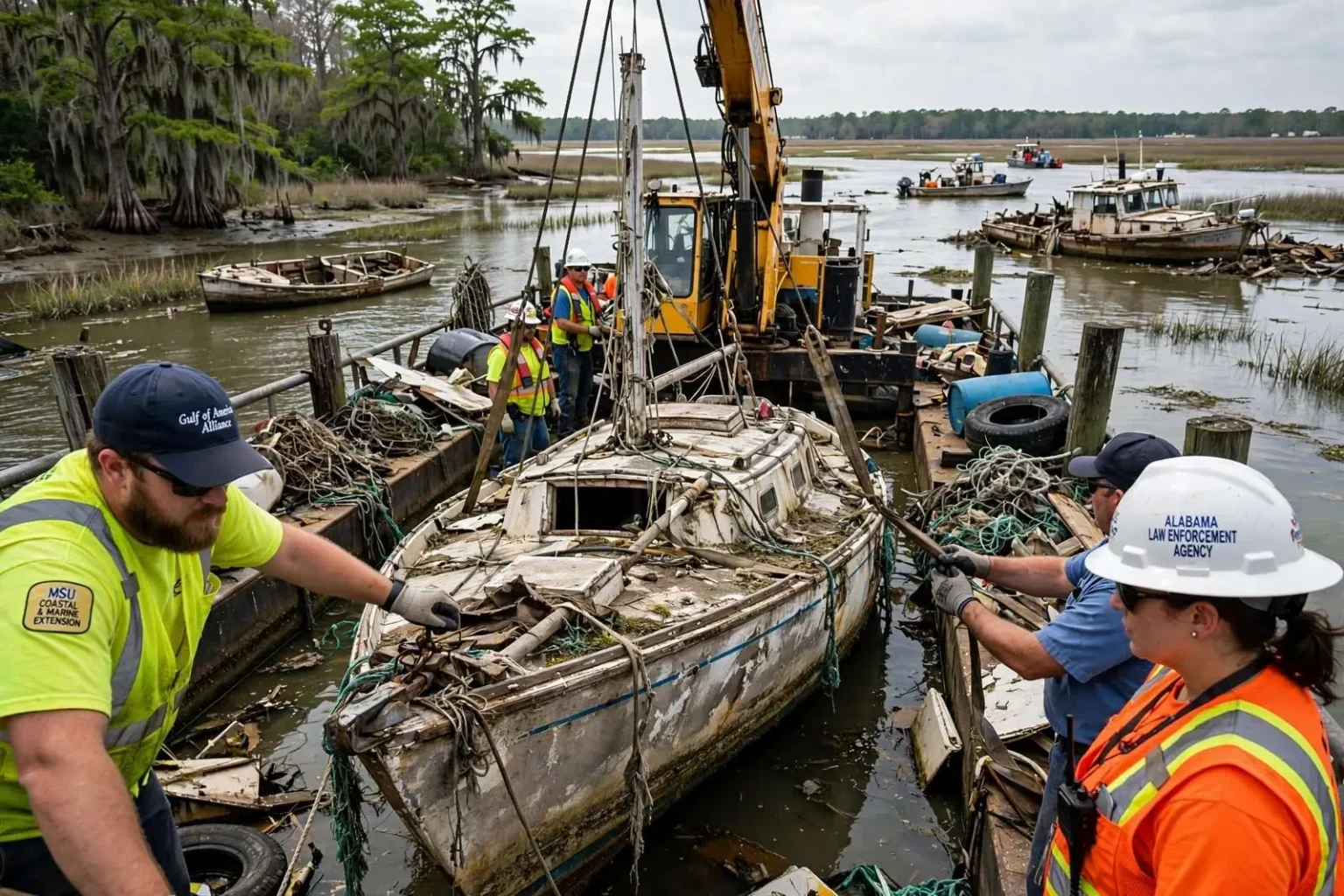
MOBILE — Crews working under a multi-agency partnership removed 42 abandoned and derelict vessels from Alabama’s coastal waterways over the past year, clearing nearly 175 tons of debris from waters used daily by commercial and recreational boaters.
The Gulf of America Alliance, working with the Alabama Law Enforcement Agency and Mississippi State University Coastal and Marine Extension, pulled 32 vessels from Bon Secour Bay, south Mobile County and the Mobile-Tensaw Delta during the winter, according to a recent report. Another 10 vessels were removed from Baldwin County and the Perdido River and Bay area in spring 2025.
The winter operation alone extracted 198,600 pounds of material from the waterways. The debris included sailboats, cabin cruisers and barges.
“The removal of abandoned vessels benefits our coastal systems in multiple ways, not just as an aesthetic issue, but most importantly as a safety issue,” Laura Bowie, executive director of the Gulf of America Alliance, wrote in a news release. “We are proud of the work with our partners to remove these threats to boaters navigating our waterways.”
What an Abandoned Vessel Actually Is
In coastal management, abandoned and derelict vessels are a defined category rather than a loose description. They are boats that have been left in the water without a responsible owner maintaining them, and that have deteriorated to the point of being wrecked, junked or substantially dismantled.
Most of them arrive in that condition by a similar route. A boat becomes uneconomic to repair or store. The cost of hauling it out, disposing of a fiberglass hull and paying the yard fees exceeds whatever the vessel is worth. The owner stops paying slip fees, moves the boat to an anchorage or a back bayou, and stops coming back. Storms accelerate the process: a hurricane or a strong frontal passage sinks or grounds boats that were already neglected, and the ones nobody claims afterward simply stay where the water left them.
The result accumulates slowly and then becomes conspicuous. A single half-sunken sailboat in a bayou is a curiosity. Dozens of them across a coastal county become a systemic problem that no individual property owner or marina has the authority or budget to solve.
Why the Safety Argument Comes First
Bowie’s framing — safety first, appearance second — reflects how these vessels behave once they begin to break apart.
A grounded or partially sunken boat is a navigational hazard in the most literal sense. It sits at or just below the waterline, often outside marked channels, in exactly the shallow water where small boats run. It does not appear on a chart. At night, at high tide or in a chop, it is effectively invisible until a hull strikes it. A collision with a submerged wreck at planing speed can hole a boat, throw occupants overboard or destroy a lower unit.
The hazard also moves. Vessels that appear settled can shift with tides, currents and storm surge, so the wreck a local boater learned to avoid last season may not be in the same place this season. A large derelict — a barge, for instance — can break loose entirely during a storm and become a battering ram against docks, bridge pilings and moored boats downstream.
For commercial traffic, the stakes scale with the vessel. Alabama’s coastal waters carry tug-and-barge traffic through the delta and along the Intracoastal Waterway, and submerged debris in or near those routes is a hazard to navigation with consequences well beyond a recreational grounding.
The Environmental Case
Chris Blankenship, commissioner of the Alabama Department of Conservation and Natural Resources, helped secure funding for the project as Alabama’s representative on the Gulf of America Alliance.
“Removing marine debris from our Gulf Coast waters supports healthy aquatic ecosystems and reduces the dangers posed to boaters and anglers by derelict and abandoned vessels,” he said.
The ecological damage from a derelict vessel comes in several forms, and it continues for as long as the hull remains.
The most immediate is physical. A grounded boat crushes and shades whatever is underneath it. In shallow Gulf Coast bays, that can mean submerged aquatic vegetation — the seagrass and freshwater grass beds that serve as nursery habitat for shrimp, blue crab, speckled trout, redfish and juvenile fish of many species. It can also mean oyster reef, which functions simultaneously as habitat, as a filter that improves water clarity and as a natural breakwater that reduces shoreline erosion. A hull that shifts back and forth with tide and wind scours the bottom repeatedly rather than settling once.
The second form is chemical. Boats are built and equipped with materials that do not belong in an estuary: residual diesel and gasoline in tanks and lines, hydraulic and lubricating oils, lead-acid batteries, antifreeze, and hull paints formulated with copper and other biocides specifically to be toxic to marine organisms. Older vessels may contain additional hazardous materials. As a hull degrades, those materials are released gradually rather than in a single event, which makes the contamination harder to detect and harder to attribute than an acute spill.
The third is persistence. Fiberglass hulls do not meaningfully decompose. They fracture into progressively smaller shards of resin and glass fiber that spread through the sediment and along shorelines, and they remain in the system indefinitely. A wooden vessel eventually returns to the environment; a fiberglass one becomes a permanent source of debris unless it is physically removed.
Derelict vessels also collect what floats past. Lost fishing gear, line and netting snag on exposed structure and continue to entangle fish, turtles and birds — the phenomenon known as ghost fishing, in which abandoned gear keeps catching long after anyone is tending it.
Who Did What
The removals required an unusual assembly of partners, which is itself a comment on why derelict vessels are so difficult to address.
The Gulf of America Alliance coordinated the work across multiple local and state agencies. The alliance is a regional partnership among the five U.S. Gulf states created to work jointly on coastal and marine issues that cross state lines — water quality, habitat, resilience and marine debris among them.
Contractors MD Thomas Construction, LLC, and Blue Diving & Salvage, LLC, removed and disposed of the vessels. The Alabama Law Enforcement Agency ensured compliance with federal, regional and local laws, and Mississippi State University Coastal and Marine Extension managed the project on site. The National Oceanic and Atmospheric Administration Marine Debris Program provided grant funding.
“We appreciate the Gulf of America Alliance, the Alabama Department of Conservation and Natural Resources and all of our partners who are working together to address these hazards,” Hal Taylor, Alabama Law Enforcement Agency secretary, wrote in the release. “Each vessel removed eliminates a potential navigational hazard and helps us continue our mission of keeping Alabama’s waterways safe for everyone.”
The Legal Knot That Makes This Hard
The reason a project of this kind requires a law enforcement agency in a compliance role, rather than a barge and a crane alone, is that a derelict boat remains somebody’s property until a legal process says otherwise.
Removing a vessel therefore begins with title and ownership research. Registration records may be years out of date. Hull identification numbers may be missing, painted over or degraded. An owner may be deceased, insolvent, out of state or simply unreachable. Where an owner is identified, notice generally has to be given and an opportunity to respond provided before a public agency disposes of the property.
Jurisdiction adds another layer. A vessel may sit in state waters, on submerged land owned by the state, adjacent to private uplands, within a navigable waterway regulated federally, or in some combination. Work in navigable waters and in wetlands can implicate federal permitting, and removal operations in sensitive habitat have to be planned so the cure is not worse than the disease — which is part of what an on-site project manager is for.
Then there is disposal. A hull that comes out of the water has to go somewhere. It is heavy, awkward, frequently contaminated, and made largely of a material with no recycling market. Fuel and fluids must be pumped and handled separately, batteries removed, and the remainder cut apart and hauled to a landfill. Those costs are the same costs that led the original owner to walk away, which is why the work almost always ends up funded publicly, in this case through NOAA’s Marine Debris Program.
Where the Boats Came Out
The geography of the removals covers some of the most productive water in the state.
Bon Secour Bay is the southeastern lobe of Mobile Bay, bordered by the Bon Secour National Wildlife Refuge and long associated with Alabama’s commercial seafood industry. It is shallow, heavily fished and heavily used by recreational boaters.
The Mobile-Tensaw Delta, north of the bay, is one of the largest river deltas in the United States and among the most biologically diverse regions in North America, with exceptional concentrations of fish, mussel, turtle and plant species. Its maze of rivers, bayous, cuts and cypress swamps is also, practically speaking, an easy place to leave a boat where few people will see it.
The Perdido River and Bay system on the Alabama-Florida line drains a comparatively undeveloped watershed into a bay shared by two states — a jurisdictional split that historically complicates cleanup work of exactly this kind.
A Recurring Job, Not a Finished One
Nearly 175 tons is a substantial haul, but derelict vessel removal is maintenance rather than a one-time fix. New boats are abandoned every year, and every significant storm adds to the inventory in a single night.
The counterweight is prevention: turn-in programs that let owners surrender an unwanted boat before it sinks, better recordkeeping on transfers and abandonment, and enforcement that makes walking away a less attractive option than disposal. Absent that, the removal work simply repeats.
For now, 42 fewer wrecks sit in Alabama’s coastal waters, and 198,600 pounds of material that had been leaching, snagging and shifting through those systems has been taken out of them.