Three Accused of Draining $800,000 From 88-Year-Old Mobile County Man Bound Over to Grand Jury
A Mobile County judge sent the cases of three people accused of financially exploiting an 88-year-old man out of roughly $800,000 to a grand jury, and the District Attorney’s Office used the hearings to warn families about elder financial exploitation. All three are presumed innocent.
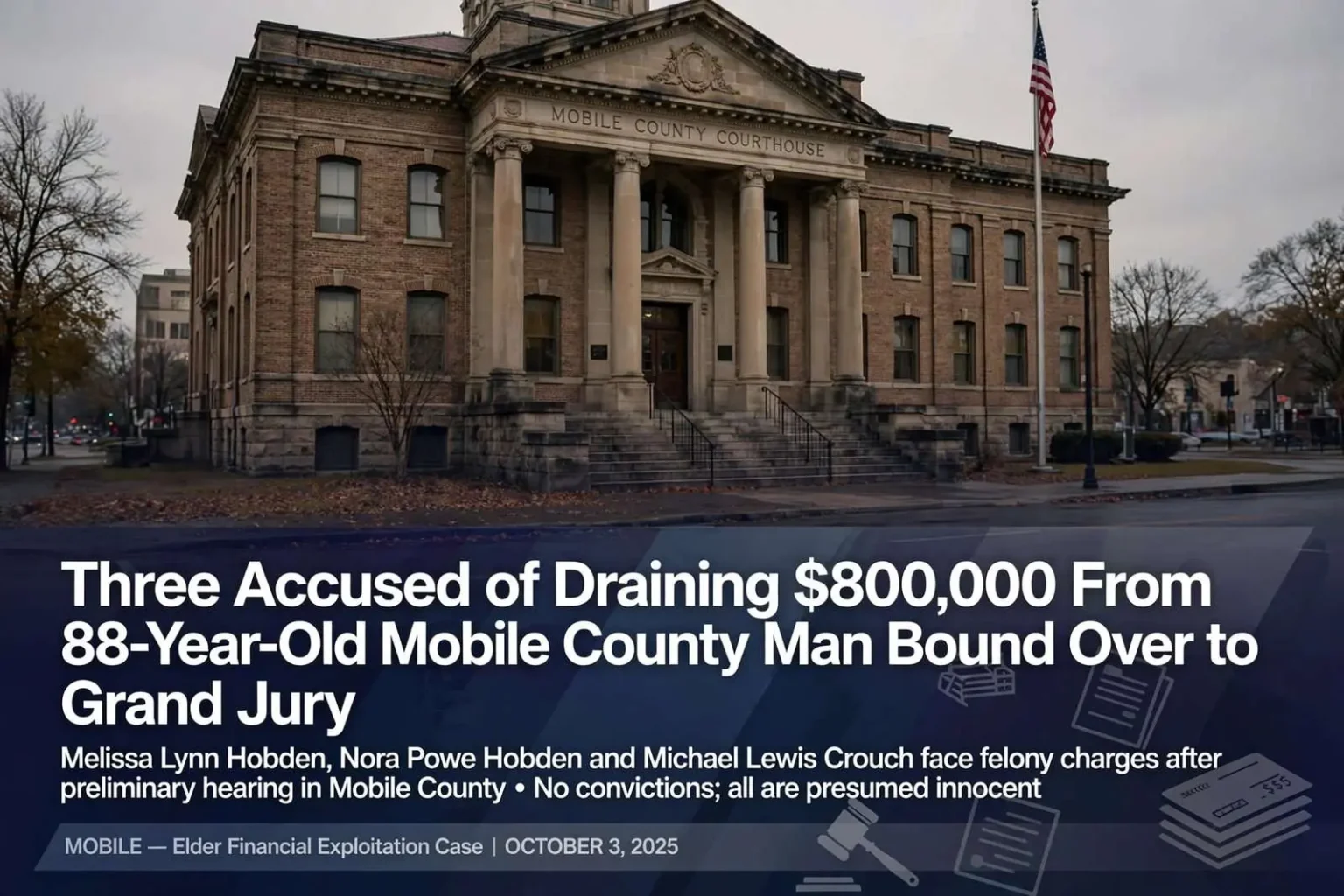
MOBILE — Three people accused of financially exploiting an 88-year-old Mobile County man out of hundreds of thousands of dollars will have their cases presented to a grand jury after a judge found probable cause at preliminary hearings Thursday.
Melissa Lynn Hobden, Nora Powe Hobden and Michael Lewis Crouch face felony charges in connection with the alleged financial exploitation of Tom Baxter. None has been convicted, and all three are presumed innocent unless the state proves its case at trial.
During the hearings, Mobile County Sheriff’s Office Detective Tanner Cheshire laid out an investigation involving hundreds of thousands of dollars in checks, two Satsuma properties and two iPhone 17s. Chief Assistant District Attorney Jennifer Sussman described the case as an example of what she called a “crime of secrecy,” saying fear and shame often keep elderly victims from speaking up.
What a Preliminary Hearing Decides
A preliminary hearing is one of the few points in an Alabama felony case where evidence is aired publicly before trial, which is why so much detail emerged Thursday. It is not a trial and it does not decide guilt.
At a preliminary hearing, a district court judge hears testimony from the state — usually the lead investigator — and decides a narrow question: is there probable cause to believe a felony was committed and that the defendant committed it? The defense may cross-examine and may present evidence, but the state is not required to prove anything beyond a reasonable doubt, and hearsay is generally admissible. Judges are not weighing credibility the way a jury eventually will.
If the judge finds probable cause, the case is “bound over” to the grand jury. If not, the charges at that stage are dismissed — though a prosecutor can still take the matter to a grand jury directly.
Because the standard is low and the state can put on a stripped-down version of its case, defense attorneys often use the hearing primarily to preview the evidence and lock a detective into sworn testimony that can be used later for impeachment.
How Prosecutors Say the Access Began
Prosecutors say the connection to Baxter began through his late wife, Peggy, who had Alzheimer’s disease. Nora Hobden cared for Peggy before she died, according to testimony, and prosecutors say that relationship gave Hobden access to Baxter and his family.
“She was a caretaker for his deceased wife who had Alzheimer’s before she passed. So, she had access to him that way,” Sussman said.
Prosecutors allege that Nora Hobden, her daughter Melissa Hobden, and Melissa’s romantic partner, Michael Crouch, later financially exploited Baxter over a period of several years.
The pattern prosecutors describe — a caregiving relationship that becomes a financial one — is among the most common fact patterns in elder exploitation cases. Caregivers occupy a position of trust and proximity: they know the household routine, where documents are kept, when family members visit and when a client is alone. Investigators and adult protective services workers often describe the resulting dynamic as isolation, in which the person who most needs help becomes dependent on the one person best positioned to take advantage.
The Checks, the Properties and the Phones
Investigators traced checks connected to the case beginning in 2020 and continuing through 2025. Cheshire testified that some checks carried memo lines describing payments for things such as “sitter,” “education” and “labor.”
Baxter told investigators he recognized signing some of the checks but said he did so under duress, according to testimony. He told investigators other signatures were not his.
Investigators say Baxter later told them he felt pressured when he transferred two Satsuma properties to Melissa Hobden in 2021. According to testimony, the transfer documents listed Melissa as his daughter.
The investigation also turned up two iPhone 17s allegedly purchased through Baxter’s AT&T account while he was hospitalized in 2025. Cheshire testified that Baxter had allowed Melissa Hobden and her son onto his phone plan but said he had not authorized the purchase of the two phones. Investigators say the phones were shipped to Melissa Hobden’s address.
Investigators estimate the checks connected to the case total roughly $628,000. Adding the value of the two properties brings the estimated alleged losses to approximately $800,000. Earlier in the investigation, Mobile County Sheriff Paul Burch said investigators were still waiting on additional financial records and believed the eventual total could exceed $1 million.
Those categories of evidence — canceled checks, recorded deeds and account records from a phone carrier — are the backbone of a financial exploitation prosecution. Each leaves a dated paper trail that can be reconstructed years later, and property transfers in particular are recorded in the probate office, where the deed, the stated relationship of the parties and the date are all public record.
A 2021 Allegation Raised in Testimony
According to testimony Thursday, Baxter told investigators that Melissa Hobden would ask him for checks and money and allegedly threatened to accuse him of sexual abuse if he refused.
Investigators also testified that Melissa Hobden did report an allegation of sexual abuse against Baxter in 2021. According to testimony, Hobden alleged that Baxter reached his hand up her shorts.
That investigation was later closed after investigators said they were unable to reconnect with Melissa Hobden to continue it. The allegation was never adjudicated, and the closure of that investigation does not establish whether the allegation was true or false.
How the Case Came to Light
Prosecutors say the alleged exploitation did not surface because Baxter reported it. Instead, they say, a fall sent him to the hospital and prompted his daughter, Tammy, who lives in Kentucky, to come to Alabama and look into her father’s affairs.
“He was afraid,” Sussman said. “And the fact that he was extorted didn’t come to light until he had a bad fall. He was in the hospital and his daughter came down from out of state and checked into his affairs and learned that he had been horrifically victimized to the tune of almost a million dollars.”
The Sheriff’s Office received a complaint in November 2025 after Baxter’s daughter noticed large transactions involving her father’s finances, according to testimony. Cheshire said he began investigating in January and interviewed Baxter multiple times.
‘A Crime of Secrecy’
Sussman said cases involving elderly victims are difficult to uncover because victims may feel embarrassed or ashamed.
“One of the reasons that we don’t see them as often is there is a lot of shame associated with an older person who is exploited,” she said. “There’s a reason that an entire genre of crimes is created around it. They’re being targeted. It’s predatory. It’s calculated. It’s intentional.”
She encouraged families to check on elderly relatives and friends regularly rather than assuming a victim will speak up.
“This is a crime of secrecy often,” Sussman said. “Please reach out to the family members and friends in your community. Let them know that this is not something they need to be ashamed of.”
Reporting early also improves the odds of getting money back, she said. “We want to help prosecute, but the earlier we do it, the more likely we are to have a good result and achieve restitution.”
Alabama treats financial exploitation of an elderly person — defined in state law as someone 60 or older — as a distinct felony offense rather than folding it into ordinary theft statutes, with the degree of the offense tied to the value involved. The separate offense category exists precisely because of the dynamic Sussman described: the conduct typically occurs inside a relationship of trust, unfolds over years rather than in a single incident, and often involves a victim who signed something.
The District Attorney’s Office also operates a unit aimed at intervening in financial scams targeting elderly residents, including a growing number involving cryptocurrency. Sussman stressed that cryptocurrency was not involved in Baxter’s case.
Preserving a Witness’s Testimony
Prosecutors indicated Thursday that they want to move quickly to preserve Baxter’s testimony because of his declining physical health and his age.
Sussman said prosecutors have no reason to believe Baxter is experiencing a mental deficit, but said preserving testimony is a recurring concern in cases involving elderly victims.
“We have no reason to think that he is at this time undergoing any sort of mental deficit,” Sussman said. “But in order to make sure that we preserve the integrity of what he has to say so that he can adequately convey his experience and how he was victimized, we want to make sure to go ahead and take that testimony early.”
The concern is a practical one. A felony case can take a year or more to reach trial, and if a central witness dies or becomes unable to testify in the interim, the state may lose the ability to prove its case. Courts have long recognized procedures for taking and preserving testimony before trial in appropriate circumstances, with the defense present and able to cross-examine — the cross-examination being the constitutional requirement that allows such testimony to be used later.
District Attorney’s Office Issues a Public Warning
The Mobile County District Attorney’s Office issued a public alert about financial exploitation cases alongside the bind-over, pointing to the three preliminary hearings held earlier in the week as an example of a pattern it says is appearing with increasing frequency.
“We are seeing these types of cases far too often, and I want to ask everyone in our community to check in with the older people in your life,” the office said in its statement.
The statement pushed back on a common assumption about who becomes a victim.
“Financial exploitation is not necessarily about competency,” the office said. “Older adults can be fully competent, independent and capable of managing their own affairs — and still become the target of someone willing to exploit their trust. The person taking advantage of them may be a family member, caregiver, acquaintance, new friend or complete stranger.”
That framing matters for how these cases are investigated. A prosecution for financial exploitation does not depend on showing that a victim was incapacitated or unable to understand a transaction; it turns on whether the defendant used deception, intimidation or undue influence to obtain or use the person’s money or property. It is why a signature on a check or a deed does not, by itself, resolve the question.
What the District Attorney Asks Families to Watch For
The office urged residents to raise the subject directly with older relatives and neighbors rather than waiting for a problem to surface.
“Talk with your parents, grandparents and elderly neighbors about financial scams and exploitation,” the statement said. “Pay attention if someone new suddenly becomes heavily involved in their life or finances, or if something simply doesn’t seem right.”
Prosecutors also flagged cryptocurrency as a growing feature of these cases.
“And don’t overlook cryptocurrency,” the office said. “Financial predators increasingly use cryptocurrency because they believe the money will be difficult or impossible to trace. Our office has invested in the technology and specialized training necessary to trace cryptocurrency transactions and follow those funds.”
The statement closed with an appeal to routine contact.
“Stay connected. Ask questions. Have the conversation,” the office said. “Taking a few minutes to check in could prevent someone you care about from becoming a victim.”
How to Report Suspected Exploitation
The District Attorney’s Office asked anyone with concerns to contact it directly rather than waiting for certainty.
“If you have suspicions that someone you know may be the victim of this type of theft or financial exploitation, call our office. We can help,” the statement said. “Time is of the essence in these cases, particularly when money is being moved through cryptocurrency. The sooner we know about it, the sooner we can begin working to trace where those funds went.”
The emphasis on speed reflects a practical reality of asset recovery. Funds moved through conventional bank transfers leave records that can be subpoenaed and, in some circumstances, frozen. Cryptocurrency transactions are recorded on a public ledger, but converting that record into a recoverable asset requires identifying the exchange or wallet service holding the funds and reaching it before the money is moved again or cashed out — which is why investigators treat the interval between the transfer and the report as the window that determines whether restitution is realistic.
What the Grand Jury Will Do
Following Thursday’s preliminary hearings, Judge Johana Bucci sent the cases against all three defendants to a Mobile County grand jury for further review.
A grand jury is a panel of citizens that meets in secret to decide whether the evidence justifies formal felony charges. Only the prosecution presents; there is no judge presiding over the presentation, no defense attorney in the room, and no requirement that the target testify. The panel decides whether to return an indictment — a true bill — or to decline, known as a no bill.
An indictment is an accusation, not a finding of guilt. Its legal effect is to move a felony case into circuit court, where the defendant is arraigned, enters a plea, and the case proceeds through discovery, pretrial motions and, if it is not resolved by plea or dismissal, trial. In Alabama, felony prosecutions in circuit court generally proceed by indictment unless a defendant waives it.
Melissa Hobden, Nora Hobden and Michael Crouch have not been convicted of the charges against them. Their cases remain pending.