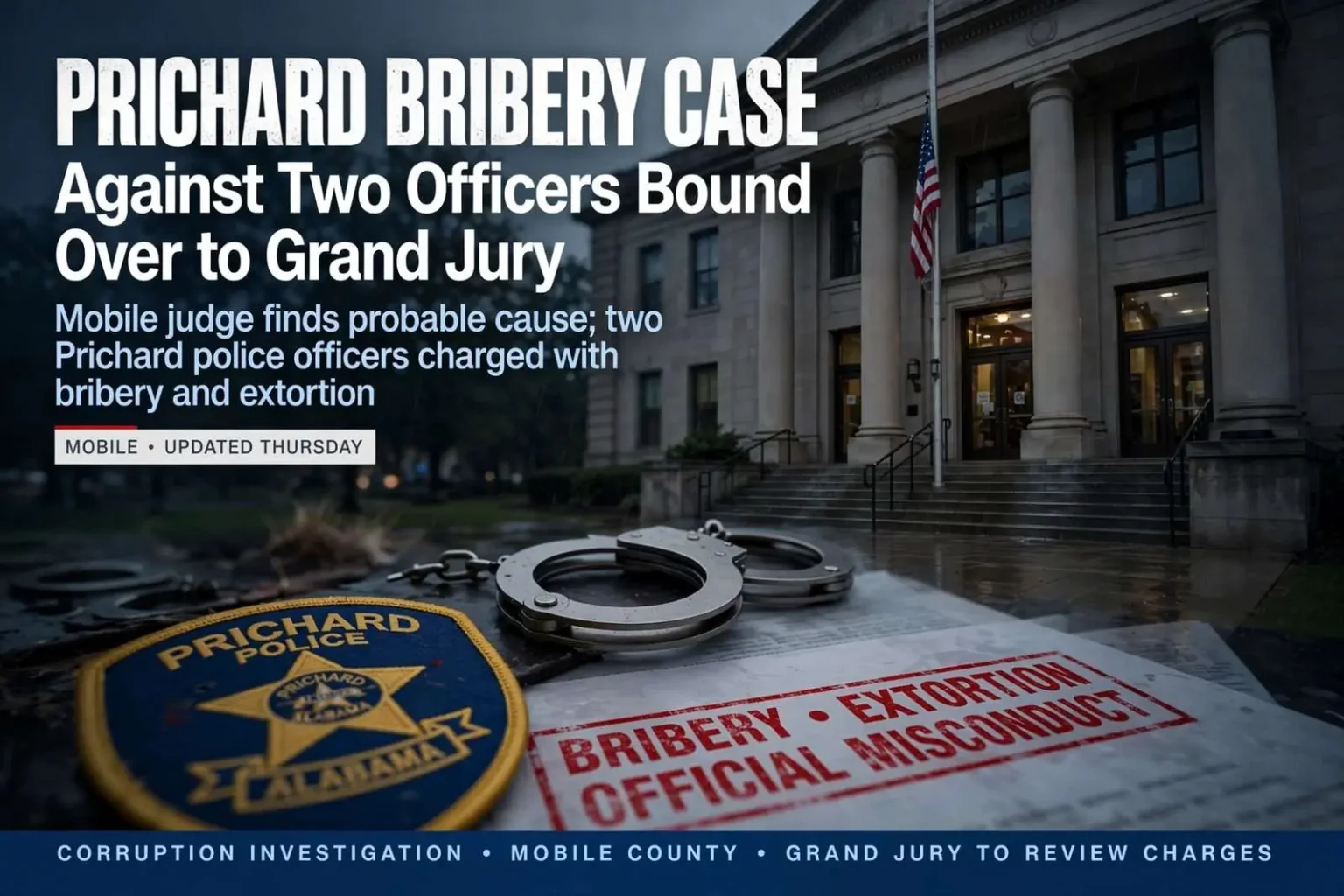
MOBILE — A Mobile County judge ruled Thursday that prosecutors presented enough evidence to send bribery and extortion charges against two Prichard police officers to a grand jury, the latest development in a widening corruption investigation into the department.
Mobile County District Judge George Zoghby found probable cause to bind over charges against Emanuel Naman Dotch II, 50, and Jihad Hasan Irby, 36, following a preliminary hearing. Both men are charged with two counts each of bribery and first-degree extortion, along with use of their official position for personal gain.
Dotch also faces separate federal charges, including allegations that he tried to frame an Atlanta lawyer and his driver on bogus drug charges; a federal judge has postponed that trial until the October court term. Both men have pleaded not guilty to the state charges.
What Investigators Say Happened
According to testimony from Mobile County Sheriff’s Office investigator Joshua Coleman, the case stems from a May 16 incident outside the Tree BBQ & Lounge in downtown Prichard, where Dotch and Irby were working off-duty as private security when a fight broke out. Two men, identified in testimony only as “J.D.” and his cousin “M.W.,” were briefly detained.
Coleman testified that J.D. offered the officers $1,000 to let him and his cousin go, even though both were subject to arrest — J.D. for allegedly violating the conditions of a pretrial release on a federal case, and M.W. on outstanding felony warrants. Investigators say Dotch accepted the money and split it with Irby, then let both men go.
Coleman testified that about 10 days later, Dotch contacted J.D. again and demanded an additional $400, telling him a third officer was upset about being cut out of the payoff. Investigators working with a Homeland Security Investigations task force arranged a “controlled delivery” and recorded Dotch accepting the additional cash on video.
Coleman testified that Dotch later confessed, while Irby acknowledged being present at the scene of the initial exchange. Investigators have said the recorded payments and the statements gathered afterward form the core of the evidence supporting both counts against each officer.
What a Bind-Over Means
A preliminary hearing is not a trial. Its only purpose is to let a district judge decide whether the state has presented enough evidence — probable cause, not proof beyond a reasonable doubt — to justify sending the charges to a grand jury. If the grand jury votes to indict, the case then moves to Mobile County circuit court, where felony cases are tried before a jury.
Zoghby’s finding of probable cause means both officers now face the next stage of the process, during which prosecutors will formally present the case to the grand jury in Mobile. Defense attorneys will have further opportunities to challenge the evidence through pretrial motions, and any trial would come months later.
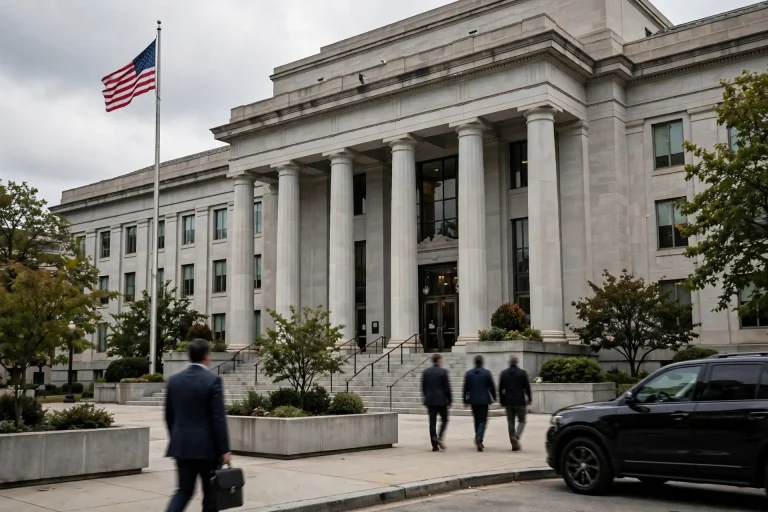
Zoghby’s courtroom handled the preliminary hearing because Mobile County’s district courts process felony cases at their earliest stage, screening them for probable cause before the grand jury step. The same courthouse will not try the case; that responsibility falls to circuit court, where a jury of county residents would weigh the recordings, the testimony and the statements investigators gathered.
The Charges and Potential Penalties
The charges themselves carry serious potential penalties. First-degree extortion is a felony under the Alabama Criminal Code, and bribery of or by a public official is likewise a felony, with sentencing ranges that can stretch well beyond a year in prison for each count. The additional charge of using an official position for personal gain is aimed directly at conduct in which a public servant leverages the authority of an office for private benefit.
A Parallel Federal Case
Dotch’s legal troubles extend well beyond the Prichard case. Federal prosecutors allege that he tried to frame an Atlanta lawyer and the lawyer’s driver on bogus drug charges, an allegation that led to separate federal charges and a trial that has now been postponed until the October court term. That postponement means the federal matter will remain unresolved while the state case moves forward.
The two tracks proceed independently. A state conviction would not resolve the federal charges, and a federal acquittal or conviction would not determine the outcome in Mobile County. Defendants facing parallel state and federal prosecutions typically see the cases unfold on separate calendars, each with its own evidentiary record and its own sentencing consequences.
A City Already Under Strain
Prichard is a city of roughly 20,000 residents in Mobile County, wedged between Mobile and Chickasaw along the U.S. Highway 45 corridor. Its police department patrols a compact urban area of older neighborhoods, commercial strips and residential streets, and the department has long operated with a modest budget and staffing level typical of a small Alabama city.
The city itself has a difficult fiscal history that residents know well. Prichard’s municipal pension fund ran out of money years ago, producing one of the most widely discussed municipal finance crises in Alabama, and the city has spent much of the past two decades working under tight budget constraints. Against that backdrop, allegations that officers traded arrests for cash strike many residents as a betrayal that compounds older problems.
How the Case Was Built
The involvement of a Homeland Security Investigations task force also reflects how modern corruption cases are built. Federal task force officers routinely partner with local sheriff’s investigators on cases involving recorded payments, controlled deliveries and surveillance, because those techniques are standard tools in federal investigations and can be adapted to state prosecutions as well.
The case is also notable for the way state and county agencies coordinated. Mobile County Sheriff’s Office investigators developed the evidence, while the Homeland Security Investigations task force supplied the operational techniques — the controlled delivery and the recording — that turned a disputed cash transaction into documented proof. That kind of cooperation has become increasingly common in Gulf Coast corruption cases, where local misconduct often intersects with federal jurisdiction.
The controlled delivery and the video recording of Dotch accepting cash are likely to be central exhibits if the case reaches trial. Recordings of an exchange of money are difficult for a defense to explain away, and prosecutors often build bribery cases around them precisely because they convert testimony about a private transaction into physical evidence a jury can watch.
Coleman’s testimony about the subsequent confession adds another layer. Statements a defendant makes to investigators, if admitted at trial, can corroborate the recorded transactions and fill in details about motive and intent. The defense will have the chance to challenge how those statements were obtained and whether they were voluntary, but until then they remain part of the record the grand jury will consider.
Irby’s acknowledged presence at the scene will be a central point of dispute. Being present is not the same as accepting a bribe, and his defense is expected to argue that testimony about who received and split the money does not establish his own criminal intent. Prosecutors, meanwhile, will point to the split of the initial $1,000 as the link that ties him to the transaction.
What Comes Next
With the case bound over, the grand jury will decide whether to return indictments on all four felony counts against each officer. Grand juries in Alabama meet regularly in Mobile, and the panel hears only the state’s side of the case; no defense presentation is required, and the standard is far lower than at trial. An indictment would move the case formally into circuit court and set a schedule for motions and hearings.
The investigation into the Prichard department appears to be continuing. Investigators have not said whether additional officers or additional transactions will be charged, and the testimony about a third officer being upset about being cut out of the payoff suggests prosecutors have been examining more conduct than what is charged so far.
For residents of Prichard, the case is a test of whether the department’s internal problems will be addressed through the courts. The officers are presumed innocent until proven guilty, and the state must still prove every element of every count. But the bind-over decision keeps the matter alive, and the coming months will show whether the grand jury returns indictments, how the federal case against Dotch resolves, and whether more evidence about the department’s off-duty security work emerges.
Questions About Off-Duty Security Work
The Tree BBQ & Lounge incident also raises broader questions about off-duty policing arrangements in small Alabama cities, where officers routinely provide private security at businesses and events. Those arrangements operate under department policies that vary widely, and allegations of shakedowns during private security work are among the harder forms of police misconduct to detect, because the interactions occur away from supervisors, patrol vehicles and routine oversight.
Whatever the grand jury decides, the episode has already put a spotlight on how off-duty security work is supervised inside the Prichard police department. Business owners across the Gulf Coast hire off-duty officers for everything from bar security to event traffic control, and the cash-handling culture around those jobs leaves room for exactly the kind of conduct alleged here. Whether Prichard tightens its own policies in response will be a question for city leadership once the criminal process runs its course.