Alabama Supreme Court Declines to Rehear Conecuh County Sheriff’s Race, Leaving the Count Tied
The Alabama Supreme Court has declined to reconsider its June ruling that two ballots counted in a 2022 recount were not lawful votes, leaving the Conecuh County sheriff’s race tied and headed back to circuit court.
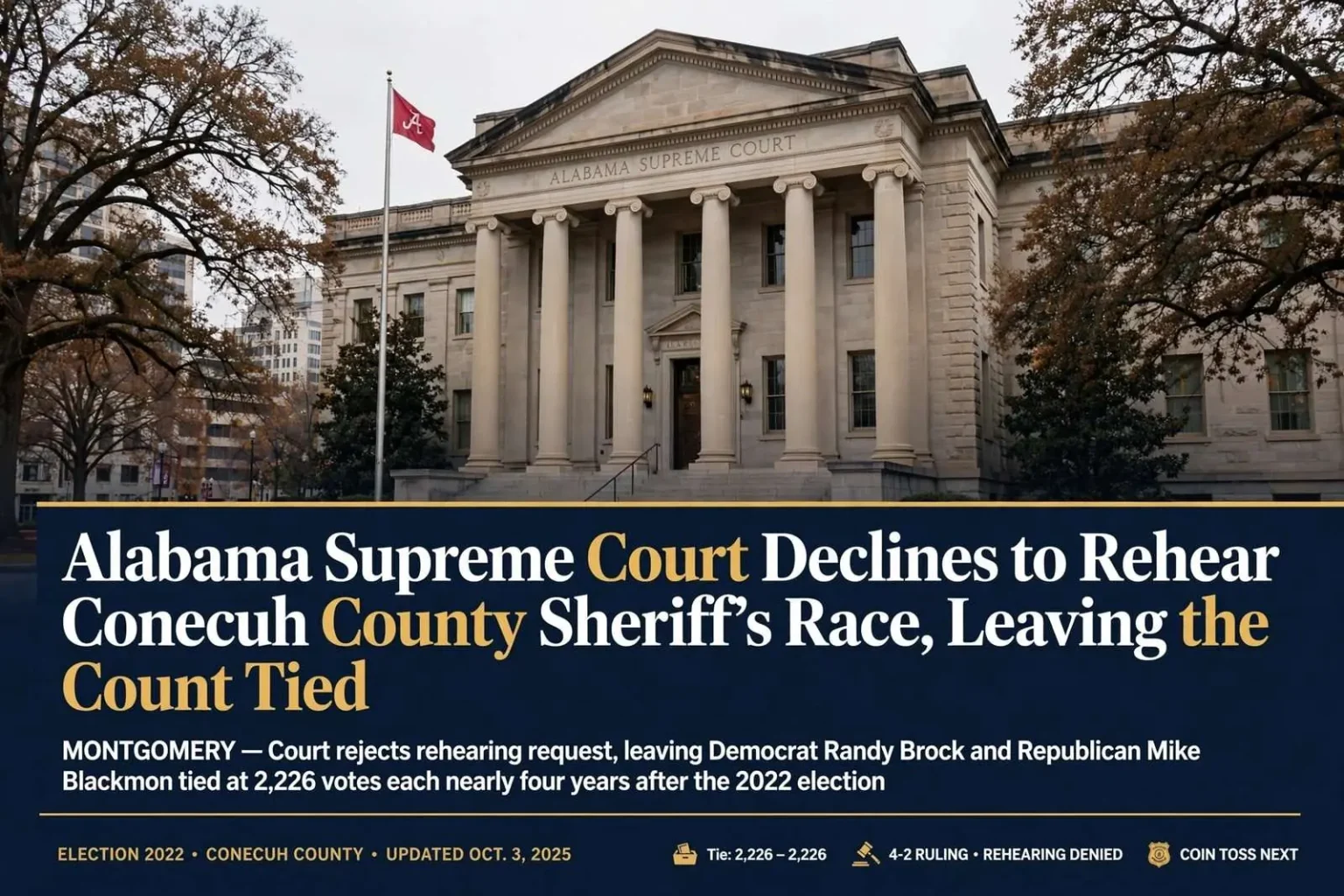
MONTGOMERY — The Alabama Supreme Court on Friday declined to reconsider its ruling in the contested 2022 Conecuh County sheriff’s race, leaving in place a June decision that two ballots counted during a recount were not lawful votes.
With those two ballots removed, incumbent Sheriff Randy Brock, a Democrat, and Republican challenger Mike Blackmon are tied at 2,226 votes each. The court overruled Brock’s application for rehearing, ending the appellate phase of a contest that has run nearly four years since the election.
Brock has held the office since January 2023.
What the Court Decided in June
The June decision was 4-2, with three justices recused. Justice Chris McCool wrote for the court.
An application for rehearing asks the same court that issued a decision to take another look at it, typically on the argument that the opinion misapprehended a fact or a point of law. Such applications are routinely filed and rarely granted; overruling one leaves the original decision standing without any new opinion on the merits.
The Two Ballots at Issue
Both disputed ballots were cast on Election Day and were rejected by the voting machines.
Neither voter filled in the oval next to any candidate or next to any party. Both instead scribbled over the Alabama Democratic Party’s logo in the straight-ticket section of the ballot. On the same ballots, both voters correctly blackened ovals to vote on constitutional amendments.
Alabama is among the states that still offer straight-ticket voting, which lets a voter select every candidate of one party with a single mark rather than voting race by race. The straight-party section carries party names and logos, and marking it is the mechanism that produces votes down the ballot.
Writing for the court, McCool noted that the ballot instructed voters, “TO VOTE YOU MUST BLACKEN THE OVAL COMPLETELY!” and that both voters had demonstrated they could follow that instruction elsewhere on the same ballot. The marks on the party logo, he wrote, may have been “mere ‘scribblings’ or perhaps even a defiant ‘scratching out’ of the ‘logo’ of the political party they did not prefer.”
“If those voters’ voices have now been ‘mut[ed]’ by the exclusion of their ballots, it is they who have muted them, not this Court,” McCool wrote.
How the Recount Changed the Result
The county canvassing board counted both ballots as straight-ticket Democratic votes during the Nov. 18, 2022, recount. That turned a certified tie into a 2,228-2,226 result for Brock.
Blackmon then filed an election contest — the statutory proceeding Alabama law provides for challenging the outcome of an election in court rather than through an administrative appeal. A contest of that kind is tried before a judge, who hears evidence about specific ballots and voters and determines whether the certified result should stand.
What the Trial Court Ruled
Retired Mobile County Circuit Judge Braxton Kittrell, a Democrat who was assigned to hear the case, ruled for Brock in May 2025 after a contest that took nearly two and a half years to reach trial.
Kittrell wrote that “the interests of justice and public confidence in the electoral process would not be served if the results of an election were overturned two and one-half years after the election.”
The Supreme Court rejected that reasoning, holding that nothing in Alabama law makes “the mere passage of time” a ground for denying an otherwise valid contest. In a footnote, the court said “the blame for much of the delay in this case may be placed not solely on Blackmon but also on the trial court and Brock.”
The Absentee Ballots That Survived the Challenge
Blackmon also challenged three absentee ballots. That part of his case did not succeed.
Voters testified at trial that other people collected and filled out their absentee ballots. Kittrell described those voters as “marginally-educated or illiterate voters,” and he described one woman who swore she had never cast the ballot counted in her name as “evasive and wholly unpersuasive.” He allowed every one of the challenged absentee ballots to stand.
The Supreme Court left those findings undisturbed, holding that assessing the credibility of witnesses was the trial judge’s call to make. That is a standard feature of appellate review: an appeals court reviews legal conclusions independently but defers to the trial judge on findings that turn on hearing and observing witnesses.
Kittrell also noted that restrictions on the collection and handling of absentee ballots that the Legislature has enacted since 2022 were not in effect at the time of that election.
Separately, Secretary of State Wes Allen was shown undercover recordings of Conecuh County voters in 2024. “If this audio is authenticated and if it was recorded in Alabama, I am outraged,” Allen said at the time, framing his statement as conditional on the recordings being verified. The Supreme Court’s decision turned on the trial judge’s credibility findings rather than on those recordings.
Reaction
Alabama Republican Party Chairman Scott Stadthagen, a state representative from Hartselle, welcomed the outcome in a statement.
“This is a win not only for Mike Blackmon, but for every Alabama voter who expects our elections to be decided by lawful votes and according to the law,” Stadthagen said. “When an election comes down to just two votes, every ballot matters.” He also quoted McCool’s opinion, which described election integrity as “foundational to, and … the fundamental safeguard of, our system of government.”
Blackmon’s attorney, Bryan Taylor, a former state senator from Prattville who previously served as general counsel to Govs. Bob Riley and Kay Ivey, argued the case pointed to a broader problem.
“Make no mistake, it didn’t just happen in this sheriff’s race,” Taylor said. “We only know about it because the result in this race was so close it went to a recount and an election contest.” That is Taylor’s characterization; the court’s ruling addressed only the ballots before it in this case.
What Happens Now
The case returns to Conecuh Circuit Court with the count tied.
Alabama law provides a specific remedy for that situation. A tie for a county office “shall be decided by lot by the judge of probate of the county in the presence of the candidates.” Deciding by lot means exactly what it sounds like — a random selection, most commonly a coin toss or a drawing, conducted in the open with both candidates present.
Provisions of this kind exist in most states because the alternative — an indefinite series of recounts or a new election every time a race ends in an exact tie — carries costs and delays of its own. They are rarely invoked, because exact ties in races with thousands of votes are uncommon.
The Coin Toss That Was Never Held
Conecuh County announced a coin toss for the sheriff’s race in November 2022, when the initial canvass produced a tie. It was never held. The recount intervened, the two disputed ballots were counted, and Brock was declared the winner by two votes.
Nearly four years later, after a trial, an appeal and a rejected application for rehearing, the race is back at the same number it started at — and the procedure that was announced and set aside in 2022 is the one Alabama law points to next.