Baldwin County Master Plan Presentation Pushed to November After Planning Board Takes No Action
The presentation of Baldwin County’s Draft Master Plan 2026 to the County Commission has slipped from Sept. 1 to the second week of November, after the county Planning and Zoning Commission ended its Aug. 6 public hearing without reaching a conclusion.
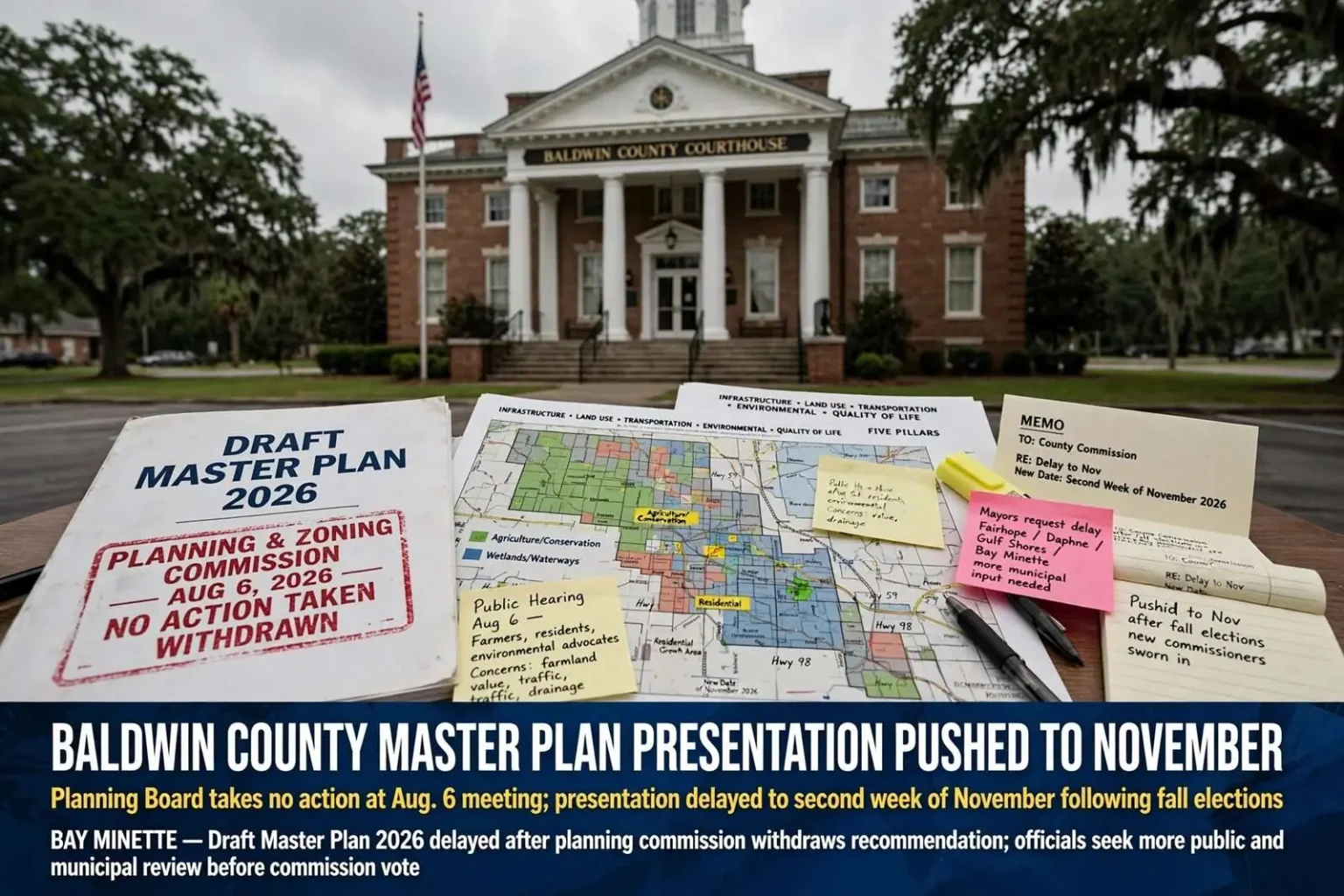
BAY MINETTE — Baldwin County’s proposed Draft Master Plan 2026 will not reach the County Commission until November, a delay of more than two months that pushes any decision on the county’s long-range growth framework past the fall election.
The plan had been scheduled for presentation to the commission on Sept. 1. That presentation was postponed after the Baldwin County Planning and Zoning Commission was unable to reach a conclusion on the document at its Aug. 6 meeting, leaving the draft without the recommendation that would normally travel with it to the elected commission.
Commissioner Jeb E. Ball, who represents District 1, said the commission’s consideration of the plan will now come during the second week of November — after the midterm elections and after any newly elected commissioners have been sworn in.
What the Draft Plan Is Meant to Cover
The Draft Master Plan 2026 is intended to provide a long-term framework for growth and development across Baldwin County. According to the county, the document addresses land use, infrastructure, transportation, environmental stewardship and quality-of-life improvements throughout the county.
Those five subject areas are the standard building blocks of a comprehensive plan. Taken together they are an attempt to answer a set of questions that individual permit decisions cannot: where new housing should go, which roads will need to carry the traffic that housing generates, which areas should stay agricultural or undeveloped, what utilities and drainage will be required, and how parks, schools and public facilities should keep pace.
A plan of that kind does not approve or deny any specific project. It sets out the county’s stated intentions, usually with maps showing preferred future land use patterns, so that later decisions — on subdivision approvals, road projects, capital budgets or regulatory changes — can be measured against a common reference point.
A Guide, Not a Zoning Ordinance
At the Aug. 6 meeting, Planning and Zoning Commission Chairman Steven Pumphrey emphasized that the document is intended as a guide for future growth rather than a zoning ordinance or a regulatory document.
That distinction is the single most common source of confusion at public hearings on master plans, and it matters here. A comprehensive or master plan is a policy statement. A zoning ordinance is law. The plan may say an area is best suited to remain in agriculture or low-density residential use; only zoning, subdivision regulations and building codes can actually restrict what a property owner may build.
The practical link between the two runs in one direction. Once adopted, a plan becomes the document that planners, elected officials and, in some cases, courts look to when a regulatory change is proposed. A rezoning request that lines up with the adopted plan is easier to justify; one that contradicts it invites the question of why the plan should be departed from. That is why landowners, developers, farmers and conservation groups all pay close attention to a document that, on its own, changes nothing.
How a County Plan Moves Toward Adoption
Alabama law allows counties to establish planning commissions and to prepare long-range plans for the areas within their jurisdiction. The sequence is deliberately two-staged, and the Aug. 6 meeting was the first stage.
Pumphrey said the planning and zoning commission’s role is to review the document and conduct the public hearing before making a recommendation to the Baldwin County Commission. The planning body is appointed rather than elected; its function at this point in the process is advisory. The County Commission, whose members answer to voters, is the body that decides whether to adopt the plan, adopt it with changes, send it back, or leave it on the shelf.
Because the planning commission’s output is a recommendation rather than a final action, an inconclusive meeting does not kill a plan. It stalls it. Without a recommendation to forward, the county commission would be asked to act on a document that has not completed the step the process assumes will come first — and that is the position the Sept. 1 presentation would have created.
The result of the Aug. 6 meeting, in the county’s description, is additional time for review and for further public and municipal input before the document moves forward.
What Came Out of the Aug. 6 Hearing
The delay follows a public hearing at which residents, farmers, environmental advocates and community leaders raised concerns and offered feedback on the proposed plan.
That mix of participants reflects the range of interests a countywide plan touches at once. Agricultural landowners in a fast-growing county are often weighing the value of land as farmland against its value as future subdivisions, and a plan that designates large areas for continued agricultural use can be read either as protection or as a constraint on what a family’s property is worth. Environmental advocates tend to focus on wetlands, watersheds, stormwater runoff and the cumulative effect of impervious surfaces. Residents of already-developed areas typically arrive with traffic, drainage and school capacity in mind.
The county has not released a summary of specific changes sought at the hearing, and the record of the meeting is what documents the range of comments received.
The Municipal Piece
A county master plan in Baldwin County has to account for a crowded municipal landscape. Bay Minette, Fairhope, Daphne, Foley, Gulf Shores, Orange Beach, Robertsdale, Spanish Fort, Loxley, Silverhill, Summerdale and Elberta each have their own governing bodies, and municipalities in Alabama generally adopt their own plans and zoning ordinances for land inside their corporate limits and, in some cases, exercise subdivision authority in a limited area beyond them.
That leaves a county plan doing two things at once: setting direction for the unincorporated territory the county controls directly, and trying to align that direction with what a dozen-plus cities intend to do on their own. The additional time for municipal input built into the current delay speaks to that second job.
The Zoning Question Underneath the Plan
Part of the sensitivity around any countywide land-use document in Baldwin County traces to how land-use regulation has been handled in the unincorporated county. Rather than a single zoning ordinance applied countywide, Baldwin County’s unincorporated areas have been organized into planning districts, with the question of whether to adopt zoning decided district by district. Some districts have zoning; others do not.
The consequence is that the same countywide plan lands very differently depending on where a property sits. In a district with zoning in place, plan language about future land use has a regulatory vehicle that could eventually give it effect. In a district without zoning, the plan is guidance and little else unless residents there choose otherwise. Speakers on both sides of a master plan hearing are often arguing less about the words on the page than about what those words might justify later.
Why the November Timing
Ball’s explanation ties the new date to the election calendar. Moving the presentation to the second week of November means the plan will be taken up by a commission seated after the midterm elections, including any members newly elected to the body.
There is a straightforward institutional logic to that. A long-range plan is meant to guide decisions for years, and the officials who will apply it are the ones seated after the election. Presenting a plan in September to a commission that could look different weeks later risks an adoption vote by members who will not be the ones implementing it — or a plan adopted by one commission and immediately reopened by the next.
The cost of waiting is time. Growth pressure in Baldwin County does not pause for a planning calendar, and every month the plan is not adopted is a month in which subdivision approvals, road decisions and utility extensions continue to be made without the framework the document is intended to supply.
What Happens Next
Between now and November, the draft remains open for review, with additional public and municipal input expected. The Planning and Zoning Commission would ordinarily need to complete its work and forward a recommendation before the County Commission takes the document up.
When the plan does reach the commission, the options are the ones available with any policy document: adopt it as written, adopt it with amendments, direct further revisions, or decline to act. Adoption would not by itself change the rules governing any parcel in the county. It would establish the reference document against which the next several years of rezonings, subdivision cases, capital projects and road planning are argued.
What happened at the Aug. 6 hearing
It was not simply that the board failed to reach a conclusion. After a public hearing that lasted roughly 30 minutes, the Planning Commission voted unanimously to withdraw the 2026 master plan from consideration, and county staff — who had spent more than a year developing the document — were left without a recommendation to carry forward. It remains unclear when the plan could be brought back up.
The opposition was organized and broad. A large group of Baldwin County mayors sent the commission a letter before the hearing asking that the plan be tabled so that cities and members of the public could review it further. The list included Eastern Shore mayors Brad Bass, Robin LeJeune and Sherry Sullivan, who wrote that the document’s significance “requires that the Commission allow sufficient time for each municipality’s planning staff, planning commission, and elected officials to thoroughly review the final draft before any action is taken to adopt the plan.”
The mayors’ letter also flagged two structural issues: that the plan’s guidance for unincorporated areas around cities could allow higher density development than in rural parts of the county, and that it does not address how often county-approved developments later seek annexation into municipalities once construction is complete.
Farmland, land values and borrowing power
Farmers and landowners who spoke at the hearing focused on how future zoning changes tied to the plan could make farmland less likely to be developable, reducing its value when the time comes to sell or to borrow against it. Resident James Philips told the commission his chief concern was exactly that: “If I went to the bank to borrow money to buy 40 acres of pasture land, and you got this zone for agriculture only, that bank is going to limit how much I can borrow for it,” he said.
Supporters of the plan pushed back. Clark Strong argued it should be passed to help the county manage the growth it has absorbed in the last five years, pointing to heavy traffic on his own road and noting the master plan also contains sector plans for different sections of the county.
Where incoming commissioners stand
Future District 4 Commissioner Tater Harris, a Democrat who takes office in November, spoke against the plan, as has future District 2 Commissioner Angelo Fermo. “I’m glad the community showed up tonight,” Harris said after the meeting. “I’ve yet to have one phone call that was in favor of this. Nobody’s against the plan, but everybody’s in favor of ‘Let’s sit together and talk and get some more information.’”
County Commissioner Matt McKenzie, D-2, the only sitting commissioner to attend the hearing, said he was glad the public had its say and that the plan needs some “tweaks.” “I think it’s a good thing. What’s the hurry to get it done tomorrow?” he said, adding he would like the plan to come back before the new commission takes over in November.