Mobile County’s Prevention Kiosks Have Dispensed 692 Items, Including 377 Naloxone Packages
The Mobile County Health Department’s five prevention kiosks have dispensed 692 free items since November 2024, including 377 two-dose naloxone packages and 195 gun locks.
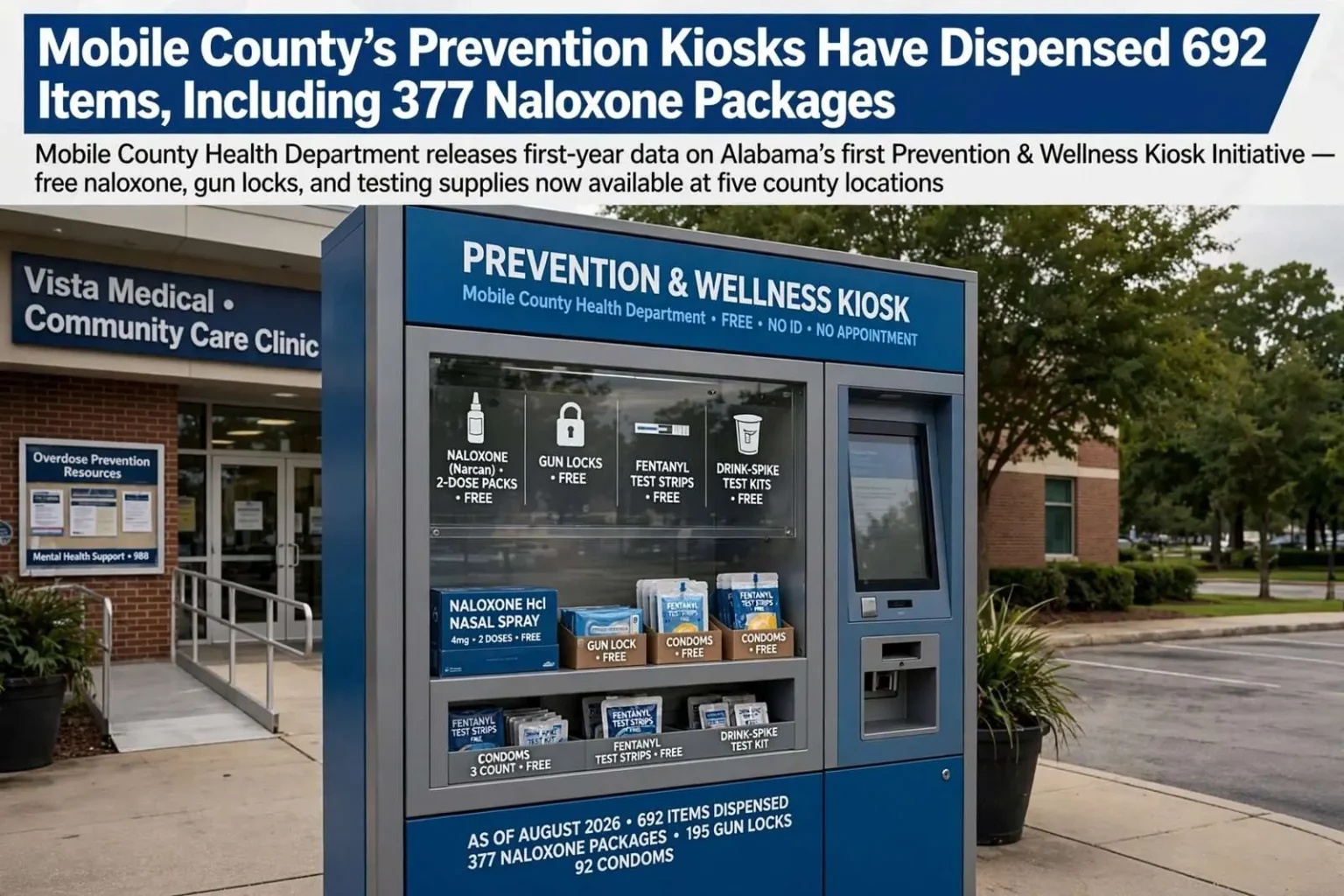
MOBILE — The Mobile County Health Department is reminding residents that free prevention supplies — including naloxone, gun locks, condoms, fentanyl test strips and drink-spike test kits — are available at kiosks placed around the county, and it has released the first full accounting of how often those kiosks are being used.
As of August 2026, the kiosks had dispensed 692 products, according to the health department. That total includes 377 two-dose packages of naloxone and 195 gun locks.
The department launched the effort in November 2024 as Alabama’s first Prevention & Wellness Kiosk Initiative. Its premise is straightforward: put the supplies where people already are, remove the cost, and remove the steps that stand between a resident and a tool that works only if it is on hand before it is needed.
“Prevention works best when people can access the tools they need before an emergency happens,” said Dr. Kevin P. Michaels, health officer for Mobile County. “Whether someone is preparing to respond to a possible overdose, securing a firearm in the home, or seeking resources to protect their health, these kiosks make prevention more accessible, private, and convenient.”
How the Program Is Built and Funded
The initiative is supported through funding awarded to MCHD by the Alabama Department of Public Health under the Centers for Disease Control and Prevention’s Public Health Infrastructure Grant — a federal program that channels money to state and local health departments to strengthen the underlying capacity of the public health system rather than to fund a single disease-specific campaign.
In the program’s first year, the health department established five kiosks. Locations were not chosen at random. MCHD said it selected them through community asset mapping and partner input, an approach that starts by cataloging where residents already go — pharmacies, clinics, community organizations — and places services at those existing points of contact rather than expecting people to travel to a health department office.
That is the significant design choice. Public health agencies have long distributed prevention supplies from their own facilities during business hours. Kiosk placement extends availability beyond those settings and, because a kiosk requires no appointment, no identification and no conversation, it lowers the practical and social barriers that keep supplies on a shelf instead of in a household.
Partners providing kiosk locations, local connections and access include Vista Medical, Semmes Pharmacy, Shell Health, the Alabama Department of Mental Health, the Mobile County Sheriff’s Office, Veterans Affairs and the University of South Alabama.
What the First-Year Data Shows
Beyond raw counts, MCHD collected information on why residents were taking naloxone. First-year data found that bystander response was the most commonly reported reason — meaning people were obtaining it in order to be prepared to respond to a potential overdose involving someone else.
That finding matters for how the program is understood. Naloxone is not used by the person experiencing an overdose; by definition, someone else administers it. A supply chain that reaches family members, roommates, coworkers, neighbors and bystanders is therefore reaching the people who are actually positioned to use it. The distribution numbers suggest the kiosks are reaching that group.
The 195 gun locks dispensed reflect a parallel logic on the injury-prevention side. Secure firearm storage is a well-established measure for reducing unintentional injuries involving children and for adding time and distance during a crisis in the home. A lock is inexpensive, but it is only useful if a household has one, and cost and inconvenience are ordinary reasons that a household does not.
The Local Overdose Picture
The health department paired the kiosk data with recent county surveillance figures.
In July 2026, Mobile County recorded 146 suspected drug overdose-related 911 runs, and 19 naloxone administrations were reported. Overdose-related 911 runs declined 18 percent from June, and overdose-related emergency department visits were 16 percent lower than in July 2025.
Geographically, the ZIP code with the highest number of overdose-related 911 incidents in July was 36608, while 36695 had the highest frequency of overdose-related emergency department visits.
Those are the kinds of numbers that public health departments track month to month rather than year to year, because they move quickly and because they guide where supplies and outreach go next. A single month’s decline is not a trend, and MCHD framed the figures accordingly: overdoses continue to affect residents and neighborhoods throughout the county.
It is worth being precise about what “suspected overdose-related 911 runs” measures. It counts emergency calls that responders classified as likely involving an overdose. It is a real-time indicator, not a confirmed medical diagnosis and not a death count. Its value is speed — it registers a change in a community within days rather than the months required for confirmed mortality data.
What Naloxone Does
Naloxone, sold under brand names including Narcan, is an opioid antagonist. It binds to the same receptors in the brain that opioids act on and displaces them, reversing the respiratory depression that makes an opioid overdose fatal. It works only against opioids; it has no effect on an overdose involving stimulants or alcohol alone, and it does not cause harm if given to someone who has not taken opioids.
The nasal spray form is designed to be used by people with no medical training. The U.S. Food and Drug Administration approved over-the-counter sale of naloxone nasal spray in 2023, ending the requirement for a prescription for that product.
Two points about how it works in practice explain why programs distribute it in multi-dose packages. First, naloxone’s effect can wear off before the opioid does, so a person can slip back into respiratory depression — which is why calling 911 is part of every response protocol, not an optional step. Second, potent synthetic opioids such as fentanyl may require more than one dose. The 377 packages the kiosks dispensed each contain two doses.
Alabama, like every state, has moved to broaden access. MCHD noted that naloxone is now available over the counter, by prescription from private providers, by mail order through the Jefferson County Health Department, at the Prevention and Wellness kiosks across Mobile County, and through peer counselor programs that connect individuals to overdose response tools and recovery support.
Fentanyl Test Strips and Drink-Spike Kits
The kiosks also carry two testing products that serve a different function from naloxone: they provide information before an exposure rather than a response after one.
Fentanyl test strips are simple immunoassay strips that detect the presence of fentanyl in a sample. They were originally developed to test urine and were adapted for checking substances. They indicate presence, not quantity, and a negative result does not guarantee a substance is free of every synthetic opioid analogue. Public health agencies distribute them because illicitly manufactured fentanyl is frequently present in supplies where the person does not expect it, and because knowing changes behavior — using less, not using alone, having naloxone at hand.
Drink-spike test kits allow a person to check a beverage for the presence of certain substances associated with drug-facilitated assault. Like the fentanyl strips, they are a screening tool rather than a guarantee, and they are distributed on the theory that a person who is worried should have an option other than uncertainty.
Where the Program Goes Next
The health department has framed the kiosks as one element of a wider prevention infrastructure rather than a standalone intervention, and its partner list reflects that: a pharmacy, medical providers, the state mental health agency, the sheriff’s office, the VA and the university.
“Every naloxone kit, gun lock, fentanyl test strip, and other prevention item represents an opportunity to reduce harm and potentially save a life,” Michaels said. “We are grateful to the partners who have made it possible to bring these critical resources closer to the people and communities we serve.”
For residents, the operational message is simple. The supplies are free, they are available without an appointment, and the case for picking them up is the same case that applies to a smoke detector or a fire extinguisher: the value is in having it before it is needed.
Residents seeking kiosk locations or additional prevention resources can contact the Mobile County Health Department.
The Program Draws National Attention and Seeds a Statewide Network
The Mobile County Health Department recently presented the kiosk initiative in a poster session at the 2026 National Association of County and City Health Officials conference, NACCHO 360, in Louisville, Kentucky. The presentation focused on how public-health infrastructure funding, strategic partnerships and community-driven solutions can work together to remove barriers and widen access to prevention resources.
Mobile County launched the first initiative of its kind in Alabama, and the model has since spread. Jefferson County now operates 17 kiosks, and Montgomery and Elmore counties have each launched one. Together with the kiosks placed throughout Mobile County, those efforts amount to a growing statewide network for putting naloxone and other prevention supplies directly into residents’ hands.
“Public health is at its strongest when we remove barriers and bring resources directly into the communities we serve,” said Danielle Simpson, administrator of community outreach programs at MCHD. “These kiosks create a simple, private, and convenient way for residents to access resources that can protect health and save lives.”
What the First-Year Numbers Show
As of August 2026, the kiosks had dispensed 692 prevention products: 377 two-dose packages of naloxone HCl nasal spray, commonly known by the brand name Narcan; 195 gun locks; and 92 packages of condoms. Naloxone accounted for roughly 55 percent of everything dispensed, making it the most frequently accessed item by a wide margin.
First-year data also captured why people were taking naloxone. Among users who reported a reason, bystander response was the most common one — meaning residents were preparing to help someone else rather than themselves.
“Every naloxone kit placed in the hands of a community member is another opportunity to prevent a tragedy,” Simpson said. “Our residents are showing that they want to be prepared to help family members, friends, neighbors, and even strangers during an emergency.”
A Model Other Counties Are Copying
The NACCHO 360 presentation recognized the initiative as an example of community-based public-health innovation, sharing lessons from the project’s first year and showing how investment in public-health infrastructure can translate into measurable local results.
“When you include the Prevention & Wellness Kiosks that MCHD has placed across Mobile County, the state has made great strides in the distribution of Narcan to communities,” said Dr. Kevin Michaels, health officer for Mobile County. “We now have strong examples in Montgomery, as well as Mobile, Elmore, and Jefferson counties. These ideas are influencing others to take action and save lives.”
The health department says it intends to expand the kiosk initiative further as additional funding becomes available.