

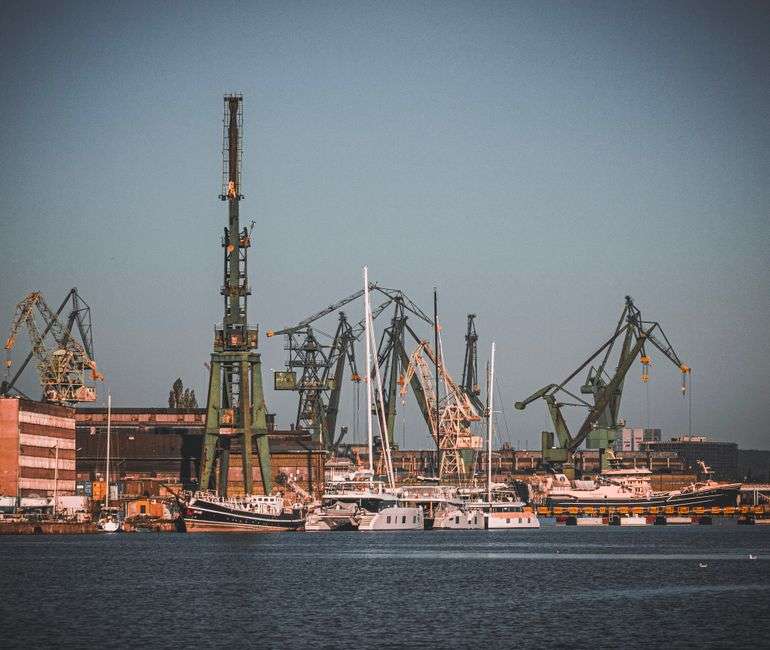
As Rep. Bradley Byrne closed out more than seven years representing Alabama’s 1st Congressional District, he pointed to the health of Mobile’s largest industrial employer as the accomplishment he is proudest of from his time in Washington.
Byrne, who did not seek re-election in 2020 and is set to leave office in the coming days, said keeping Austal USA competitive for federal shipbuilding contracts was a fight that never let up during his tenure representing Lower Alabama.
“It’s not easy to make sure Austal isn’t hurt in this competition over which defense projects get money,” Byrne said. “That was a fight we fought every day.”
The Mobile shipyard is winding down production on the aluminum-hulled Expeditionary Fast Transport vessel and the littoral combat ship, two Navy programs that have anchored Austal’s workforce for years. Byrne said the company’s future was secured by a recent Navy announcement that Austal will begin building steel-hulled ships, opening a new line of work for the yard.
“Austal’s got a great future with the Navy,” Byrne said. “This new 30-year ship plan that just came out from the Navy is right in their sweet spot.”
The pivot from aluminum to steel is more than a change of materials. It moves Austal from a pair of programs winding down toward the Navy’s long-range construction plans, and it required the yard to prove it could master a different set of shipbuilding disciplines. For Mobile’s industrial economy, the difference between a shipyard with a closing product line and one with a thirty-year runway is measured in thousands of jobs.
The Airbus win
Byrne also pointed to Airbus’s expanding footprint just north of downtown Mobile as one of the signature wins of his time in office. He said fighting to remove tariffs on imported aircraft parts helped pave the way for Airbus’s partnership with Canadian manufacturer Bombardier and the buildout of the A220 production line at Mobile Aeroplex at Brookley.
The tariff fight grew out of a long-running transatlantic trade dispute that threatened to tax the very imports Mobile’s aerospace industry depends on. Byrne’s argument in Washington was local in substance: a penalty on aircraft parts arriving for assembly in Alabama would raise costs at the one place in America where Airbus builds jets, and every dollar of added cost weakened Mobile’s case against rival assembly sites elsewhere.
The A220 line that followed gave the Brookley campus a second aircraft program alongside the A320 family work, broadening the site’s base and deepening the supplier network that has grown up around it across the Gulf Coast.
The bread-and-butter work
Byrne said the higher-profile fights over shipbuilding and aerospace jobs were only part of the job. He said a long list of less visible constituent work and federal coordination on behalf of the district mattered just as much to the people he represented over his three terms.
“They may not seem like the romantic stuff, but that’s the bread-and-butter stuff that really matters when you’re a member of Congress to the people you represent,” Byrne said.
The bridge that didn’t get built
Not everything went the way Byrne had hoped. He named the continued stalemate over a new Mobile River Bridge and the accompanying widening of the Interstate 10 Bayway as his biggest disappointment leaving office.
The long-planned project, meant to relieve one of the worst bottlenecks on the Gulf Coast, has stalled amid disagreements between state and local officials over a proposed toll to help pay for construction. The crossing carries traffic between Mobile and the Eastern Shore, and its congestion has become a daily fact of life for commuters and freight haulers alike — a bottleneck that constrains the port, the shipyards and the beach economies on either side of the bay.
Byrne warned that the clock is running out on the federal funding and regulatory approvals already in hand for the bridge project, and urged state and local leaders to resolve their differences over tolling before that window closes.
“I don’t think it’s dead yet, but the window on all of this is closing rapidly, and the federal money there, we’ll lose,” Byrne said. “So they have to get their act together on that.”
His warning reflected the unforgiving arithmetic of federal transportation projects. Environmental approvals, funding commitments and design work do not wait indefinitely for political consensus; when they lapse, a project must often begin the process again, at escalating cost. The tolling dispute — with resistance concentrated among commuters who would pay it daily — has proven the sticking point that years of planning could not dissolve.
Seven years in the district’s seat
Byrne, a Republican from Fairhope, was first elected to represent Alabama’s 1st Congressional District in a 2013 special election and went on to win three full terms before leaving Congress at the end of the 116th Congress. His district stretched across the state’s southwestern corner, covering Mobile and Baldwin counties and much of Alabama’s Gulf Coast.
Throughout his time in office, Byrne sat on committees overseeing armed services and education issues in the House, positions he used to advocate for the region’s defense contractors, shipbuilders and aerospace manufacturers.
The committee assignments were not accidental. A district whose economy runs on shipbuilding, aviation and the ports draws its federal leverage from precisely those jurisdictions, and Byrne’s places on the armed services and education panels let him shape the bills and budgets where Mobile’s employers live or die. Education matters in the same equation — the shipyard and the aircraft plant both depend on training pipelines that federal workforce and education policy touch.
Supporters of Austal and Airbus in Mobile have credited the region’s congressional delegation with helping stabilize thousands of manufacturing jobs tied to both companies over the past decade.
Leaving the list unfinished
Byrne’s departure closes a chapter that began with a special election — the sort of low-turnout contest that rewards candidates who can organize quickly — and ends with the district’s two industrial anchors in stronger positions than when he arrived. Austal is transitioning toward steel ship construction with Navy demand in view, and Airbus has doubled its Mobile production footprint with the A220 line rising beside the original A320 assembly operation.
The unfinished business he leaves behind is, by his own account, the bridge. Every recent member of Congress from the district has confronted the I-10 bottleneck, and each has watched the project advance and retreat as funding plans shifted. Byrne leaves with federal approvals and funding secured but the political question — who pays, and through what toll — unresolved by the state and local officials who own it now.
The debate over the Mobile River Bridge and Bayway project is expected to continue into the new Congress, with local business leaders and elected officials continuing to press state transportation officials for a funding plan that can move the project forward before federal approvals expire.
For the district he leaves behind, the stakes of that fight are concrete. The same geography that makes the region valuable — a deepwater port, a river, a bay and the interstate that threads between them — also concentrates its traffic into crossings that can no longer absorb the growth of the past two decades. Whether the next bridge gets built will depend on leaders who, as Byrne put it on his way out the door, have to get their act together before the window closes.
In the meantime, the manufacturing base he spent his tenure defending continues to define the region’s economy. Shipyard cranes on the Mobile River and jet fuselages arriving at Brookley are visible from the very corridors where the bridge debate plays out — daily reminders that the district’s economic future rides on both the factories that are building and the infrastructure that has yet to be.
Byrne’s vantage point on the district was unusual among modern members of Congress: he had run for office in Mobile politics before, served as a county commissioner-level figure in the region’s government, and approached the congressional seat as a continuation of work he had begun closer to home. Colleagues on both sides of the aisle came to know him as a member who measured legislation by its effect on a specific stretch of the Gulf Coast — the shipyard gates, the aerospace campus, the port terminals and the beach towns of Baldwin County.
That local lens also shaped his approach to defense authorization bills, where the fate of a single ship class can decide hiring plans for years. Members from districts without shipyards can treat such programs as abstractions; for a representative from southwest Alabama, every amendment is a jobs vote. It is the discipline Byrne described as a fight fought every day, and the one his successors inherit along with the seat.
What comes next for the district is the open seat he leaves behind and the delegation relationships that must be rebuilt around it. The seniority that protects shipbuilding programs and aerospace interests accrues slowly in the Senate and House alike, and the region’s next representative will spend early years earning the committee positions and institutional trust that Byrne used to keep Austal and Airbus competitive. In the view he offered on his way out, the foundations — a yard with a future, an aircraft plant with two product lines and a district that knows what it contributes — are in place to be defended.