Baldwin County Planning Commission Withdraws 2026 Master Plan After Farmer, Mayor Pushback
The Baldwin County Planning Commission withdrew its 2026 master plan Thursday after farmers, mayors and incoming commissioners argued the zoning and development guide was moving too fast without enough public input.
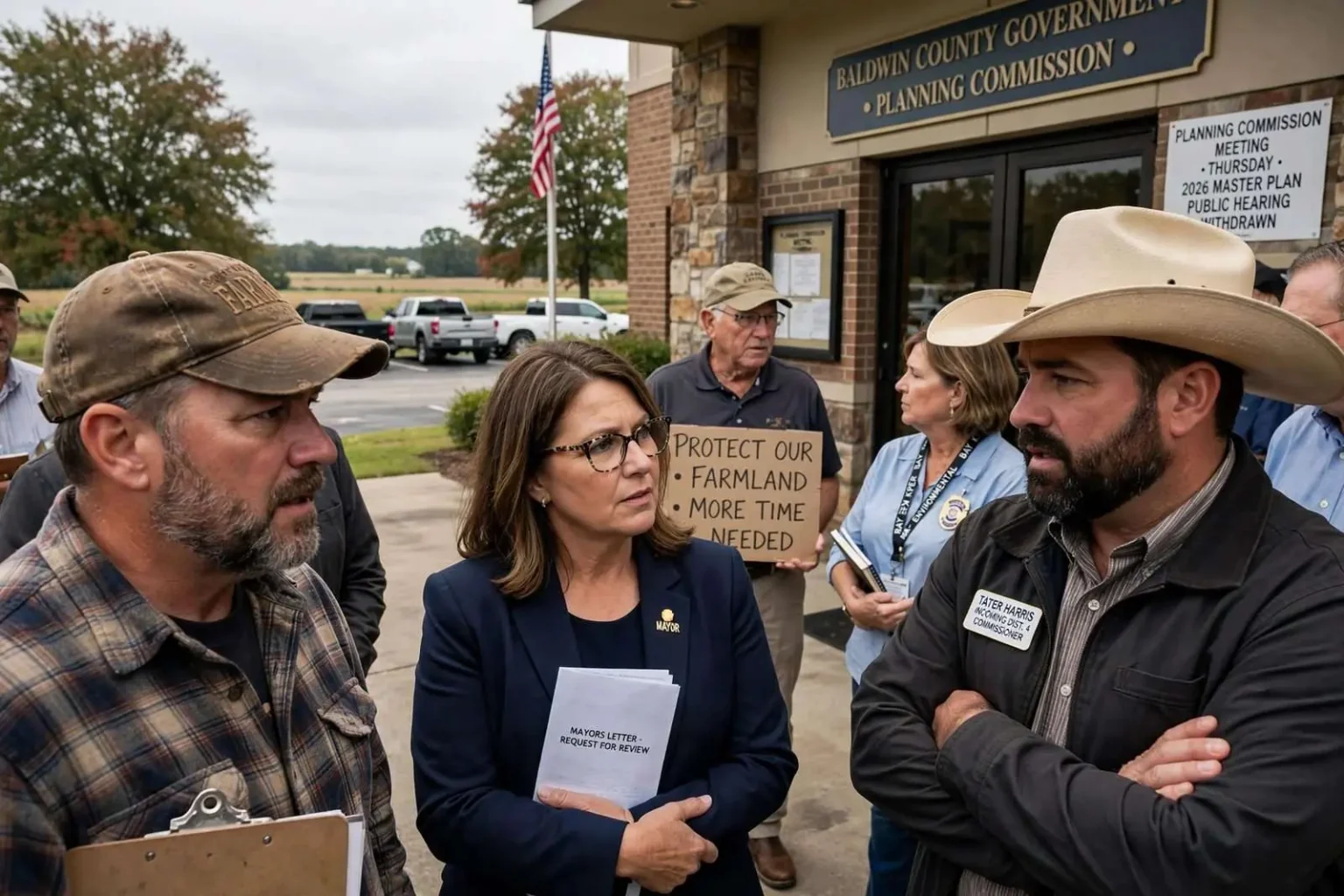
A group of farmers, mayors and future county commissioners spoke out against a new Baldwin County master plan Thursday, arguing the zoning and development guide moved through the approval process too quickly for one of the nation’s fastest-growing counties. Following a roughly 30-minute public hearing, the Baldwin County Planning Commission voted unanimously to withdraw the 2026 master plan, which county staff had spent more than a year developing.
It remains unclear when — or in what form — the plan could return to the commission’s agenda.
Farmers Fear Loss of Land Value
Several residents who spoke during the meeting, including incoming District 4 Commissioner Tater Harris, said the plan as written would make it harder to develop swaths of farmland because of potential zoning changes. Farmers argued that shift could devalue their land and make it more difficult to sell property or use it as collateral for loans.
“I’m glad the community showed up tonight,” Harris told reporters after the meeting. “I’m glad that the farmers have given input, the mayors have given input. We’ve had developers give input, Bay Keepers who gave input, and a bunch of other concerned citizens. I’ve yet to have one phone call that was in favor of this. Nobody’s against the plan, but everybody’s in favor of ‘Let’s sit together and talk and get some more information. Look through it.’”
Baldwin County resident James Philips said his chief concern was how the plan would affect farmers’ ability to borrow against their land. “If I went to the bank to borrow money to buy 40 acres of pasture land, and you got this zone for agriculture only, that bank is going to limit how much I can borrow for it,” he said.
Mayors Ask for More Time
Ahead of the hearing, a group of Baldwin County mayors — including Eastern Shore mayors Brad Bass, Robin LeJeune and Sherry Sullivan — sent a letter to the Planning Commission asking that the plan be tabled for further review by cities and the public. “Given the significance of this document, we respectfully request that the Commission allow sufficient time for each municipality’s planning staff, planning commission, and elected officials to thoroughly review the final draft before any action is taken to adopt the plan,” the mayors wrote.
The letter also raised concerns that the master plan’s guidance for areas surrounding cities could allow higher-density development than in more rural parts of the county, and that it did not adequately address how often county-approved developments later seek annexation into nearby municipalities once construction is complete. “Municipalities have increasingly experienced developments that receive subdivision and building approvals through the County, only to seek annexation into nearby cities after construction is complete,” the letter reads. “Better coordination between municipal and county planning efforts can help ensure that growth is planned comprehensively from the outset, benefiting developers, local governments, and future residents alike.”
A Guidance Tool, Not Regulation
During the meeting, Planning Commission Chairman Steven Pumphrey reminded attendees that the 2026 Master Plan is intended as a guidance tool rather than a regulatory document. County planning staff typically use the master plan to judge whether proposed projects align with how the county envisions an area developing over the long term.
Harris, who takes office in November alongside incoming District 2 Commissioner Angelo Fermo, said both opposed the plan in its current form and want it tabled until several issues are addressed. “I think we’re smarter together,” he said. “We can build a better Baldwin County when we work together and we listen to our municipal leaders, our planning people from our cities, and we listen to our farmers and we listen to the building communities, our ordinary citizens and our legacy citizens.”
Not everyone at the meeting opposed the plan. Clark Strong, who supported it, argued the county needs stronger guidance to manage its rapid population growth.
“It looks to me like a great effort is being made to relocate the entire population of Wisconsin, Illinois, Ohio, and Michigan to (Baldwin County),” he said. “I sometimes have 50 to 60 cars go by before we get out of my driveway. If I had an emergency, my best option is just lay down, relax, and die. I think the point that a lot of people are missing is there will also be sector plans (in the master plan for different sections of Baldwin County).”
What Happens Next
County Commissioner Matt McKenzie, the only sitting commissioner to attend the hearing, said he was glad residents had a chance to weigh in and that the plan needs some “tweaks.” “If we can get the citizens to give input to our planning and zoning and that email and tell us about what they would like to see, maybe it will help us with this,” McKenzie said. “I think it’s a good thing. What’s the hurry to get it done tomorrow?”
McKenzie said he would like to see a revised master plan come back before the commission for approval before the new slate of commissioners takes office in November — leaving county staff and residents just a few months to work through the concerns raised Thursday night.
Baldwin County has been one of Alabama’s fastest-growing counties for more than a decade, a trend that has fueled recurring debate over how to balance new development with the county’s agricultural heritage and municipal growth plans. The Planning Commission has not announced a date for when a revised draft might return to its agenda.
How County Planning Works in Baldwin
Unlike most Alabama counties, Baldwin County has authority to apply zoning in its unincorporated areas, but that authority is organized by planning districts: zoning takes effect in a district only after its voters approve it. A countywide master plan does not rezone property by itself; it serves as the reference the Planning Commission and County Commission use when weighing rezoning requests and other development decisions in the districts where zoning applies.